

Hey team, here’s issue #217 of Ancient Beat.
Here’s the latest ancient news. 👇
🗞 Ancient News: Top 5
Seeds and Preserved Hair in Tomb Point to Oldest Signs of Cannabis High 2,800 Years Ago, Study Suggests — At Tunnug 1, a large burial mound in the Uyuk Valley of southern Siberia and one of the earliest monumental tombs with Scythian material culture, excavations that began in 2017 recovered more than 1,000 cannabis seeds alongside preserved human hair. Radiocarbon dates on the seeds and chemical traces in the hair are presented as the earliest known evidence of cannabis used for its psychoactive effects, at least 2,800 years ago and some 300 years earlier than known use in neighboring China. The seeds appear to have been placed in the tomb deliberately. How the cannabis was taken, smoked or eaten, isn’t clear. Not everyone is convinced: one independent forensic toxicologist calls the hair analysis weak and says it can’t tell consumption from contamination by plant material buried alongside, while another specialist argues hair testing is an established method and that the results point to actual use. Other finds from the site include weapons, horse gear and animal-style motifs.
Revisiting the Anatomy of the Florisbad Hominin Cranium: Visualization of New Internal Features and Observations on Its Supposed Pathologies — The partial skull from Florisbad, South Africa, dated to 300,000–243,000 years ago, is a key fossil in debates over the origins of our species, mixing older traits shared with Homo erectus or Homo rhodesiensis with features shared with Homo sapiens. It has been argued that disease left it lopsided, unusually thick and marked by lesions, which would muddy comparisons. A micro-CT re-examination finds those supposed pathologies all fall within the normal range for living humans and fossil hominins, so the claims that disease altered its symmetry, thickness and internal structure aren’t supported. The scans also revealed new details of the frontal sinuses, the vessel channels within the skull bone and brain imprints on the inside of the vault. In bone distribution and brain-case proportions, Florisbad most resembles the somewhat older Kabwe 1 skull, though without the very large frontal sinuses of Kabwe 1, Bodo and Petralona. The authors conclude that classifying Florisbad as Homo sapiens may be unwarranted, because it lacks many of our species’ defining features.
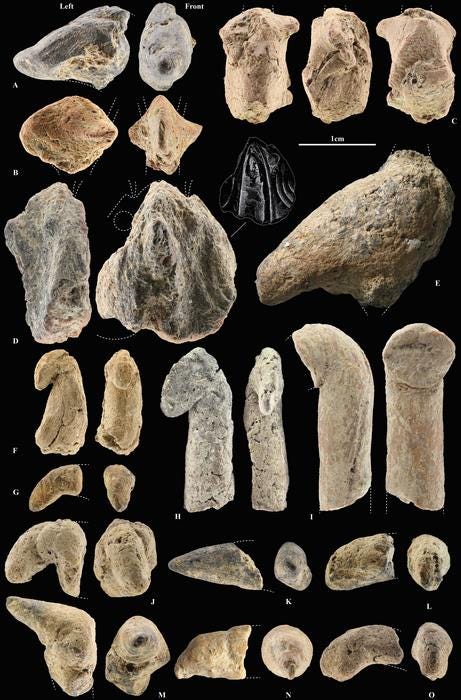
Tiny Fingerprints, Big Discovery: Children Helped Shape Clay Art 15,000 Years Ago — A fresh look at overlooked clay fragments from three Natufian sites in Israel (Eynan-Mallaha in the Upper Jordan Valley, Hayonim Terrace in the Galilee and el-Wad Terrace on Mount Carmel) has turned up 154 clay figurative pieces: 15 recognizable figurines plus 139 cylindrical fragments that probably belonged to figures. Some date back about 15,000 years, making this the earliest known clay figurine tradition in Southwest Asia, thousands of years before farming and pottery. Birds dominate (11 of the 15), including what look like ducks, geese and birds of prey, a few with heads tilted down and to the left in a pose that may echo duck courtship displays. There is also a gazelle, another mammal and two human forms, and red coloring, including a thin layer of colored clay (engobe) on one 15,000-year-old piece that is the earliest known use of that technique. The best part is the fingerprints: some come from children likely under ten, and one human figurine carries overlapping prints from an adult and a child, which may capture a moment of hands-on teaching. Whether the figures told stories or recorded knowledge about animals and seasons remains an open question.
Where Did Stonehenge’s Mysterious, Six-Ton Altar Stone Really Come From? Geologists Rule Out the Scottish Hypothesis as the Search Deepens — Stonehenge’s six-ton sandstone Altar Stone, the flat slab lying beneath the fallen upright and lintel of the monument’s largest trilithon, was linked in 2024 to northeast Scotland’s Orcadian Basin, at least 465 miles away by land. A new, wide-ranging study built a detailed “geological fingerprint” of the stone from its sedimentology, geochemistry and mineralogy, using the stone itself and museum samples, then compared it with about 70 field samples gathered across the basin. None matched, so a northeast Scottish source now looks very unlikely. With northeast Scotland and southern Britain both ruled out, the search moves to rock formations in northern England, other parts of Scotland or even Ireland. Pinning down the quarry matters because it would show where the stone’s long journey to Salisbury Plain began.
Neanderthals Had Flatter Feet Than Modern Humans, Which May Have Helped Them Navigate Rough Terrain — The first full 3D analysis of Neanderthal heel bones compared seven Neanderthals with 64 modern humans spanning hunter-gatherers, Iron Age farmers and recent post-industrial people, using laser scanning and CT to build digital models. Neanderthal heels turned out shorter, wider and taller than ours, and the shape points to a pronated foot with a lower arch, in other words flatter feet. Rather than a flaw, the researchers interpret this as an adaptation for stability and load-bearing on rough, mountainous ground while carrying heavy loads, in keeping with the Neanderthals’ muscular, heavy-boned build and very active lives. Among modern humans, hunter-gatherers came closest to the Neanderthal pattern, while people living closest to the Industrial Revolution had noticeably weaker heels, which the team links to sedentary lives and stiff, restrictive footwear. It’s a neat reminder that bones respond to how we live, not just to our genes.
That’s it for the free Top 5! If you’re a free subscriber, sign up for the paid plan for another 33 discoveries and 1 recommended piece of content.
Until next time, thanks for joining me!
-James
Twitter: @jamesofthedrum
P.S. Here’s my Buy Me A Coffee link if you’d like to support my efforts with a donation.
P.P.S. If you want access to the paid version but it’s a little too steep for you right now, just email me — I want this to be accessible.
P.P.P.S. Paid members, read on!
