

Hi folks! We’ve got a long one today. Let’s do it.
Here’s the latest ancient news. 👇
🗞 Ancient News: Top 5
Ancient Coins Suggest Influential Iron Age King Was Female — A new interpretation of ancient coins suggests that a powerful Iron Age ruler of southern Britain, traditionally assumed to be male, was actually a woman. The ruler governed the Atrebates, whose territory included modern Hampshire and West Sussex, during the early first century CE. Coins bearing the Latin title rex (king) depict a slender, bare-breasted female warrior riding a horse with a spear. The title itself was not necessarily gender-specific, and the ruler’s name also has a feminine ending. Around 40 CE, the ruler was overthrown and fled to Rome, seeking military assistance. This exile helped precipitate the Roman invasion of Britain in 43 CE, potentially making the ruler one of the most consequential female political figures in early British history. The findings challenge longstanding assumptions about women’s political authority in Iron Age Britain, although the interpretation remains a scholarly argument rather than a universally established conclusion.
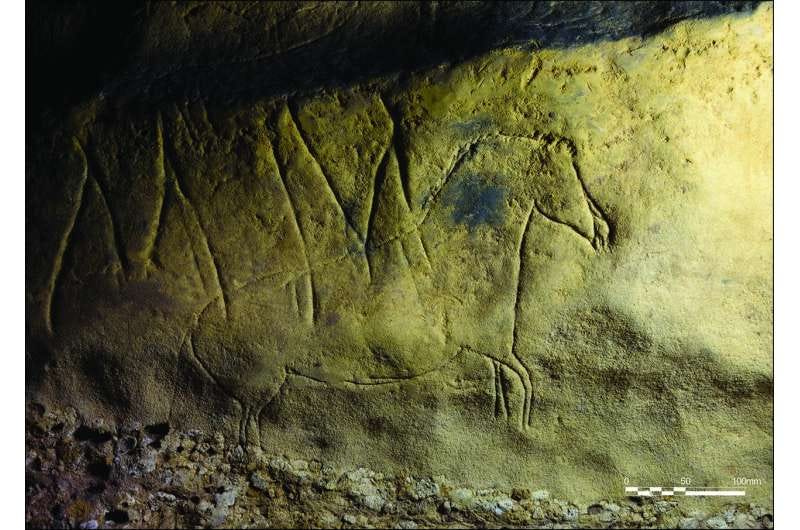
Hundreds of Ice Age Rock Art Engravings Discovered Hidden in Plain Sight — Archaeologists have identified 280 Paleolithic engravings inside Cova de la Font Major, a cave in Catalonia, northeastern Spain, that has been visited for centuries and operated as a tourist attraction since 1993. Despite decades of exploration, the Ice Age artwork had gone unrecognized, with some modern visitors even carving names and dates over the ancient designs. The engravings include representations of horses, aurochs (extinct wild cattle), parallel lines, and hundreds of loop-shaped motifs. The discovery represents the largest known concentration of Paleolithic cave engravings in Catalonia and the third-largest assemblage on the Mediterranean side of the Iberian Peninsula. Previously, only two Paleolithic cave art representations had been documented in Catalonia. The newly identified artwork appears stylistically distinct from the better-known Franco-Cantabrian tradition of northern Spain and France, suggesting that northeastern Iberia developed its own artistic practices during the Ice Age and may have supported more substantial prehistoric populations than previously believed.
Buried for 2,600 Years Beneath Nile Mud, a Massive Ancient Egyptian Complex Was Just Found — From Space — Satellite radar and underground electrical scans have revealed a massive 2,600-year-old mudbrick complex beneath the ancient city of Buto in Egypt’s northwestern Nile Delta. The structure, approximately 420 feet long and 203 feet wide, dates to the 26th Dynasty (664–525 BCE) and lies 10–20 feet underground. Its purpose remains uncertain, but it may have served as a tomb, religious shrine, or residence for priests. Excavations uncovered funerary figurines known as ushabti and shawabti, a faience baboon figurine associated with the god Thoth, and a limestone altar with carved channels containing residues consistent with animal blood. Above the structure, archaeologists identified pottery fragments, displaced mudbricks, and limestone debris from later Ptolemaic and Roman occupation. Most remarkably, the builders placed a thick layer of clean sand beneath the complex to stabilize it against the Nile Delta’s shifting, waterlogged clay. The sophisticated foundation demonstrates an impressive understanding of engineering more than 2,800 years ago.
Ancient DNA Rewrites the Story of How Germanic and Celtic Languages Spread Across Europe — Ancient DNA analysis is challenging long-standing theories about how Germanic and Celtic languages spread across Europe. By comparing 712 newly sequenced ancient genomes with more than 4,000 existing ones, researchers identified a previously unknown migration from the Baltic region, possibly near Finland and northeastern Sweden, into southern Scandinavia. This movement may have introduced early Germanic languages roughly 800 years later than traditionally believed. Within 500 years, the newcomers had mixed extensively with local populations. Around 350 CE, another migration carried people from southern Scandinavia into present-day Germany, Poland, and the Netherlands, while others moved northward. The study also suggests that Celtic languages spread westward around 1000 BCE from the Urnfield culture of eastern Central Europe into France, Britain, Ireland, Iberia, and Italy, challenging theories that Celtic originated along Europe’s Atlantic coast. Although DNA cannot identify which languages people spoke, the findings offer new evidence about prehistoric migration and cultural change.
Charcoal From Spanish Rock Shelter Suggests How Neanderthals Kept Their Camp Clean — An analysis of 640 charcoal fragments from Abric Romaní, a Neanderthal rock shelter near Barcelona, Spain, suggests that its inhabitants deliberately organized their living spaces and cleaned out their hearths. Neanderthals occupied the shelter between roughly 110,000 and 40,000 years ago, using different areas for sleeping, toolmaking, and waste disposal. About 76% of the charcoal examined came from mountain pine, and microscopic evidence suggests that Neanderthals primarily collected dead branches rather than cutting living trees. Mapping the charcoal revealed two distinct patterns: a broad concentration near hearths in the northern section, interpreted as a primary refuse area, and smaller, scattered clusters in the south, possibly resulting from hearth cleaning and waste disposal. Although water and other natural processes may have redistributed some charcoal, the findings suggest that Neanderthals maintained organized camps with designated areas for different activities.
That’s it for the free Top 5! If you’re a free subscriber, sign up for the paid plan for another 35 discoveries and.
Until next time, thanks for joining me!
-James
Twitter: @jamesofthedrum
P.S. Here’s my Buy Me A Coffee link if you’d like to support my efforts with a donation.
P.P.S. If you want access to the paid version but it’s a little too steep for you right now, just email me — I want this to be accessible.
P.P.P.S. Paid members, read on!
