

Good morning, my friends.
It’s beautiful fall day in my neck of the woods. A perfect day for a hot cup of something and quick nerdout on the ancient world.
✅ Hot cuppa
✅ Issue #214 of Ancient Beat
✅ First sip
✅ Sigh of contentment
Let’s get into it.👇
🗞 Ancient News: Top 5
Fingerprints Reveal Who May Have Built China’s Terracotta Army — Fingerprints preserved in China’s famous Terracotta Army suggest that women and children may have helped manufacture the thousands of life-sized figures created for the first Qin emperor’s mausoleum during the third century BCE. A study examined 79 well-preserved fingerprints on 36 ceramic soldiers from Unit T23 in Pit 1 of the burial complex near Xi’an. By measuring the spacing between fingerprint ridges and applying a statistical model, the analysis estimated that approximately 45% of impressions came from adult men, 32.7% from adult women, and 22.3% from children younger than 15. The findings challenge the assumption that the enormous production effort relied exclusively on adult male craftspeople. Ancient inscriptions on Qin lacquerware also refer to women and children participating in state-controlled manufacturing. However, the percentages represent fingerprints rather than individual workers, and comparisons with modern European populations introduce uncertainty. Even so, the evidence suggests a more diverse workforce than previously recognized.
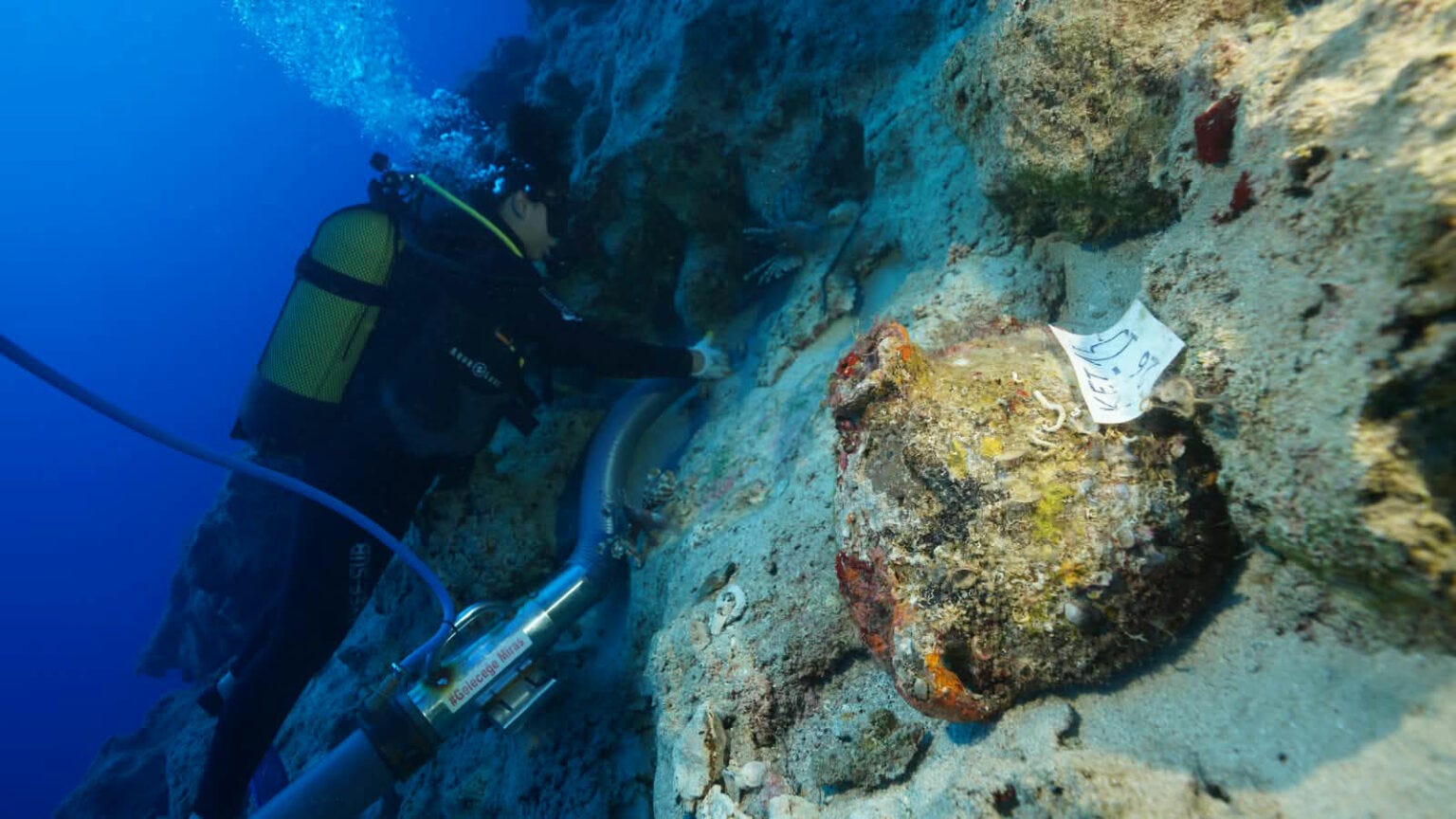
World’s Oldest Shipwreck Discovered in the Mediterranean — A Bronze Age shipwreck discovered near Kekova Island, off the coast of Antalya in southern Turkey, has been dated to approximately 2700–2400 BCE, making it a candidate for the world’s oldest known shipwreck. Although the ship’s wooden structure has not survived, its cargo of more than 30 amphorae remains on the seabed at a depth of approximately 100 feet. The pottery vessels resemble examples found in Egypt and the Middle East, providing evidence for the wreck’s age and connections to ancient Mediterranean trade networks. Based on the cargo’s size, the merchant vessel is estimated to have measured around 30 feet long. Three large stone anchors were also discovered nearby. Some intact amphoras contain residues that are being analyzed to determine whether they once held commodities such as olive oil, wine, or tree resins. The ship may have departed from an eastern Mediterranean port and been heading toward Crete or northwestern Turkey when it sank in the hazardous waters surrounding Kekova Island.
Early Humans in America Endured Climate Chaos—New Research — New investigations of prehistoric human footprints at White Sands National Park in New Mexico have revealed how early Americans endured dramatic environmental changes during the last ice age. Excavations identified 20 distinct layers of sediment containing footprints dating from approximately 23,500 to 21,700 years ago, demonstrating repeated human activity over nearly 2,000 years. At the beginning of this period, the region contained a large lake surrounded by conifer forests, with average temperatures about 7°F colder than today. As the climate warmed, Lake Otero shrank, forests gave way to oak and sagebrush, and increasingly dry conditions transformed the landscape. A severe drought around 23,200 years ago coincided with an abrupt climatic event recorded in Greenland ice cores. Analysis of ancient pollen and plant waxes helped reconstruct these changes. Computer simulations also revealed that footprints were more likely to survive during environmental transitions, when exposed mud was subsequently buried by sediment. Consequently, gaps in the footprint record do not necessarily indicate human absence, offering a more nuanced picture of early American populations.
Roads and Terraces Discovered Near Machu Picchu — Drone-mounted LiDAR has revealed approximately 1.5 miles of ancient roads, agricultural terraces, platforms, and circular structures hidden beneath dense vegetation near Machu Picchu in Peru. The features were identified on the steep, forested slopes of Mount Yanantin, close to the famous Inca citadel. Some pathways follow zigzagging routes across the mountainside, with one measuring less than 3 feet wide. After identifying the structures through laser scanning, archaeologists cleared thick vegetation with machetes to confirm their existence on the ground. Although the arrangement of the roads is consistent with Inca engineering, the structures have not yet been securely dated, and some may predate the Inca Empire, which flourished during the 15th and early 16th centuries CE. The discoveries suggest that the landscape surrounding Machu Picchu was more extensively developed than previously recognized. Additional LiDAR surveys are planned, with many more structures potentially hidden in the surrounding forest.
Was Neanderthal Life Violent? This Wound Suggests Lethal Fighting Was More Common — A Neanderthal who died approximately 75,000 years ago may have been killed by a wooden spear, providing rare evidence of lethal violence in prehistoric societies. The remains, discovered in Shanidar Cave in Iraqi Kurdistan, include a left shoulder blade with a nearly circular, 0.6-inch hole, along with a right hand, three ribs, and several teeth. The point likely entered the chest, damaging a lung and major blood vessels before exiting through the shoulder blade. Experiments with reconstructed wooden spears produced similar punctures, although if it was a spear, the injury could have resulted from a hunting accident rather than an attack. Another Neanderthal from the same cave, dating to around 50,000 years ago, had a partially healed rib wound possibly caused by a stone-tipped spear. Evidence from a 430,000-year-old site in northern Spain also suggests repeated violence, including 57 healed head injuries among 20 individuals, nine potentially fatal cranial injuries, and six similar punctures at the back-left of skulls. Together, these discoveries suggest lethal interpersonal violence existed long before agriculture, although its frequency remains uncertain.
That’s it for the free Top 5! If you’re a free subscriber, sign up for the paid plan for another 24 discoveries and 3 recommended pieces of content.
Until next time, thanks for joining me!
-James
Twitter: @jamesofthedrum
P.S. Here’s my Buy Me A Coffee link if you’d like to support my efforts with a donation.
P.P.S. If you want access to the paid version but it’s a little too steep for you right now, just email me — I want this to be accessible.
P.P.P.S. Paid members, read on!
