

This, my friends, is #211 of Ancient Beat. Let’s get into it.
Here’s the latest ancient news. 👇
🗞 Ancient News: Top 5
Ancient Wall Found Beneath Paris Could Confirm Site of First Settlement — A roughly 65-foot-long stone-and-timber wall uncovered beneath the Hôtel-Dieu hospital on Paris’s Île de la Cité may be part of the defenses of Lutetia, the Iron Age settlement of the Gallic Parisii that preceded modern Paris. The wall bears traces of intense burning, and carbon dating of charred material places it between about 200 and 10 BCE. That range includes 52 BCE, when Roman accounts describe the Gauls burning Lutetia before fighting Roman forces. The discovery is especially important because scholars have long debated whether Gallic Lutetia actually stood on Île de la Cité or farther west around modern Nanterre. The structure survives only about 3.3 feet high and lay roughly 13 feet below the hospital courtyard. Its construction follows Gallic traditions, while a thick platform of sand and gravel behind it may have strengthened it as a defensive rampart. Its exact function and date still require confirmation.
A 72-Year-Old Photo Is Revealing New Clues About ‘Meretneith,’ a Powerful Woman Who May Have Ruled Egypt 5,000 Years Ago — Digital enhancement of a 1954 photograph may strengthen the case that Meretneith, a powerful First Dynasty woman who lived roughly 5,000 years ago, exercised pharaonic authority. The original objects—13 mud sealings found around a tomb shaft at Saqqara—are now missing, leaving the old photograph as key evidence. Each sealing carried four serekhs, emblems normally containing a ruler’s name; the enhanced image appears to show signs consistent with Meretneith in two of them. Other inscriptions call her “king’s mother” and connect her with important state functions such as the treasury, while she may have ruled jointly or served as regent for her young son. Her tomb was also comparable in scale and construction to royal burials. However, the interpretation remains disputed: another reading of the enhanced photograph holds that the seals name only the male ruler Djer, so Meretneith’s precise political status is still unresolved.
Butchered Bones in Chile Dated to 13,000 Years Ago — Cut marks on gomphothere bones from the basin of ancient Lake Tagua Tagua in central Chile provide evidence that some of South America’s earliest inhabitants butchered these extinct, elephant-like mammals between 12,000 and 13,000 years ago. Stone tools recovered from the same site strengthen the case for deliberate processing by humans. Earlier excavations in the lake basin also uncovered bones from extinct horses and deer bearing cut marks and signs of burning. Together, the finds show that early inhabitants of the Southern Cone exploited several species of large mammals for food and potentially other resources near the end of the Pleistocene. Further analysis of the bones and surrounding sediments may reveal more about how these early communities lived and adapted to the landscape.
Wood Beneath German Lake May Reveal Buildings 3,000 Years Older Than Region’s First Farms — Remarkably preserved wooden remains beneath Lake Arendsee in northern Germany may represent Mesolithic structures built around 10,500 years ago, roughly 3,000 years before farming reached the region. The finds lie about 66 feet underwater beneath a thin layer of sediment, preserved because geological activity associated with an underlying salt dome has gradually lowered the lakebed rather than allowing it to silt up normally. Alongside stone tools and animal bones, divers recovered a worked wooden post about 5.2 feet tall bearing felling marks and split boards up to 4.3 feet long. These could be parts of huts or another type of wooden construction, though their purpose remains uncertain. If confirmed as buildings or intensively used living spaces, they would provide rare evidence that hunter-gatherers were modifying landscapes architecturally long before the first farming communities arrived around 5500 BCE.
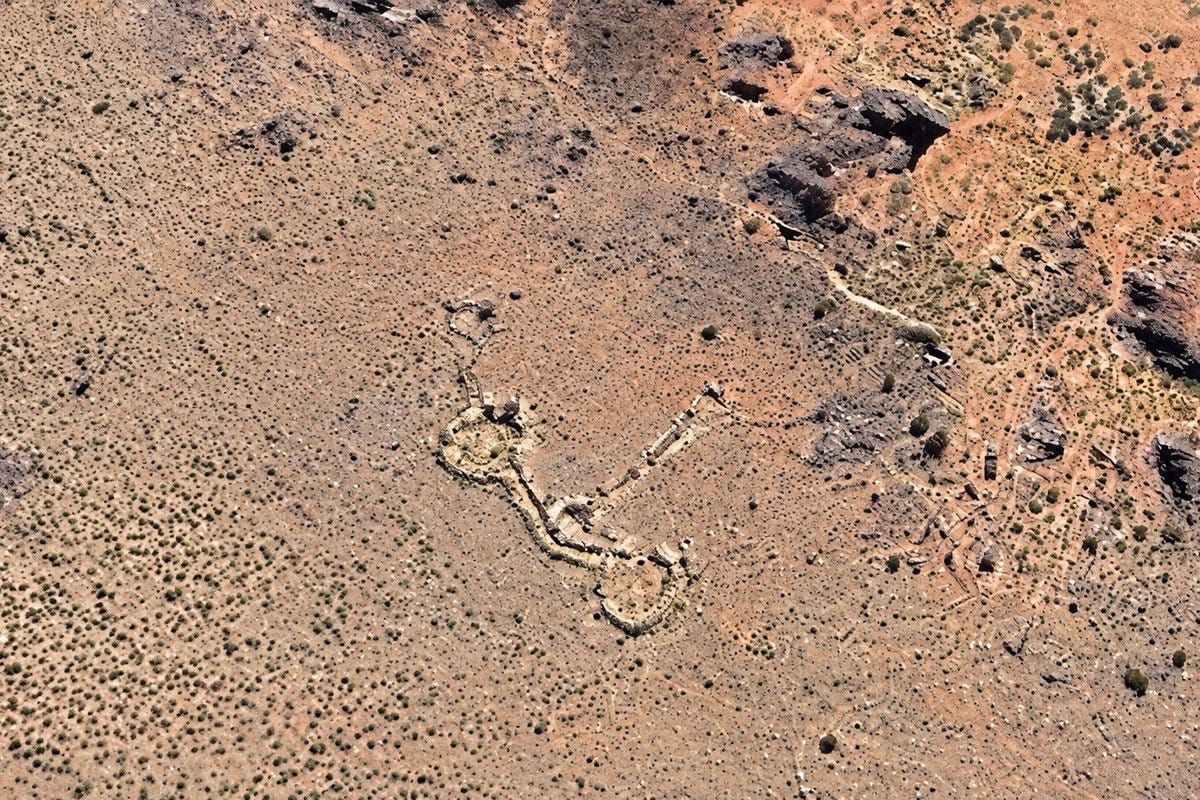
Mysterious Giant Stone Circles Discovered High in Argentina’s Andes — A previously unknown complex of monumental stone features has been documented in the Cordillera del Tigre of Mendoza Province, Argentina, at an elevation above 9,840 feet. The site contains enormous circular constructions measuring roughly 89–115 feet across, linked by passageways and accompanied by stone walls, channels or ditches, partially buried stones, and excavated areas. First noticed in satellite imagery in 2025 and reached on foot in February 2026, the complex has no obvious parallels currently known in Mendoza. No pottery, food debris, or other surface material associated with permanent settlement has yet been reported, raising the possibility that the isolated mountain complex had a ceremonial or symbolic function. It could potentially relate to the Inca period or earlier pre-Hispanic populations, but its builders, age, and purpose remain unknown pending excavation, sediment analysis, and remote sensing.
That’s it for the free Top 5! If you’re a free subscriber, sign up for the paid plan for another 32 discoveries and 3 recommended pieces of content.
Until next time, thanks for joining me!
-James
Twitter: @jamesofthedrum
P.S. Here’s my Buy Me A Coffee link if you’d like to support my efforts with a donation.
P.P.S. If you want access to the paid version but it’s a little too steep for you right now, just email me — I want this to be accessible.
P.P.P.S. Paid members, read on!
