

Hi folks! Welcome to issue #209 of Ancient Beat. Let’s get right into it.
Here’s the latest ancient news. 👇
🗞 Ancient News: Top 5
Scientists Find a Trove of Denisovan Fossils and Tools in Southwest China, Giving an Unprecedented Glimpse Into Our Extinct Cousins’ Lives — Bianfu Cave in Yunnan Province, southwestern China, has produced seven Denisovan fossils—two skull fragments, four teeth, and part of a forearm bone—from at least four individuals who lived about 167,000–134,000 years ago. The bones were identified through ancient proteins after more than 60,000 fragments were examined; DNA had not survived. The forearm is the first Denisovan radius ever identified and combines some Neanderthal-like traits with an overall shape closer to modern humans. More than 1,300 stone and bone tools indicate hominin activity in the cave between roughly 190,000 and 70,000 years ago. Cut and fractured bones from deer, water buffalo, and other animals suggest skilled hunting and butchery of large prey, while pollen indicates a conifer-rich environment. The site provides the first direct evidence of Denisovans in southwestern China.
Major New Discoveries Beneath the Forest Canopy Near Machu Picchu — Drone-mounted LiDAR has revealed more than 1.5 miles of previously unknown pre-Columbian roads beneath dense rainforest on Mount Yanantin, across the Urubamba River from Machu Picchu in Peru. The longest continuous section runs for at least three-quarters of a mile, and the total network may ultimately prove twice as extensive. The surveys also identified previously undocumented terraces, platforms, and circular structures at elevations of about 6,560–8,860 feet. The narrow, zigzagging roads resemble known Inca engineering, although some may predate the Inca and have been rebuilt or reused later. More than 60 archaeological sites are already known within the wider Machu Picchu landscape, but most documented activity has been on the opposite side of the river. The newly detected infrastructure suggests this forested area was also heavily developed and may substantially change interpretations of how the larger Machu Picchu region was organized and connected.
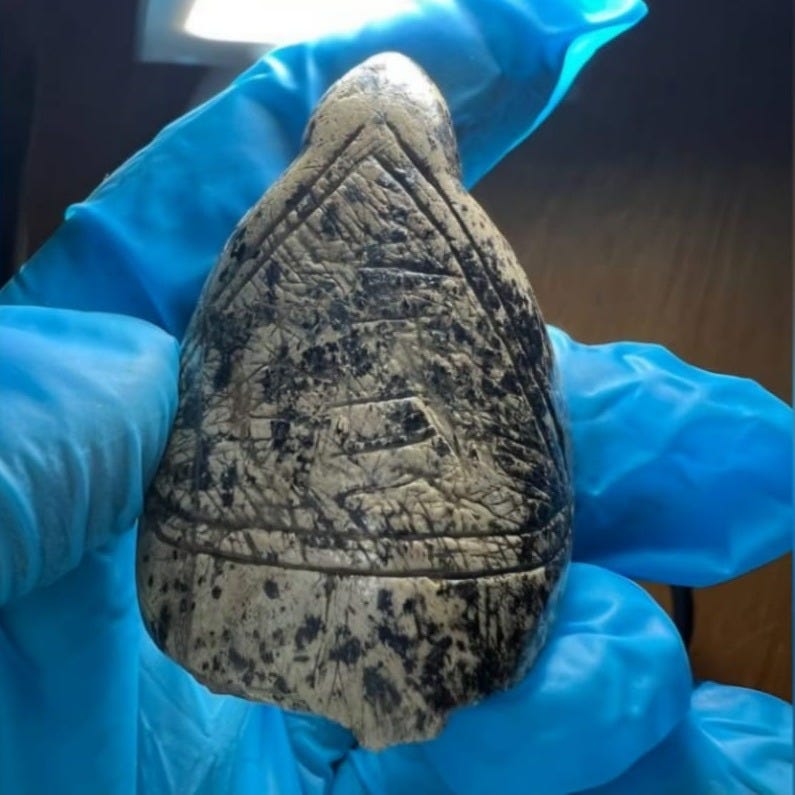
18,000-Year-Old Ice Age Artists Used Natural Mammoth Tusk Patterns in Their Art — Analysis of 18 female figurines from Mizyn in northern Ukraine suggests Ice Age artists deliberately incorporated the natural internal patterns of mammoth tusks into their designs. Dating to about 18,000 years ago, the ivory figures belong to the broad category often called “Venus” figurines. High-resolution microscopy and 3D modeling revealed that engraved geometric patterns frequently follow or imitate natural Schreger and Owen lines created as tusks grow, showing that craftspeople planned their carvings around the material itself. The figurines also illuminate a major shift in Paleolithic art: human figurines largely disappeared during the Last Glacial Maximum, with an apparent production gap of roughly 1,000–3,000 years before reappearing around 18,000 years ago. The Mizyn examples are among Europe’s earliest anthropomorphic images after that hiatus and represent an eastern European artistic tradition distinct from later western examples.
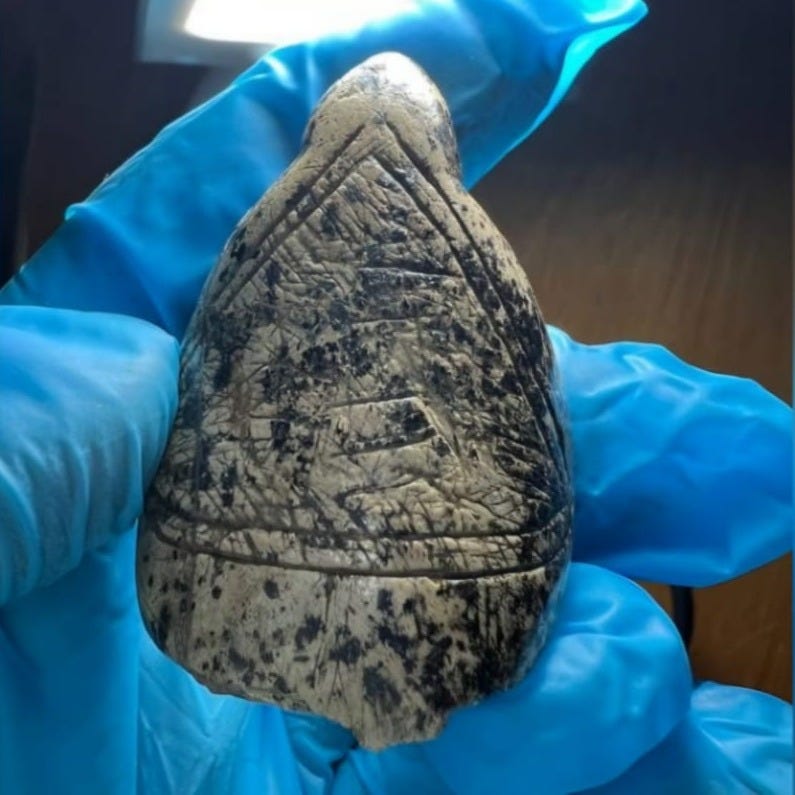
Image credit: University of York Oldest North African Defensive Structure Outside Egypt Identified — A 3,500- to 4,000-year-old defensive complex at Oued Beht in Morocco has been identified as the oldest known fortification in Africa outside the Nile Valley. Located around 60 miles from the Atlantic coast, the ditch-and-rampart enclosure dates to the early to middle second millennium BCE. Although first noticed in the 1930s, it had not previously been securely dated. The structure blocked access to the southern end of a settlement and used the natural ridge to strengthen its defenses. Its exact purpose remains uncertain: it may have protected inhabitants against attack, controlled movement through the landscape, or reflected increasing competition over territory. Oued Beht was also home to a large Late Neolithic farming settlement, previously identified as the largest known in Africa outside Egypt for its period. The fortification shows that Maghreb communities were capable of organizing substantial public construction projects by the Bronze Age.
Roman Inscription Marks Lightning Strike at Hadrian’s Villa — A marble inscription found near the amphitheater at Hadrian’s Villa in Tivoli, Italy, appears to mark a spot struck by lightning and subsequently treated as sacred. The slab bears the Latin words “FVLGVR SVBMANIVM,” referring to Summanus, the Roman deity associated with nighttime lightning. Romans believed objects or places struck by lightning had been touched by divine power, and the fulgur conditum ritual involved burying affected material and formally marking the location as consecrated ground. The inscription therefore provides physical evidence for a religious practice otherwise known largely from ancient texts and other ritual contexts. Its location may also help explain changes to the layout and use of this part of Hadrian’s sprawling second-century CE villa complex, showing how an unpredictable natural event could permanently reshape Roman sacred space.
That’s it for the free Top 5! If you’re a free subscriber, sign up for the paid plan for another 31 discoveries and 4 recommended pieces of content.
Until next time, thanks for joining me!
-James
Twitter: @jamesofthedrum
P.S. Here’s my Buy Me A Coffee link if you’d like to support my efforts with a donation.
P.P.S. If you want access to the paid version but it’s a little too steep for you right now, just email me — I want this to be accessible.
P.P.P.S. Paid members, read on!
