

Hey hey! Welcome to issue #207 of Ancient Beat.
Here’s the latest ancient news. 👇
🗞 Ancient News: Top 5
Strange ‘Hobbit’ Species Walked More Like Us Than Like ‘Lucy,’ Hip Bones Reveal — A new analysis of the pelvis of Homo floresiensis, the diminutive human relative discovered on Flores, Indonesia, suggests the species walked more like members of the genus Homo than like earlier australopithecines. The study examined LB1, an adult female about 3.5 feet tall who died between 100,000 and 60,000 years ago, comparing her pelvis with humans, African apes, and 26 fossil hominin pelves. Nearly all measured pelvic traits fell within the range of modern humans, and the overall shape most closely resembled other Pleistocene Homo. The anatomy points to habitual upright, terrestrial walking. Their evolutionary origin remains unresolved: they may represent island-dwarfed Homo erectus or descendants of an earlier, naturally small-bodied Homo lineage.
40.8-Pound Viking Silver Hoard Found in Denmark Is the Largest Ever Discovered — A homeowner preparing a patio in Rebild, northern Denmark, has uncovered the largest known Viking Age silver hoard in the country. Dating to the 10th century CE, the 40.8-pound deposit contains around 700 objects and fragments, including numerous silver bars, bracelets, 47 complete coins and coin fragments, cut-up silver, and a small Thor’s hammer. About 14.1 pounds remained inside the original clay pot, while the rest had scattered into the surrounding soil. Arabic dirhams and Anglo-Saxon pennies—including two minted under an English ruler who reigned from 899 to 924 CE—show connections reaching Britain and the Islamic world. One silver bar bears a short runic inscription, possibly reading “hutu,” whose meaning is unknown. The dominance of bars, jewelry, and chopped silver suggests the hoard functioned as carefully measured wealth, with silver valued primarily by weight and purity.
9,000-Year-Old Mining Workshop Unearthed at Çayönü Hill — A purpose-built mineral-working workshop dating to about 6900–6800 BCE has been uncovered at Çayönü Hill in southeastern Türkiye. The roughly 54-square-foot workspace was surrounded by at least six postholes, probably supporting a canopy, and contained a stone-paved working surface. Forty-two malachite fragments were recovered, representing raw, partly processed, and finished material, alongside copper beads and other copper objects. Together they preserve nearly the entire production sequence, from preparing minerals to manufacturing finished items, and suggest specialized craft production rather than occasional household work. Copper and malachite had been used at Çayönü since around 9100 BCE, indicating that knowledge of these materials persisted for more than 2,000 years. This was not yet large-scale smelting or casting, but sophisticated working of native copper and copper minerals. Nearby pottery associated with the Proto-Hassuna and early Pottery Neolithic periods dates to about 6800–6600 BCE.
Old-Growth Tropical Forests Bear Lasting Legacy of Ancient Maya Civilization — LiDAR data from northwestern Belize suggests that ancient Maya land management thousands of years ago may still shape the structure of supposedly untouched tropical rainforest. The strongest effect appears around engineered wetland fields, where ancient canal systems correspond with taller trees and denser, more varied canopies today. Forest growing over former settlements also tends to have greater canopy cover and more vegetation high above the ground, possibly because limestone from ancient buildings altered the soil and because useful species such as Ramón trees remained concentrated around settlements. Weaker patterns were detected near ancient upland walls. The relationships were clearest across areas about 330 to 980 feet wide. The findings suggest that some modern “old-growth” forest is partly a long-term ecological legacy of Maya settlements, agricultural engineering, and plant management rather than a landscape untouched by human activity.
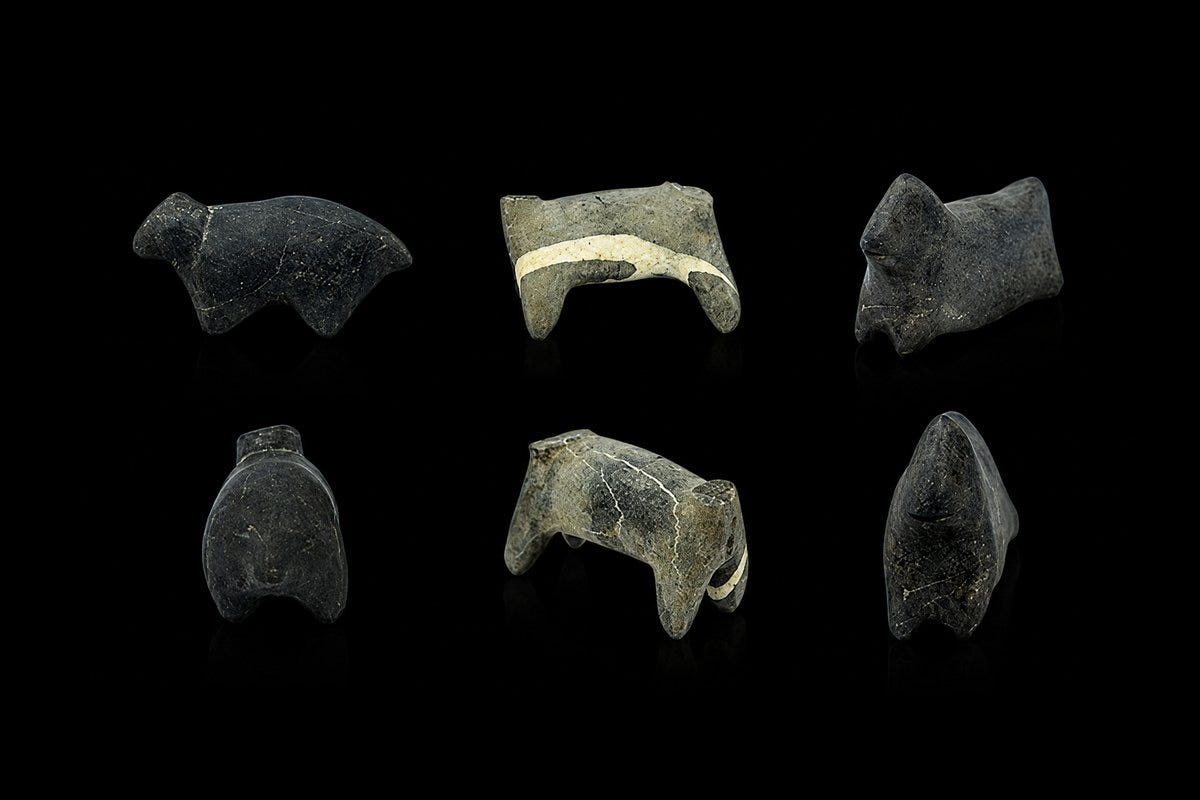
Mysterious Stone Figures at Kuélap Reveal Clues to Ancient Fertility Rituals — Small stone figures uncovered at Kuélap in northern Peru may offer new evidence for fertility rituals during the site’s later occupation under Inca influence. The objects, known as illas, depict animals with female sexual characteristics and resemble Andean conopas, ritual stones often carved as llamas or alpacas. During the Inca period, such objects were associated with fertility, abundance, protection of livestock and crops, and household well-being. Some conopas contain cavities for offerings such as camelid fat, coca leaves, or chicha. The Kuélap figures are especially notable because their explicitly female traits may point more directly to beliefs surrounding reproduction. Kuélap was a major Chachapoya center before the region was absorbed into the Inca Empire and remained occupied during the Late Horizon. The new finds may reveal whether local traditions continued, were replaced by Inca customs, or blended with them.
That’s it for the free Top 5! If you’re a free subscriber, sign up for the paid plan for another 30 discoveries and 1 recommended piece of content.
Until next time, thanks for joining me!
-James
Twitter: @jamesofthedrum
P.S. Here’s my Buy Me A Coffee link if you’d like to support my efforts with a donation.
P.P.S. If you want access to the paid version but it’s a little too steep for you right now, just email me — I want this to be accessible.
P.P.P.S. Paid members, read on!
