

Hey team, this is issue #205 of Ancient Beat.
Here’s the latest ancient news. 👇
🗞 Ancient News: Top 5
Denisovans Were Surprisingly Tall, New Fossils From Taiwan Suggest — Two fossilized Denisovan leg bones dredged decades ago from the Penghu Channel in the Taiwan Strait suggest some members of this archaic human group were exceptionally large. Ancient proteins identified a Denisovan-specific collagen variant in the femur and tibia, while related fossils from the channel indicate an age of about 45,000–43,000 years. The femur belonged to someone estimated at roughly 5 feet 11 inches and 183 pounds; the tibia suggests an individual around 6 feet 3 inches and 200 pounds. These proportions rival some of the largest Pleistocene humans known from Africa and Europe and are striking for subtropical Taiwan. The femur also has a pronounced ridge resembling one seen in highly mobile modern humans. The large body size may relate to a meat-heavy diet and hunting lifestyle, though that remains a hypothesis. The findings are currently reported in a preprint rather than a peer-reviewed study.
New Bone Analysis Challenges Long-Held Theory on Farming’s Arrival in Ireland and Great Britain — Bones from Ferriter’s Cove on Ireland’s Dingle Peninsula that were thought for more than 30 years to be the earliest evidence of domesticated cattle in Ireland and Britain have been reidentified as bear and wild boar. The fragments came from a late Mesolithic context, before 4000 BCE, and their supposed identification as cattle had supported the idea that Irish hunter-gatherers were already interacting with continental farming communities before agriculture became established. Protein analysis of collagen preserved in the bones showed that none actually belonged to cattle, removing a key piece of evidence for this theory. There is therefore currently no archaeological evidence that domesticated cattle—or farming communities themselves—reached or influenced Ireland before about 4000 BCE. Further testing may determine whether the bear remains came from brown or polar bears, potentially adding to evidence about Ireland’s prehistoric bear populations before their eventual extinction.
Neanderthals May Have Trekked Through the Saudi Arabian Desert 55,000 Years Ago, Farther South Than Experts Thought Possible — Stone tools from Jebel Katefeh-1, beside an ancient lake near Jubbah in Saudi Arabia’s Nefud Desert, may show that Neanderthals ventured much farther south than previously demonstrated. Hundreds of sharp stone flakes struck from carefully prepared cores were compared with artifacts from Arabia, the Levant, and northeastern Africa; their shapes more closely resemble tools associated with Neanderthals than those made by Homo sapiens. Similar results came from nearby ALM-3. Dating of sand grains places occupation at about 55,000 years ago, just as an arid period gave way to wetter conditions and the local lake began refilling, potentially drawing grazing animals—and hunters—into the desert. No Neanderthal bones or DNA have been found in Arabia, so the identification remains circumstantial rather than conclusive, but it suggests Neanderthals could adapt to open, increasingly green desert landscapes as well as colder environments.
Early Settlement Dynamics in the Pacific Revealed Through Ancient DNA — Ancient DNA from 72 people who lived across western Remote Oceania during the past 3,000 years has clarified how the Pacific was settled. The first major expansion began in Southeast Asia around 5,000 years ago and reached previously uninhabited Vanuatu, Fiji, and Tonga by about 3,000 years ago. A later migration brought Papuan-related ancestry from Near Oceania, reaching Vanuatu around 2,700 years ago but not appearing farther east in Fiji until roughly 500 years later. DNA also directly records Polynesian migration into southern Vanuatu about 1,000 years ago, explaining today’s “Polynesian outlier” communities. In Fiji, burials from about 1,500 years ago allowed reconstruction of a five-generation family tree. Papuan-related ancestry was unevenly distributed, with one biological kin group having a distinct ancestry profile, suggesting family membership may have been tied to inherited status or wealth.
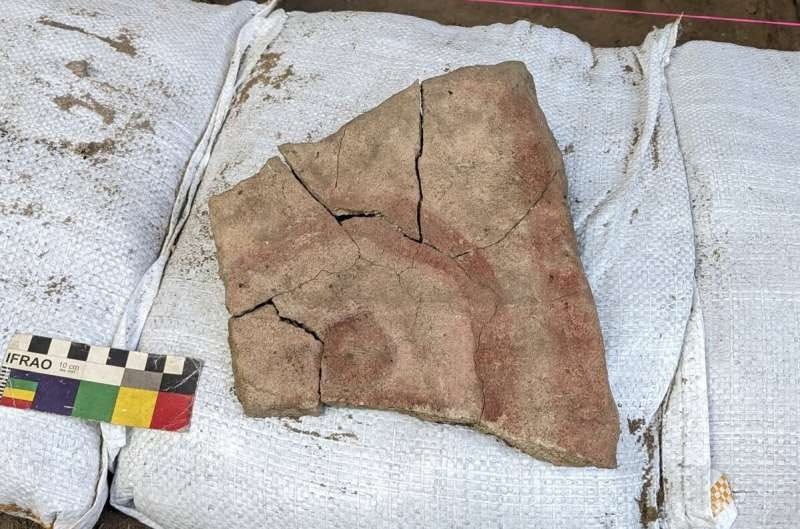
Ancient Austronesian Seafarers Carried Symbolic Art 4,000 Years Ago — A painted stone plaque from Huknaur rockshelter on Wetar Island in eastern Indonesia is the first known portable example of the Austronesian Painting Tradition. Dating to roughly 4,090–3,900 years ago, when Austronesian-speaking seafarers were rapidly spreading through Island Southeast Asia, the plaque bears a red design of concentric circles surrounded by radiating “sun rays.” Similar motifs occur widely on cave and rockshelter walls across eastern Indonesia and the western Pacific, but those examples are difficult to date. The portable plaque shows that these symbols could travel with people and may have communicated shared identity, beliefs, or protection between island communities. Crucially, it was recovered from a preceramic layer, indicating that this symbolic tradition reached Wetar before pottery—normally one of the main archaeological markers used to trace Austronesian expansion.
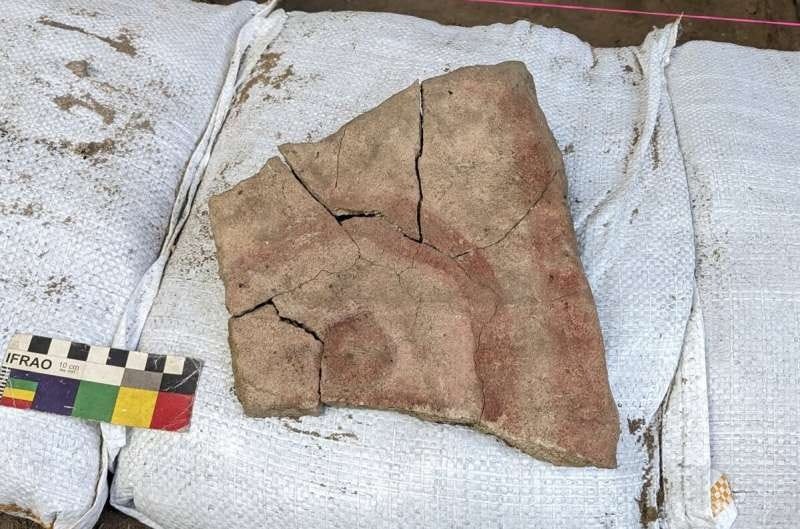
Image credit: Shimona Kealy/Australian National University.
That’s it for the free Top 5! If you’re a free subscriber, sign up for the paid plan for another 36 discoveries and 2 recommended pieces of content.
Until next time, thanks for joining me!
-James
Twitter: @jamesofthedrum
P.S. Here’s my Buy Me A Coffee link if you’d like to support my efforts with a donation.
P.P.S. If you want access to the paid version but it’s a little too steep for you right now, just email me — I want this to be accessible.
P.P.P.S. Paid members, read on!
