

Hey, friends! This is issue #204 of Ancient Beat.
‘Nuff said.
Here’s the latest ancient news. 👇
🗞 Ancient News: Top 5
Study Shows Prehistoric People Targeted Female Mammoths — Ancient DNA suggests Ice Age hunters deliberately targeted female woolly mammoths rather than killing males and females equally. Genetic analysis covered 521 mammoths spanning roughly 50,000 years, including 100 animals whose bones accumulated at 11 human-associated sites across Central and Eastern Europe and Siberia. About 70% of these hunted mammoths were female, compared with only 34% among mammoths from natural deposits. Female-led herds may have followed more predictable seasonal routes than solitary adult males, making them easier to locate repeatedly; females were also smaller, and herds containing juveniles may have been easier to trap. Some mammoth bones still contain embedded projectile points. The largest site, Kraków Spadzista in southern Poland, dates to about 30,000–25,000 years ago and contains remains from more than 100 mammoths, stone tools, and evidence of butchery.
5,800-Year-Old Chinese Site Yields 7 Fire Pits Resembling the Big Dipper — Seven fired-earth pits arranged like the Big Dipper have been uncovered at the Neolithic Niuheliang site in Liaoning Province, northeastern China, suggesting that Hongshan culture communities were tracking celestial movements about 5,800 years ago. The pits lie within a large ceremonial platform and may have formed a model of the constellation, whose handle changes orientation with the seasons. Niuheliang contains more than 60 archaeological sites, while its largest precinct includes nine monumental platforms and related structures covering over 1.08 million square feet. Other discoveries include an early temple containing a sculpted head interpreted as a goddess, as well as three concentric ritual platforms whose dimensions may correspond to observations of the solstices and equinoxes; the largest is about 72 feet across. Finds from the site also include pottery and elaborate jade dragons, phoenixes, human figures, and cloud-shaped pendants. Their differing combinations in higher- and lower-status tombs suggest an emerging ritual system and social hierarchy.
Ancient Roman Women Left More Than 120 Inscriptions Inside a Hidden Cave in Spain Dedicated to a Mysterious Goddess — At least 120 Latin inscriptions have been documented in a secluded sanctuary more than 656 feet inside Cova Dones near Millares, Valencia, Spain—up from only about 15 previously known. Most date to the first and second centuries CE, and many contain female names, indicating that women were major participants in the cave’s ritual life. Five inscriptions invoke a goddess as Domina, “the Lady,” while three also contain the mysterious word “MALACI,” possibly an unknown divine name or epithet; the deity may have had connections with water. Offerings include bronze rings, bracelets, chalice-shaped vessels, pottery, animal remains, and numerous spindle whorls, some deliberately deposited in natural pools. The same cave contains Paleolithic paintings and engravings around 24,000 years old, while earlier Roman finds include a coin from the reign of Claudius.
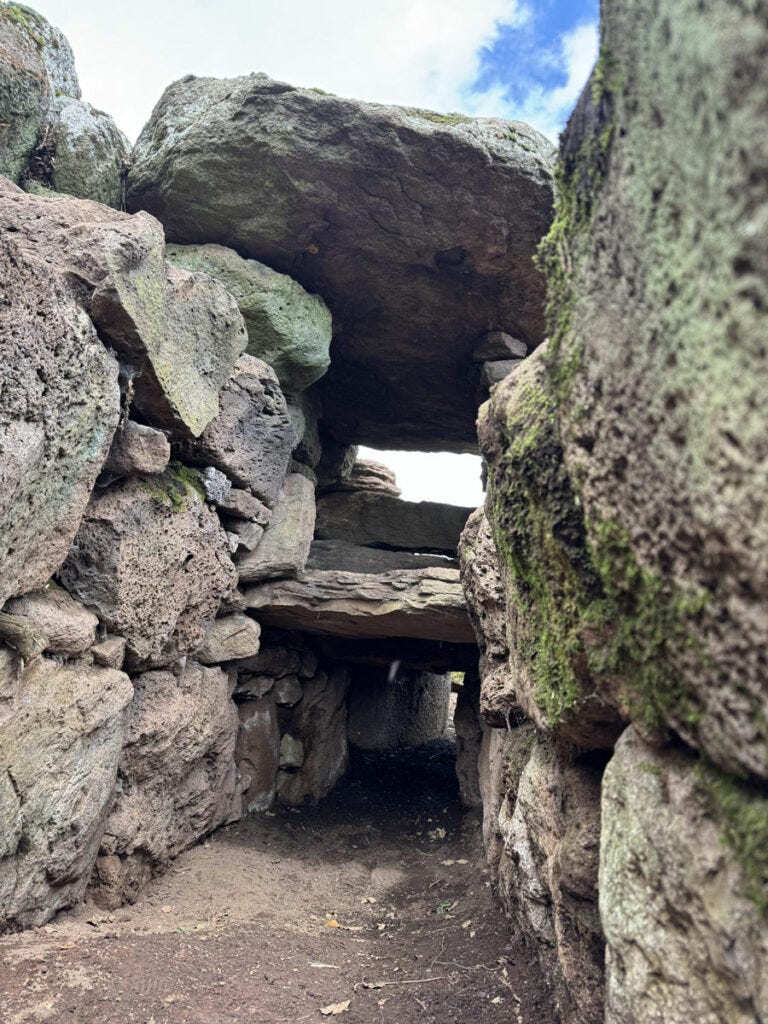
Megalithic “Giant’s Tomb” Uncovered in Sardinia — Dense vegetation at Carrarzu Iddia near Bortigali, Sardinia, concealed a previously unknown Bronze Age “Giant’s Tomb,” one of the monumental collective burial structures built by the Nuragic civilization beginning around 1800 BCE. Constructed from large trachyte blocks, the tomb preserves its burial chamber and a broad semicircular forecourt, or exedra, where ceremonies honoring the dead were likely performed. The chamber has an unusual two-level arrangement near its entrance, a feature rarely seen in these tombs. Although the monument was disturbed by illegal digging, ceramics survive inside. It belongs to a much larger archaeological landscape containing two proto-Nuragic stone structures, a settlement, sacred well, extensive cemetery, and an earlier dolmen, showing that the area served residential, ritual, and funerary purposes across a long span of prehistory.
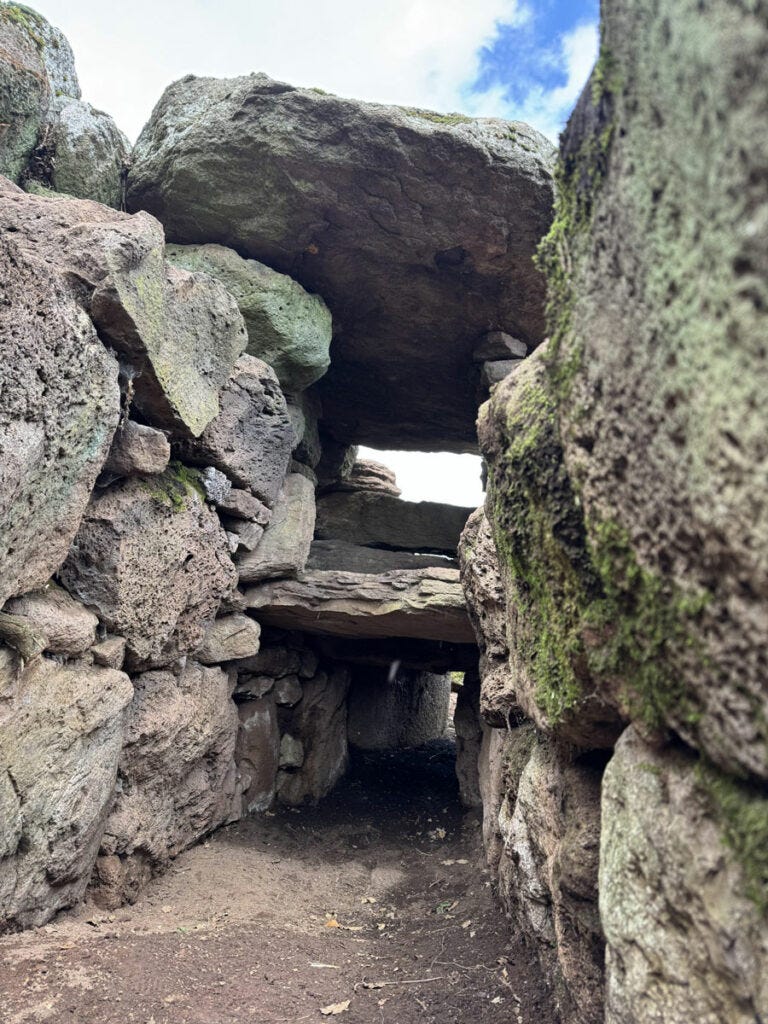
Image credit: Superintendency of Archaeology, Fine Arts, and Landscape for the Metropolitan City of Cagliari and the Provinces of Oristano and South Sardinia Brittany Burial Mounds May Hide Human-Shaped Stones as Coëby Cemetery Mystery Deepens — Two enormous Neolithic burial mounds at the Coëby cemetery in Brittany, France, may conceal large, roughly human-shaped standing stones. The elongated mounds, TRED30 and TRED31, measure 164–262 feet long and up to 5.9 feet high. Because the protected monuments cannot be excavated freely, electrical-resistivity surveys were used to map their interiors. Both contain clusters of highly resistant material matching the signature of local granite. TRED30 appears to contain substantial stone structures deep within its center, while TRED31 has stones closer to the surface; erosion has even exposed the tip of one block. Similar stones were found during an earlier excavation elsewhere in the cemetery. The mounds may resemble Passy-type funerary monuments known elsewhere in France, in which long earthen barrows covered standing stones or related burial structures. Only excavation can establish their precise form and purpose.
That’s it for the free Top 5! If you’re a free subscriber, sign up for the paid plan for another 18 discoveries and 2 recommended pieces of content.
Until next time, thanks for joining me!
-James
Twitter: @jamesofthedrum
P.S. Here’s my Buy Me A Coffee link if you’d like to support my efforts with a donation.
P.P.S. If you want access to the paid version but it’s a little too steep for you right now, just email me — I want this to be accessible.
P.P.P.S. Paid members, read on!
