

Hey team! This is issue #203 of Ancient Beat. Let’s get groovy. 🕺
Here’s the latest ancient news. 👇
🗞 Ancient News: Top 5
Ancient Fossil Footsteps Found in Kenya May Hint That an Early Human Relative Was Larger Than Previously Thought — Twenty-one hominin footprints preserved at GaJi10 in northern Kenya’s Koobi Fora Formation capture at least eight individuals crossing a muddy lakeshore 1.43 million years ago. Most walked westward, apparently at roughly the same time, while one traveled east. The tracks indicate individuals up to about 5 feet 11 inches tall and 165 pounds—larger than most skeletal estimates for Paranthropus boisei. Their flatter arches and relatively mobile big toes resemble feet attributed to that species, although their size is closer to Homo erectus, leaving the makers’ identity uncertain. Several were probably large adult males moving together, raising the possibility of organized group behavior. The surface also preserves tracks from hippopotamuses, antelope, and water birds, offering a brief snapshot of life beside an ancient lake.
40,000-Year-Old Bird Carvings Provide Clues to How Ice Age Humans Flourished — Two thumbnail-sized bird figurines carved from mammoth ivory were uncovered in the same Aurignacian layer of Hohle Fels Cave in southwestern Germany. Dating to around 40,000 years ago, each measures roughly 0.8 by 0.4 by 0.2 inches; they were found about 5 feet apart and weigh only around 0.05 and 0.02 ounces. One complete bird appears to be resting or sitting on a nest and has prominent eyes. The second is incomplete but shows a defined beak, feather markings, and spread wings, possibly representing flight, landing, or a courtship display. They may depict ptarmigans, whose bones occur frequently in the cave, although grouse or a bird of prey are also possible. Their tiny scale and careful naturalistic details demonstrate exceptional ivory-working skill. Hohle Fels has now produced three bird carvings, unlike nearby Ice Age art caves, suggesting that birds held distinctive symbolic importance there.
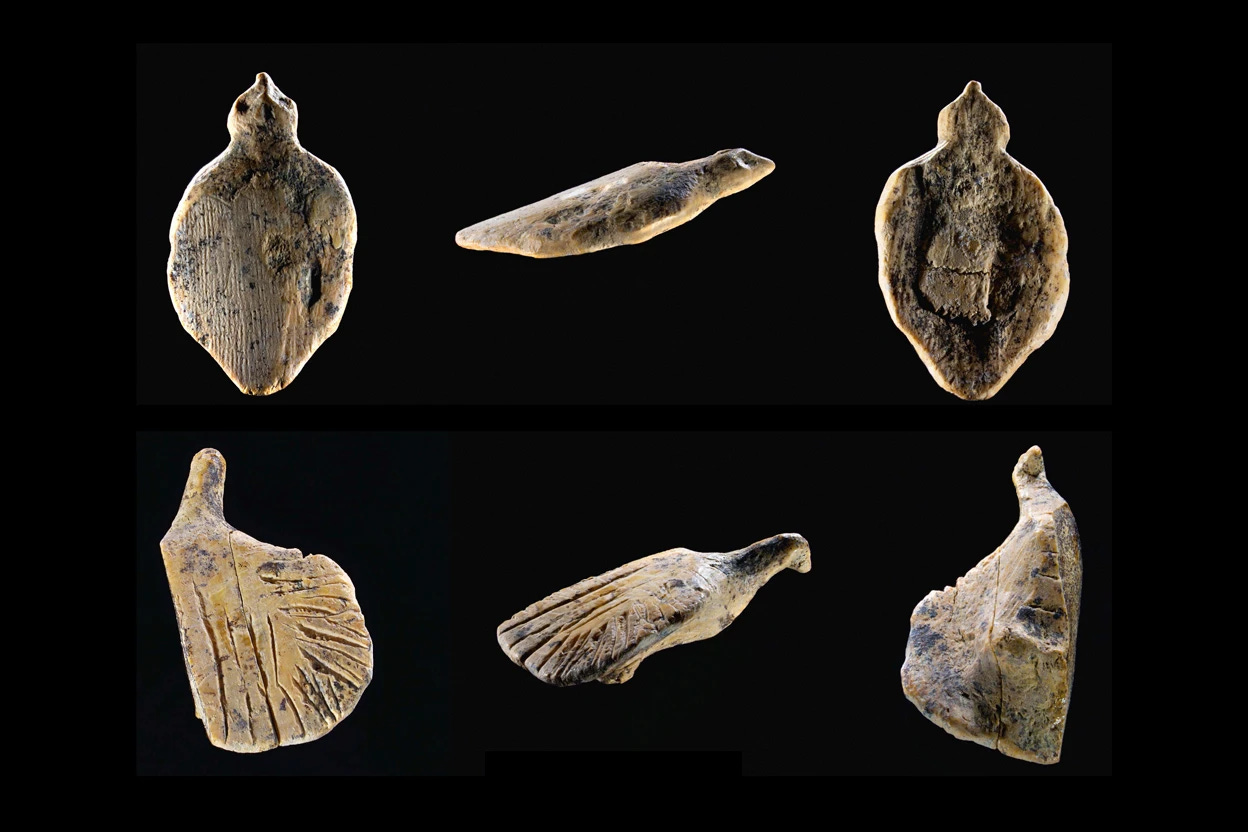
Image credit: R. Ehmann, University of Tübingen Ancient Calakmul Mural Reveals Earliest Evidence of Maya Calendar Writing — A charcoal mural from Calakmul in Campeche, Mexico, contains the earliest known calendrical writing from the ancient Maya city. Dating to approximately 400–200 BCE, the roughly 6.2-by-5.6-foot painting features a sign from the 260-day ritual calendar beside a mythological hero hunting an aquatic creature. Digital imaging and photogrammetry helped recover details obscured by heavy deterioration. The mural was painted inside an arched vault designed to resemble a sacred cave, while the building’s exterior displays descending celestial deities and masks symbolizing the maize god’s birth. The scene may represent sacrifice, renewal, or an episode in the maize god’s life cycle, with the calendar sign possibly added later to commemorate the ritual event. Removed for preservation in 2005, it is also the earliest known written communication from Calakmul.
Mesolithic Hunter-Gatherers on Malta Relied on Repeated Sea Crossings, Study Suggests — Hunter-gatherers occupied Malta between about 8,500 and 7,500 years ago, roughly 6500–5500 BCE, despite the island being too small to sustain an isolated population over the long term. Modeling based on changing sea levels, vegetation, available resources, and ethnographic comparisons indicates that Malta could initially have supported no more than 419 foragers, falling to around 170 by 7000 BCE—well below the level needed for demographic stability. Malta and Sicily had become separate islands by around 12,200 BCE, and the minimum crossing between them soon expanded to approximately 50 miles. The island’s Mesolithic occupation therefore probably depended on repeated long-distance voyages that brought new people, maintained social connections, and prevented the population from dying out. Malta may have been occupied seasonally or for longer intervals, revealing substantial Mediterranean seafaring before farming arrived.
A Newly Discovered Rock Art Site at Bukit Batu Kepale, Bangka Island, Indonesia — The first formally documented rock-art site on Indonesia’s Bangka Island occupies a granite shelter near the summit of Bukit Batu Kepale in Gudang Village, South Bangka. The shelter stands about 574 feet above sea level on a steep hillside and consists of upright granite boulders supporting a broad, flat ceiling slab. Four painted panels contain geometric, linear, abstract, human, animal, and possible plant imagery. Most designs are red, with smaller amounts of dark-red and rare yellow pigment. Motifs include straight and parallel lines, grids, zigzags, waves, chevrons, concentric shapes, stylized people, stick figures, triangular-bodied forms, and scenes possibly showing relationships between humans and animals. The paintings resemble rock art elsewhere in western Indonesia but also display distinctive local traits. Their exact age remains unknown; stylistic evidence suggests they are premodern, but direct dating is still needed.
That’s it for the free Top 5! If you’re a free subscriber, sign up for the paid plan for another 34 discoveries and 3 recommended pieces of content.
Until next time, thanks for joining me!
-James
Twitter: @jamesofthedrum
P.S. Here’s my Buy Me A Coffee link if you’d like to support my efforts with a donation.
P.P.S. If you want access to the paid version but it’s a little too steep for you right now, just email me — I want this to be accessible.
P.P.P.S. Paid members, read on!
