

Hi folks! Welcome to issue #200 of Ancient Beat.
Wow, 200 issues! This calls for a celebration.
No paywall this week. And here’s 25% off forever, just in case you’d like the whole kit and caboodle more often.
Ok, here’s the latest ancient news. 👇
🗞 Ancient News: Top 5
Neanderthals and Modern Humans May Have Shared Culture 59,000 Years Ago in Turkey, Study Finds — Finds from Üçağızlı II Cave on Turkey’s Mediterranean coast suggest remarkable cultural continuity between Neanderthals and the Homo sapiens who arrived later. Teeth and part of a jaw identified Neanderthal occupation from about 77,000 to 59,000 years ago and modern human occupation from roughly 59,000 to 47,000 years ago. Although the groups apparently did not overlap inside the cave, both obtained flint from the same local sources, made similar stone tools, and hunted wild goats, fallow deer, roe deer, and wild boar. Excavations also recovered 29 shells from small marine snails that appear to have been collected as ornaments rather than food. Several were pierced for stringing, and one from a Neanderthal layer had been deliberately heated, apparently to alter its color. The close match in hunting, technology, and symbolic practices suggests the two populations may have exchanged traditions elsewhere in the region, rather than one culture simply replacing the other.
Ancient DNA Reveals the Mysterious Collapse of Europe’s Megalith Builders — DNA from 132 people buried in a roughly 5,000-year-old megalithic tomb near Bury, about 31 miles north of Paris, reveals a sharp population break around 3000 BCE. People from the earlier burial phase resembled farming communities in northern France and Germany, while those buried later had strong genetic ties to southern France and the Iberian Peninsula. The lack of close ancestry between the groups suggests that the original population largely disappeared and was replaced by migrants from the south. DNA also revealed plague and louse-borne relapsing fever, though disease alone probably did not cause the collapse; environmental pressures and other disruptions may also have contributed. The earlier group experienced unusually high mortality, particularly among children and young adults. Burial customs changed as well: extended families were initially interred together over several generations, but later burials were more selective and centered on one male lineage. The upheaval may help explain the contemporary end of megalith construction across much of Europe.
Homo Floresiensis Probably Didn’t Hunt Stegodons or Use Fire — New evidence challenges the image of Homo floresiensis as a fire-using big-game hunter. More than 3,100 dwarf-elephant (Stegodon) bone fragments and nearly 7,000 rodent remains from Liang Bua Cave on Indonesia’s Flores Island were examined, along with experimental tooth marks made by a Komodo dragon. Dragon damage clustered on meat-rich bones, suggesting the reptiles usually reached carcasses first, while hominin cut marks appeared mainly on ribs, toe bones, vertebrae, and skull fragments with less meat. No projectile wounds or impact damage indicated active hunting, making scavenging more likely. Only one elephant rib showed burning, probably from a much later fire. None of more than 4,200 rodent bones from layers associated with H. floresiensis were burned, compared with about 20% from modern-human layers. The species’ Liang Bua fossils date to roughly 100,000–60,000 years ago.
5,000-Year-Old Wolves Found on Remote Island Rewrite What We Know About Domestication — Two wolf specimens recovered from Stora Förvar cave on Stora Karlsö, a roughly 1-square-mile island in Sweden’s Baltic Sea, date to the Late Neolithic and Bronze Age, about 3,000–5,000 years ago. Because the island had no native land mammals, people almost certainly transported the animals there by boat. DNA identified both as Eurasian gray wolves with no detectable dog ancestry. Yet they were unusually small, and one had lower genetic diversity than any of 72 previously studied ancient wolves—a pattern more comparable to dogs or isolated, managed populations. Isotope analysis showed both ate large amounts of seals, fish, and other marine foods, closely matching the diet of the island’s seal hunters and fishers. One wolf also survived severe limb damage that would have hindered hunting, suggesting it may have been fed or cared for. The evidence points to people keeping or controlling wolves without fully domesticating them. I’ll pass on having a wolf in the house. My chihuahua is fierce enough, thank you very much.
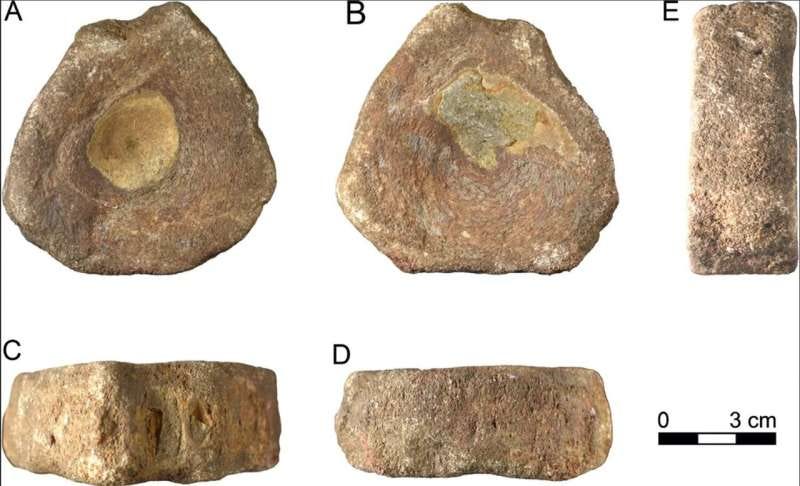
The Oldest Deliberately Collected Fossil Ichthyosaur Was Discovered in Roman Britain Around 1,800 Years Ago — This one isn’t groundbreaking by any means, but I always enjoy a good story about ancient people collecting even more ancient things. We aren’t so different. So, a weather-worn ichthyosaur vertebra found in Colchester, England, appears to be the earliest known deliberately collected fossil from one of these prehistoric marine reptiles. The bone, more than 100 million years old, was deposited in a pit dating to the second century CE at the site of Roman Britain’s first provincial capital. Other objects in the pit included pottery fragments, a horse tooth, possible cat remains, and a ligula—a small Roman spoon associated with personal hygiene or medicine. Green sandy rock attached to the vertebra suggests it originally came from the coast of eastern Kent between Folkestone and Hythe, an area where the Romans quarried greensand building stone. The fossil may have been kept simply as a curiosity or interpreted as the remains of a giant or mythological creature. Its unusual companions could indicate that it was eventually placed in the pit as part of a ritual deposit, although the precise reason remains uncertain.
🗞 Ancient News: Deep Dive
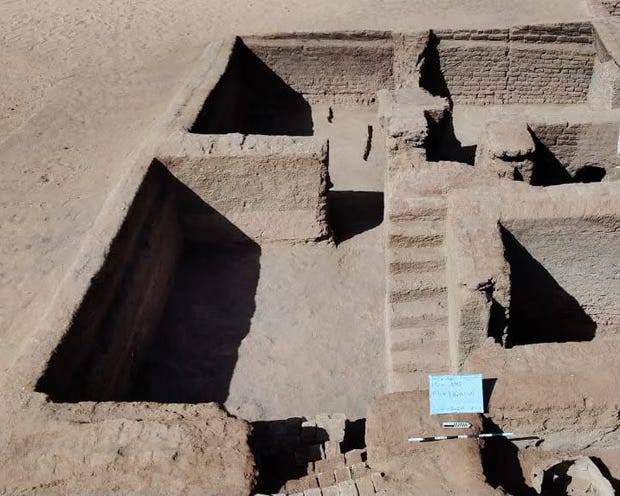
Archaeologists Uncover Ancient Byzantine City in Egypt’s Western Desert — A well-preserved fourth-century CE city has been uncovered at Ain El-Sabil in Egypt’s Dakhla Oasis. North–south roads crossed east–west streets to create public squares, while a mid-fourth-century basilica overlooked the main thoroughfares. Two watchtowers and a heavily fortified structure protected the settlement. Residential buildings contained reception halls, vaulted roofs, kitchens, bread ovens, and stone grain-grinding tools. One house, occupied by a church deacon during the second half of the fourth century, may have functioned as a house church before the basilica was built. Finds include bronze coins bearing imperial portraits, Latin inscriptions, and Christian symbols, along with gold coins dating to 337–361 CE. Nearly 200 ostraca—broken pottery pieces reused as writing surfaces—carry Coptic and Greek records of purchases, commercial agreements, correspondence, and other aspects of daily life.
Larger Brain, Smaller Face: Human Evolution Took a Different Course Than Previously Thought — An analysis of three-dimensional measurements from 87 Homo fossils challenges the idea that steadily larger brains and smaller faces were primarily produced by continuous, directional natural selection. The sample covers most well-preserved human fossils from the past two million years, including Homo habilis, Homo rudolfensis, Homo erectus, Homo heidelbergensis, Neanderthals, and early and recent Homo sapiens. Comparisons with six evolutionary models found that neutral genetic changes, stabilizing selection, ecological and biological constraints, and long periods of little change explain much of the variation more convincingly. Major expansions in brain size may have occurred when technological and cultural innovations temporarily eased nutritional, metabolic, or environmental limits. Culture may therefore have acted as a buffer, allowing human populations to occupy new habitats and access resources without every anatomical feature being tightly adapted to local conditions.
Rare Neanderthal Baby Fossil Reveals Our Ancient Relatives May Have Begun Life Much Like Modern Humans — Twelve tiny Neanderthal bone fragments from Sesselfelsgrotte, a rock shelter in Bavaria, southern Germany, offer a rare look at development before birth between about 90,000 and 50,000 years ago. DNA from a leg bone confirmed that the remains belonged to an unborn Neanderthal in the late third trimester, around eight or nine months of gestation. The surviving pieces include portions of the femur, upper arm, ribs, jaw, and skull; some carry faint marks consistent with carnivore digestion. Noninvasive micro-CT scans showed rapidly forming bone tissue broadly comparable to that of modern human fetuses. The limb bones appeared slightly more developed than the jaw and skull, probably reflecting different ossification processes rather than a uniquely Neanderthal pattern. Two milk teeth from separate children contained poorly mineralized dentine, possibly recording vitamin D or calcium deficiency, impaired absorption, or another systemic stress. If confirmed, it would be the earliest known evidence of this disturbance in Neanderthals.
Researchers Rediscover Lost Ming Dynasty Goldsmithing Technique — Experiments have reconstructed Jin zhe si, a long-lost Chinese technique used to create finely folded, corrugated gold ornaments with a soft, satin-like surface. The investigation focused on a pair of gourd-shaped gold earrings recovered from the tomb of a Ming Dynasty prince who died in 1545 CE in China’s Hubei Province. Microscopic examination and practical tests showed that artisans formed the earrings by repeatedly folding and corrugating extremely thin sheets of high-purity gold—not by engraving or embossing the finished pieces. Comparative experiments using gold, silver, and aluminum foil found that only high-purity gold was ductile enough to withstand the repeated folding needed to produce intricate three-dimensional shapes without cracking. The reconstruction explains how Ming goldsmiths achieved the distinctive texture described in historical records and demonstrates the unusually advanced control they exercised over exceptionally delicate materials.
The Discovery of an Ancient Child’s Skull Sheds Light on the Early Prehistoric Farmers of Norway — Excavations at the Skipshelleren rock shelter near Bergen on Norway’s west coast uncovered additional remains belonging to a child buried around 4,000 years ago. Preliminary examination indicates the child was about two to four years old, and the grave dates to the later Stone Age, when early farming communities were becoming established in Norway. Parts of the skeleton were first found in 1955, but renewed work located the original burial area beneath backfill from a 1931 excavation. The discovery confirms that the shelter served as both a home and a burial place. People had used the naturally protected site for more than 7,500 years, leaving thick occupation layers containing stone and bone tools, pottery fragments, and thousands of animal remains. Around 40,000 animal bones have now been recovered, while the oldest artifacts date to roughly 7,000 years ago. DNA, isotope, botanical, and soil analyses may reveal the child’s ancestry, diet, and connections to Norway’s earliest agricultural populations.
Hundreds of Pilgrim Medallions Spanning Four Centuries Discovered in Switzerland — Hundreds of religious medallions dating from the 17th through 20th centuries were recovered from a single area near Villmergen, Switzerland. The objects honor the Virgin Mary and numerous saints and originated at pilgrimage destinations across Europe. The largest group came from Einsiedeln Abbey and depicts its venerated image of Mary, while others were brought from Ettal and Wessobrunn in southern Germany, Rome, and Lourdes in France. Roman examples show the city’s four Holy Doors, which open during Jubilee Years held every 25 years and were associated with indulgences for pilgrims who passed through them. The medallions were worn as pendants, attached to rosaries, hung above cradles, placed near crops, or displayed in homes for protection against illness, evil, and misfortune. Individual saints addressed particular concerns: Saint Anastasius was invoked against headaches and mental illness, while Saint Anthony aided in recovering lost objects. One heavily worn Saint Anthony medallion was repaired after its suspension hole broke, showing its owner’s long attachment to it.
Golden Horde Structure Discovered in Kazakhstan — A large medieval structure has been identified at the Zhantai tract in northern Kazakhstan through excavation, lidar, and ground-penetrating radar. Numerous fragments of fired brick measure about 9.8 by 9.8 inches, matching a construction standard associated with the Golden Horde, which controlled a vast territory from Central Asia and Siberia to Eastern Europe between the 13th and 15th centuries. Such bricks were used in palaces, mosques, mausoleums, and other monumental buildings, suggesting the remains belong to an important architectural complex rather than an ordinary settlement. The site lies within a wider survey area covering the left bank of the Irtysh River, Lake Kyzylkak, and the valleys of the Olenti, Shiderty, and Sileti rivers. Further excavation will be needed to determine the structure’s plan, function, and precise date.
Elite Chariot Burial and Noblewoman’s Tomb Unearthed — A sixth-century BCE Picene aristocratic cemetery at Sirolo in Italy’s Le Marche region has yielded a princely burial containing a ceremonial two-wheeled chariot, helmet, axe, and other weapons. Unlike the ring ditches usually surrounding Picene monuments, its large funerary circle was enclosed by a wooden palisade, marked by evenly spaced postholes containing selected pottery fragments as ritual deposits. Large bronze vessels sealed with ceramic lids held organic material, animal remains, and pottery, possibly the remnants of a funerary feast or food offerings. A neighboring noblewoman’s grave preserved pieces of textiles and footwear, numerous fibulae securing her clothing and burial shroud, and a large amber-set fibula behind her head that may have decorated an elaborate hairstyle or headdress. Together with another warrior’s tomb found nearby, the burials reveal a hierarchically organized elite group with broad ties across central Italy and the Adriatic.
Study Finds Cannibalism Disappeared Because It Was Biologically Unsustainable — A mathematical model proposes that cannibalism became rare not only because of cultural change, but because repeated consumption of humans carried biological costs that outweighed its limited nutritional value. Evidence shows that cannibalism occurred at various times and places in the archaeological, historical, and ethnographic record, both during starvation and as a ritual practice. Human flesh provides only a moderate number of calories, while consuming members of the same species makes it especially easy for infectious diseases to spread. Cooking can destroy many pathogens, but not prions—the abnormal proteins responsible for fatal neurological illnesses such as kuru. The model suggests cannibalism might offer a short-term advantage during extreme famine, but regular practice would increase epidemic risk and contribute to population decline. Widespread taboos may therefore have developed as protective cultural adaptations, favoring societies that restricted the behavior.
Scattered Bronze Bells in Chinese Lord’s 2,600-Year-Old Tomb Point to Ritual Deactivation — A 2,600-year-old tomb at Zaoshulin in Hubei, China, contained two contrasting sets of bronze bells that appear to record a deliberate change in the deceased ruler’s role after death. The ruler of the Zeng state commissioned ornate bells decorated with dragons, inlaid with quartz, and inscribed with appeals to powerful ancestors for protection against the rival state of Chu. After the two states became allies, the bells’ original message became politically obsolete. At burial, mourners apparently broke their wooden rack and scattered the bells, preventing them from functioning and ritually “deactivating” their power. Looting is unlikely because the tomb remained intact. A second set of smaller, simpler bells was neatly stacked facing southeast and carried inscriptions intended only for the afterlife. The arrangement suggests the bells were treated not merely as instruments, but as spiritually active objects tied to lineage, political authority, and communication with ancestors.
Periodontal Disease May Have Influenced Human Evolution — An analysis of 71 fossil jaws dating from 5.3 million to 2.6 million years ago suggests gum disease may have influenced the development of the human face. Three-dimensional reconstructions and scanning electron microscopy revealed crater-like lesions, defects, and horizontal loss of the jawbone that anchors teeth—all signs of periodontal disease. These features appeared in fossils belonging to the genus Homo but were largely absent from australopithecine remains. The findings raise the possibility that chronic inflammation and bone loss around the teeth interacted with other biological changes during human evolution, potentially contributing to the facial structure seen in later humans. The idea remains a hypothesis rather than proof that disease directly drove evolutionary change, but it suggests illnesses usually viewed as purely damaging may sometimes have longer-term anatomical consequences.
Possible Timber Circle Detected on Scotland’s Isle of Arran — A geophysical survey at Machrie Moor on Scotland’s Isle of Arran has detected what may be a previously unknown prehistoric timber circle beneath the peat. The monument measures about 92 feet across and consists of 12 probable pits or postholes spaced roughly 21 feet apart. Two wider gaps may mark additional features that have decayed or become difficult to detect. Machrie Moor already contains six ceremonial circles dating from approximately 3500 to 1500 BCE, making the possible timber monument part of a major prehistoric ritual landscape. The survey also identified buried anomalies around Circle 2, which is currently marked by eight standing stones. These traces suggest the monument may originally have contained 14 stones, substantially changing its reconstructed appearance and design. Excavation will be needed to confirm whether the newly detected features truly formed a timber circle and establish when it was built.
Military Camp in Uzbekistan Sheds New Light on Alexander the Great’s Legacy — Excavations at Iskandar Tepa in southeastern Uzbekistan have identified a temporary Hellenistic military camp dating to the Greco-Bactrian period, centuries after Alexander the Great’s Central Asian campaigns. A defensive ditch about 1,312 feet long enclosed approximately three acres on the hilltop. It reached 23 feet wide and 3.3 feet deep, while postholes along its edge indicate that a timber palisade once strengthened the defenses. Large ceramic jars buried around the camp probably stored water carried up from the valley, allowing troops to occupy the exposed site temporarily. Coins depicting three Greco-Bactrian rulers indicate the camp was used no earlier than the second century BCE. The hill was later repurposed as a burial ground during the first century CE. The remains offer evidence of the military infrastructure that sustained Greek-influenced states in Central Asia long after Alexander’s empire fragmented.
Two Centuries On, Experts Unlock Secrets of Red Sea and Gulf of Aden Sailing Chart — A paper scroll made in Gujarat, India, during the late 18th or early 19th century has been recognized as a sophisticated navigational chart for sailing the Red Sea and Gulf of Aden. Only about 9.8 inches wide, it was designed to be partially unrolled aboard ship as sailors needed different sections. The chart depicts more than 180 islands, along with reefs, coastlines, ports, landmarks, ships, religious buildings, and flags. All 66 place-names written in Devanagari script have now been matched with probable locations. Astronomical information helped sailors calculate latitude, while 29 rhumb lines marked coastlines, open-water directions, and possibly safe routes into and out of ports. Its distorted geography, once viewed as an error, made the document compact and portable. The chart depended on experienced sailors’ knowledge of stars and local waters, serving as a practical memory aid for trade between India, Arabia, and the Horn of Africa.
3,800-Year-Old Ritual Offerings Discovered at Peñico — A ceremonial deposit dating to between 1800 and 1500 BCE has been uncovered inside a major public building at Peñico in Peru’s Lima region. The cache was placed during the construction of a new platform, enclosed by a semicircle of pebbles, and sealed beneath a large stone. Packed into an area just 8.7 inches long were 43 carved wooden and bone objects, including anthropomorphic figures, possible deities, mythical beings, birds, snakes, tadpoles, and geometric designs. Some had been exposed to fire, while others contained cavities for mineral or semiprecious-stone inlays. The deposit also held three beads, three pieces of chrysocolla, two land-snail-shell bead fragments, nine shell eyes made for sculptures, and eight unidentified objects. Founded around 1800 BCE, the 48-acre city contains 15 public buildings and lies about eight miles from Caral, linking coastal, highland, and rainforest exchange networks.
Ancient Bladder-Stone Surgery Tool Discovered at Bulgarian Roman City — A rare third-century CE surgical instrument has been discovered in a room beside the Temple of Hercules at Heraclea Sintica in southwestern Bulgaria. The bronze lithulkos was part of a specialized medical kit used during lithotomy, the painful and dangerous operation of removing stones from the bladder. Its curved double hooks are missing, but the well-preserved handle is decorated with a row of raised rings. Only one other comparable instrument is reportedly known, from Italy. Although Roman doctors commonly used scalpels, needles, curettes, and spoons, highly specialized tools such as this are unusual and point to advanced medical treatment in the prosperous city. Its location raises the possibility that the adjoining building treated sick people who visited the temple seeking divine healing, though the structure’s precise function remains uncertain.
Ministry Announces Several Major New Discoveries at Marina Alamein — Eighteen previously unknown tombs have been excavated at Marina Alamein on Egypt’s Mediterranean coast, bringing the site’s total to 44. The discoveries include 11 rock-cut underground tombs reaching depths of 26 feet, seven limestone surface tombs, surrounding burials, and an abandoned well later reused for interment. Several chambers remained sealed by their original stone slabs. Artifacts include complete and nearly complete pottery, plates, limestone altars and basins, architectural pieces, glass tear bottles, a false-door offering altar, an unfinished marble statue of Aphrodite, and a seated limestone figure holding a bird. An 8.2-foot granite sarcophagus retained its lid and contained human remains, while a damaged plaster statue depicted Harpocrates. Twenty-four gold “tongues” placed in the mouths of the dead included an Eye of Horus amulet. The city, about 62 miles west of Alexandria, flourished from the Hellenistic through Byzantine periods and peaked between the first and third centuries CE.
90,000-Year-Old Homo Sapiens Jaw Wound Points to Possible Violence in Early Human Groups — A Homo sapiens fossil known as Qafzeh 25, recovered from Qafzeh Cave in Israel and dated to between 145,000 and 92,000 years ago, preserves one of the oldest known healed sharp-force injuries. Microscopic examination and high-resolution scans revealed a narrow cut on the left side of the lower jaw that reached a premolar. New bone growth shows that the individual survived for some time afterward. The weapon or tool cannot be identified, and an accident remains possible, but the wound’s form and position make interpersonal violence a stronger explanation. Scans also revealed a concealed cavity inside a premolar and enamel defects affecting several teeth. The skeleton showed no carnivore damage or prolonged surface exposure, and its bones remained arranged as expected in a deliberate burial. The remains therefore document injury, survival, dental illness, and formal treatment of the dead among early modern humans in the Levant.
New Genomic Study Uncovers Family Ties Linking Scythian Elite Burials Across the Eurasian Steppe — Genome-wide DNA from 85 Iron Age people—38 buried in richly furnished elite kurgans and 47 from simpler graves—suggests that Scythian-Saka status was frequently inherited. Elite individuals were 11 times more likely to be related to one another than to non-elites, even when their tombs lay more than 62 miles apart. Identified relationships included two pairs of brothers, a brother and sister, a parent and child, and two grandfather-grandson pairs. Nearly half of the elite group was female, showing that high-ranking women occupied prominent positions. The study also produced the first genome-wide data from Kazakhstan’s “Golden Man,” buried at Issyk around 400–300 BCE. The individual was probably male and lay in a wooden chamber with more than 4,000 gold ornaments, weapons, a gold-decorated headdress, animal-shaped objects, and a silver bowl bearing undeciphered writing.
New Sections of Ancient Egyptian Temple Reveal Inscriptions of Pharaoh Psamtik I — Previously unexplored sections of a temple complex at al-Qasr in Egypt’s Bahariya Oasis have revealed a main hall supported by 16 sandstone columns, along with interconnected rooms and shrines. The temple dates primarily to the 26th Dynasty, which ruled from 664 to 525 BCE. Stone blocks bear the names and titles of Psamtik I, the dynasty’s founder, while hieroglyphic inscriptions mention the deities Amun-Ra, Amunet, and Khonsu. Older material shows that the religious center had a much longer history: a stone stele dates to the reign of Amenhotep II during the 18th Dynasty, and fragments belong to the reign of Ramesses II in the 19th Dynasty. Later activity is represented by fourth- and fifth-century CE ostraca bearing Coptic and Latin texts, as well as basins used to produce wine and oils. The finds indicate that the oasis settlement remained an important religious, administrative, and economic center across several periods.
Interpreting the Firing Technology Logic of the Jingdezhen Egg-Shaped Kiln Through Experimental Archaeology — An experimental firing has clarified how traditional egg-shaped kilns produced Jingdezhen’s varied porcelain glazes. Introduced during the late Ming period and widely used during the Qing Dynasty, these kilns contained distinct thermal zones rather than maintaining a uniform temperature. The reconstructed firing progressed through drying, oxidizing, and reducing stages, reaching approximately 2,192–2,462°F. Temperatures varied by as much as 270°F from front to back and 90°F vertically, with the front and upper areas generally hotter and richer in reducing gases. These differences altered glaze melting, crystal formation, and the chemical state of iron, producing opaque green, transparent green, and brown-black celadon surfaces. Potters managed the uneven environment by placing different wares in carefully selected positions and adjusting fuel quantity, airflow, and the moisture content of the fuel throughout the firing. The results show that the kiln’s variations were deliberately exploited rather than simply tolerated.
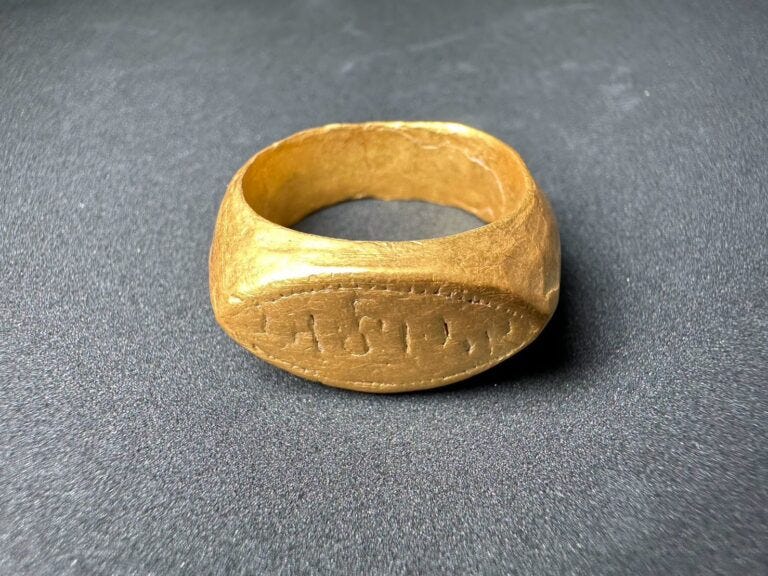
Ancient Inscribed Gold Ring Found at Phetchaburi Site — Two ancient gold rings have been recovered beside Skeleton No. 4 at the Don Yai Thong archaeological site in Phetchaburi, Thailand. One is believed to have been a signet ring and carries a rare inscription in Brahmi script dating to approximately 100 BCE–100 CE, or around 1,900–2,100 years ago. The inscription reads “Pusrakhitasa,” which can mean “belonging to Pusrakhita” or “protected by the Pushya star.” The wording may indicate that the owner belonged to the Vaishya merchant caste. The second ring is undecorated. Comparable Brahmi inscriptions have been found on seals and jewelry at sites in Krabi and Chumphon, supporting evidence of early trade and cultural connections between the Indian subcontinent and communities in present-day Thailand. The excavation was undertaken partly because rising groundwater, soil salinity, and seasonal rain threatened the site’s human remains and fragile artifacts.
13th-Century Wall Paintings Discovered at the Mahabodhi Pagoda — Traces of 13th-century wall paintings have been identified on the upper floor of the Mahabodhi Pagoda in Bagan, Myanmar. Conservators examined 13 sample areas while repairing the building and cleaning its floral architectural decoration. Paint survived in three locations: a clearly visible section on the eastern wall, a faint example on the southern wall, and a heavily faded section on the northern wall. The discovery adds the Mahabodhi Pagoda, cataloged as ancient building No. 1670, to the known painted monuments of Bagan. Of the ancient city’s 3,837 recorded pagodas and temples, 416 had previously been documented as containing murals. Continued investigation may reveal the paintings’ subjects, pigments, original extent, and relationship to the pagoda’s architecture.
Archaeologists Find More 23,000-Year-Old Stone Engravings at Foz Côa — Several Upper Paleolithic engravings more than 23,000 years old have been identified on Rock 9 at the Fariseu site in Portugal’s Côa Valley Archaeological Park. Two complete figures have been documented, while other newly detected carvings remain under study, bringing the number of known motifs on the rock to 40. The engravings belong to the Solutrean period, broadly dated to 20,000–15,000 BCE in Western Europe and the Iberian Peninsula. Excavations at Rock 9 began in 2020, when the same panel yielded the world’s largest known engraved aurochs: an approximately 11.5-foot depiction of the extinct wild cattle carved into schist. Fariseu lies within a nearly 49,421-acre protected landscape renowned for its open-air prehistoric art.
Chinese Scientists’ Horse-Head Discovery Sheds Light on Ancient Elite Sacrificial Traditions — A roughly 2,800-year-old horse’s head sealed inside a pottery vessel has been uncovered at an Eastern Zhou ritual site in Zhejiang Province, eastern China. The find dates to the Eastern Zhou Dynasty, which lasted from 770 to 256 BCE and encompassed the Spring and Autumn and Warring States periods. The region belonged to the Yue state, a powerful polity known particularly for its sophisticated metalworking and swords. Horse remains were normally deposited in pits or ditches, making the careful placement of a head inside a ceramic container highly unusual. Because horses represented wealth, military strength, and elite standing, the elaborate offering points to an organized, state-sponsored ceremony overseen by the upper levels of Yue society.
Ancient Inscription Revealing Christianity’s Clash With Mysterious Cult Decoded — A 1,700-year-old Aramaic inscription at Zerzevan Castle in southeastern Türkiye appears to document the Christian closure of an underground temple dedicated to Mithras. The Roman fortress stands about 40 miles north of the Syrian border, and its sanctuary is among the best-preserved Mithraic temples known. Discovered at the entrance in 2017 beside an image of a cross, the engraving dates to the third or fourth century CE. It mentions Mithras, Jesus Christ, and the Holy Cross, providing rare written evidence that Christians symbolically sealed the sanctuary as Christianity displaced a rival religion. Mithraism, associated with light and cosmic order, was widespread across the Roman Empire during the second and third centuries CE. Coins had previously suggested that the temple was abandoned around this time, but the inscription offers more direct evidence of how and why it closed.
Archaeologists in Mexico Uncover 1,400-Year-Old Settlement With Maya-Like Stela and Charred Corn — Near Coatepec in Veracruz, Mexico, excavations uncovered an Early Classic settlement dating to roughly 200–600 CE that may represent a previously unidentified Gulf Coast culture. Its centerpiece is a platform about 98 feet long and 39 feet wide, built from stone slabs and dressed limestone with a white, plaster-like finish. Circular and square designs on the structure have no known local parallel. Deposits interpreted as ritual offerings contained pottery vessels, figurines, charred maize, and a broken greenstone bead. A carved stela measuring about 6.2 by 4.8 feet had been deliberately buried face down and covered by later construction. It depicts two richly dressed, seated figures facing one another, wearing headdresses and ear ornaments, beneath an entity that appears to release a liquid—possibly part of a water or rain ritual. Although one figure has Maya-like traits and the composition resembles older Isthmian art, the site lies beyond the Maya heartland and is not clearly Totonac.
New Evidence Could Rewrite the History of a Mysterious Ancient Mountaintop Temple — The “Small Temple” at the Sanctuary of Men on Gemen Mountain near Yalvaç, southwestern Turkey, may have honored Hecate rather than Demeter, as archaeologists proposed after its excavation in 1912–1913. Standing about 5,250 feet above sea level, the temple includes a front hall, central sacred chamber, rear chamber, and an octagonal base that probably supported a cult statue. The revised identification rests on figurines and reliefs associated with Hecate, along with two sacrificed dog burials found at nearby Pisidian Antioch. Dogs were closely connected with the goddess of night, crossroads, boundaries, and the underworld, although the burials alone are not conclusive. No firm construction date is given, but the building was damaged in late antiquity, probably as pagan sanctuaries were dismantled or reused during Christianization. If confirmed, it could be Turkey’s second architecturally identified Hecate temple after the sanctuary at Lagina. Scattered architectural blocks may allow partial reconstruction.
An Ancient Bridge Was Lost to History. Archaeologists Just Found It — Underwater archaeologists in Solothurn, northwestern Switzerland, have found physical evidence of a long-suspected Roman bridge across the Aare River. Divers investigating ahead of renovations to the modern Wengi railway bridge uncovered a row of wooden piles about 6 feet long, lying just upstream and roughly 32 feet from the southern bank. Wood samples date the supports to the fourth century CE, during the Late Roman period. The bridge probably carried a major highway linking northern Italy with the Rhine frontier through the Great St. Bernard Pass, Swiss Plateau, and Jura region. Roman road remains had already been identified on both sides of the river, but the crossing itself had remained elusive. Its location at a narrow channel also fits Solothurn’s Roman name, Salodurum, derived from a Celtic term meaning “river narrows.” The piles narrowly survived a 1969 river-deepening project and will remain underwater while further exploration continues.
❤️ Recommended Content
Here’s an article about a “new star” in a 12th century poem that ended up being a supernova.
Here’s an article about some interesting 5,000-year-old marble statuettes, including “The Stargazer.”
Here’s a video about the newly discovered Egyptian city mentioned above.
Here’s a video about some newly discovered ancient technologies.
And here’s a video about antiquity smugglers and thieves who got busted this year.
Nice to see you all the way down here! Thanks for reading. It means a lot.
Until next time, friends.
-James
🧐
P.S. Here’s my Buy Me A Coffee link if you’d like to support my efforts with a donation.