

Happy Fourth to those of you in the US!
So, how’s it going? What’s new? Been a minute. Let’s get into some fresh discoveries, eh?
This is issue #199 of Ancient Beat. Here’s the latest ancient news. 👇
🗞 Ancient News: Top 5
Early Homo sapiens May Have Lived in Rainforests, New Clues Suggest — and It Could Overturn Our Understanding of Human Evolution — The old “humans evolved on the savanna” story is getting more complicated. Evidence now suggests early Homo sapiens may have used, and perhaps lived in, tropical forests far earlier than once thought. Part of the problem is preservation: rainforest soils are acidic and wet, so bones, tools made from organic materials, and long sediment sequences rarely survive. Stone tools have helped fill the gap. Finds show humans in coastal tropical forests in Kenya about 78,000 years ago, Equatorial Guinea around 45,000 years ago, the Democratic Republic of the Congo around 18,000 years ago, and Ivory Coast about 150,000 years ago. The Ivory Coast artifacts include quartz flakes, heavy picks, and choppers, suggesting people could make practical toolkits for dense forest life. Direct evidence is still scarce, but two 46,000- to 63,000-year-old teeth from Tam Pà Ling cave in Laos preserve zinc-isotope evidence of a rainforest-based diet. The next frontier may be ancient environmental DNA from tropical lake sediments, which could reveal where people moved, what they ate, and which diseases they faced.
Earliest Americans Specialized in Megafauna Hunting From Alaska to South America, Analysis of 50 Sites Reveals — A hemisphere-wide analysis of 50 early archaeological sites argues that some of the first peoples in the Americas were not broad-spectrum foragers, but highly focused hunters of the largest animals available. The study looked at Eastern Beringian sites in Alaska and the Yukon, Clovis sites across North America, and Fishtail Projectile Point sites in South America. Across those groups, an estimated 83% to 88% of food came from huge plant-eaters such as mammoths, gomphotheres, and giant ground sloths. Smaller animals may have been common on the landscape, but they barely appear in the campsite record. That specialization may help explain why similar toolkits, including large projectile points and butchering tools, appear across such different regions. The study also links megafauna extinctions to a southward wave of human arrival, with mammoths and horses gone from Alaska by about 11,350 BCE, Clovis-era megafauna disappearing by about 10,850 BCE, and some South American giants surviving until about 9650 BCE.
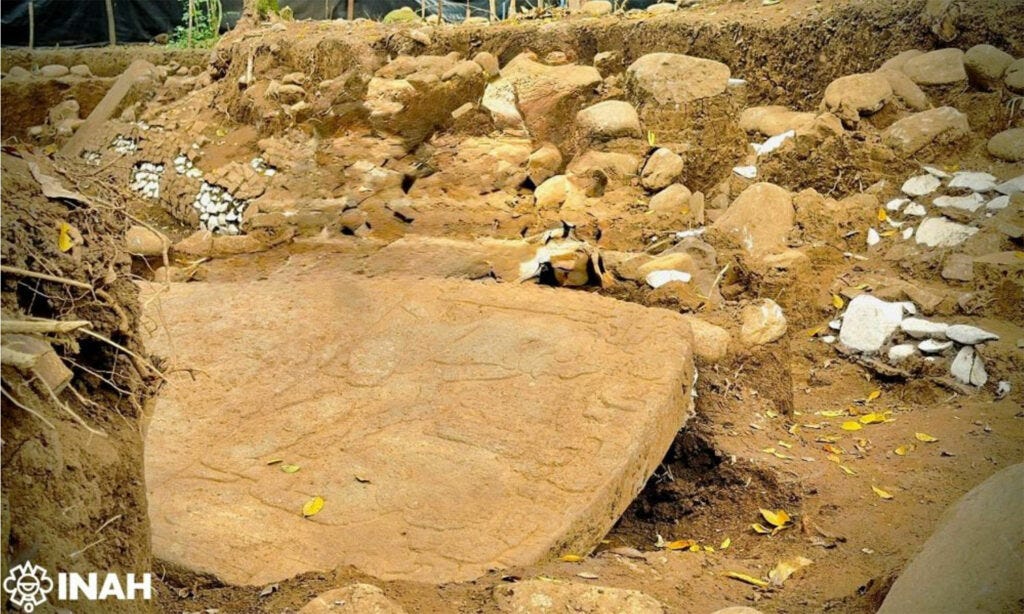
Unusual Platform and Monolith Found in Eastern Mexico — At Campo Viejo in Veracruz, eastern Mexico, excavations uncovered a circular stone platform and a carved monolith dating to the Early Classic period, between 200 and 600 CE. The platform was made with circular stones and decorated with squared lines or figures, and so far no clear parallels have been identified at nearby ancient sites. The monolith stands more than 6 feet tall and is engraved with two figures, one of whom appears to have Maya features. Both figures hold a bowl and seem to be receiving something, possibly a liquid. The scene may show water being given by a deity, perhaps in the context of drought. If so, the monument may preserve a local ritual image tied to water, divine favor, and environmental stress in eastern Mexico.
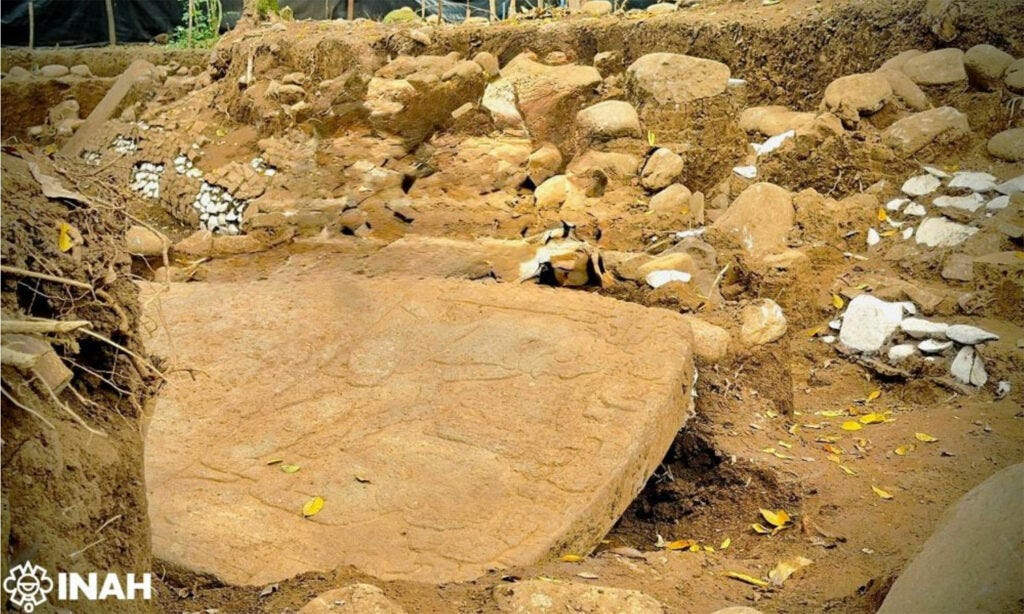
Image credit: INAH The Oldest Evidence of Mourning Rituals — At Arene Candide Cave in Liguria, Italy, a richly furnished Upper Paleolithic burial suggests that grief, care, and ritual were already deeply human concerns around 27,500 years ago. The grave belonged to a 15-year-old boy who had been badly mauled by a bear, with injuries to his jaw, neck, and left shoulder. Before he died, his community appears to have brought him into the cave, packed ochre into his wounds, and stayed with him. Afterward, they buried him on a bed of red ochre. His grave goods included hundreds of perforated shells and deer canines arranged as a cap around his head, mammoth ivory pendants, four decorated elk antler batons, and a flint blade held in his right hand. The cave seems to have been used for burial over a very long span, from about 34,400 years ago into the Neolithic, around the sixth century BCE. Later burials at the same site included ochre-stained graves and more than 29 deliberately broken pebble halves, possibly split so one half stayed with the dead and the other remained with the living as a keepsake.
Unknown 4,000-Year-Old Stone Circle in Belfast Uncovered by Archaeologists — Excavations near the Giant’s Ring, just outside Belfast in Northern Ireland, uncovered a previously unknown stone circle dating to at least 4,000 years ago, in the Late Neolithic or Early Bronze Age. The discovery began with aerial photographs showing crop marks that suggested the Ballynahatty Ritual Complex extended farther than expected. That wider complex includes 50 or more known monuments along the southern end of the Malone Ridge. The newly excavated circle had been disturbed in the 19th century, when farmers dismantled monuments that interfered with agriculture. So far, there is no evidence that the circle was connected with burials. Its purpose remains uncertain, but it may have been used for ceremonies, seasonal gatherings, or celestial observation, like other prehistoric circles in Ireland. One small but lovely artifact from the dig was a broken arrowhead found during the community excavation.
That’s it for the free Top 5! If you’re a free subscriber, sign up for the paid plan for another 31 discoveries and 2 recommended pieces of content.
Until next time, thanks for joining me!
-James
Twitter: @jamesofthedrum
P.S. Here’s my Buy Me A Coffee link if you’d like to support my efforts with a donation.
P.P.S. If you want access to the paid version but it’s a little too steep for you right now, just email me — I want this to be accessible.
P.P.P.S. Paid members, read on!
