

Hi friends! Welcome to issue #198 of Ancient Beat.
Here’s the latest ancient news. 👇
🗞 Ancient News: Top 5
Ancient Humans Used Fire Nearly 1.8 Million Years Ago, Cave Evidence Suggests — New evidence from Wonderwerk Cave in South Africa suggests early humans were using fire deep inside caves nearly 1.8 million years ago. The key finds are tiny burnt animal bones from Early Pleistocene layers about 98 feet inside the cave, far beyond the likely reach of natural wildfires. Archaeologists examined 161 fossilized micromammal bones, many likely deposited by barn owls, using infrared spectroscopy and a newer blue-light luminescence method that makes burnt bone glow reddish through special filters. Burnt remains appeared in both Stratum 10 and the older Stratum 11, and in Stratum 11 every white and gray fossil bone tested positive for burning. The clustered pattern suggests repeated fire use in specific cave areas over long periods, not random burning. The evidence points to early Acheulean hominins, likely Homo erectus, carrying fire into the cave, though not necessarily making it themselves. They may have collected fire from natural wildfires and maintained it temporarily.
Oldest Maya Long Count Calendar Date May Reveal How Royalty Turned Time Into Power — A carved stone monument at El Palmar in Campeche, Mexico, may preserve the earliest known Maya Long Count date in the lowlands. The date, recorded as 8.7.1.0.0, corresponds to August 31, 180 CE, making it more than a century older than the previously known earliest Long Count date in the region, 292 CE. The date appears on Stela 46, one of three weathered limestone monuments studied at the site, along with Stelae 20 and 45. Because the surfaces were badly worn, the carvings were read using photogrammetry, high-resolution 3D scanning, and digital lighting from multiple angles; the scan captured details down to about 0.004 inches. The newly visible inscriptions link the calendar date to historical and ritual events, possibly including a ruler’s accession and a public ceremony involving the Jaguar god of the Underworld. The find suggests early Maya rulers were already using timekeeping, sacred calendars, and monumental public writing to frame political authority in cosmic terms.
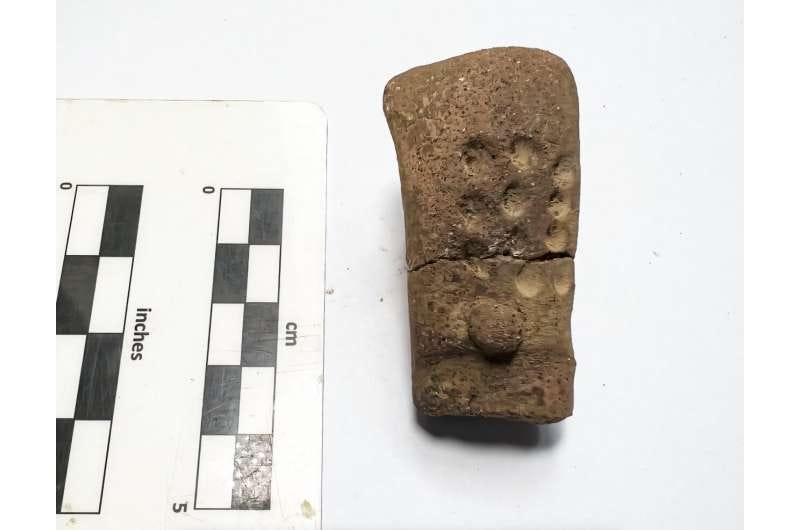
Ancient Clay Figurine From Guatemala May Bear the Oldest Written Numbers in Mesoamerica — A small clay figurine from La Blanca, on Guatemala’s Pacific coast, may preserve the oldest known written numbers in Mesoamerica. Dated to about 750 to 650 BCE, the object belongs to a group of more than 300 “tab” figurines found at the site. These figures lack normal heads and faces, instead ending in a stump-like tab, though some still show headbands or ear ornaments. This example is unusual because 11 dots were pressed into the head area in three columns: one column of three and two columns of four. That uneven arrangement may argue against simple decoration, especially because Mesoamerican art often favored symmetry. The head placement is also important, since identity, personhood, names, and calendar-linked destiny were later closely tied to heads and numbers across Mesoamerica. The dots may represent a name, calendrical date, or other identity marker, though the exact meaning remains uncertain. Other ceramics from La Blanca also carry symbols resembling later calendar glyphs, suggesting early experiments with writing.
Planned Tool Production in Israel Dates Back Some 800,000 Years — Basalt tools from Gesher Benot Ya‘aqov in northern Israel suggest Acheulian hominins were planning tool production nearly 800,000 years ago, rather than simply grabbing whatever stone was closest. The site, on the shores of ancient Lake Hula, has yielded stone tools made from flint, limestone, and basalt, along with evidence for fire use, plant exploitation, animal processing, and fish consumption. In this study, 780,000-year-old basalt artifacts from several archaeological layers were chemically compared with nearby basalt flows and with now-buried basalt layers identified in a borehole. Many artifacts, including giant cores, were made from basalt close to the site, while some cleavers came from basalt sources that have not yet been identified. The pattern suggests toolmakers knew the landscape well and selected different raw materials for different parts of the process: large slabs were shaped into giant cores, large flakes were removed, and those flakes were then turned into hand axes and cleavers. The find points to long-lived technical traditions passed down over generations.
Earliest Known Domesticated Dogs Identified at Prehistoric Sites in Türkiye — Ancient DNA from sites in central Anatolia has identified some of the earliest confirmed domestic dogs yet known. At Pınarbaşı, a rock shelter used by mobile hunter-gatherers during the Epipalaeolithic period, dog puppies dating to about 15,800 years ago were confirmed through nuclear DNA. Their careful burials suggest they were not just useful animals, but close companions with emotional or ritual importance. Isotope analysis showed they ate large amounts of fish, matching a key part of the human diet at the site. These dogs may have helped with hunting and protection in a landscape where people pursued wild sheep and large wild cattle and shared the environment with wolves and leopards. Related early dogs have also been identified across Europe, suggesting domestic dogs were already widespread by at least 14,000 years ago. At nearby Boncuklu, about 18.6 miles from Pınarbaşı, dogs were found in a Neolithic farming settlement dating to around 9000 BCE, where they were sometimes buried beside humans and may have served as hunters, guards, or early herding animals.
That’s it for the free Top 5! If you’re a free subscriber, sign up for the paid plan for another 28 discoveries and 3 recommended pieces of content.
Until next time, thanks for joining me!
-James
Twitter: @jamesofthedrum
P.S. Here’s my Buy Me A Coffee link if you’d like to support my efforts with a donation.
P.P.S. If you want access to the paid version but it’s a little too steep for you right now, just email me — I want this to be accessible.
P.P.P.S. Paid members, read on!
