

Hi folks, welcome to issue #197 of Ancient Beat!
Here’s the latest ancient news. 👇
🗞 Ancient News: Top 5
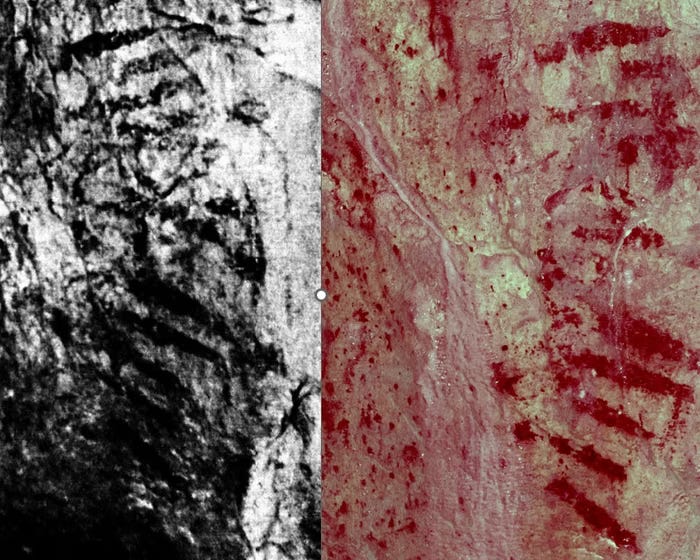
Striped Rock Dismissed As Natural In 1928 Reclassified As UK’s Oldest Cave Art — Red horizontal bands on the wall of Bacon Hole, a cave near the Mumbles in south Wales, have been reclassified as intentional Paleolithic rock art after being dismissed for nearly a century as natural mineral staining. The panel was first reported in 1912, rejected by 1928, and has now been dated to about 17,100 years ago, making it the oldest known rock art in Britain and northwestern Europe. The markings were made with red pigment, arranged in structured, evenly spaced horizontal lines, and appear to have been applied by finger. Analysis found calcite and clay residues in the pigment mixture, supporting the idea that the marks were deliberately created rather than formed by red oxide seeping through the limestone. At the time, Wales was emerging from a severe cold phase, with the Bristol Channel area likely attracting grazing megafauna and nearby caves offering shelter for hunter-fisher-gatherer groups.
Stone Age Humans Built Complex Grass Beds At Border Cave 200,000 Years Ago, Study Finds — Middle Stone Age people at Border Cave, high in the Lebombo Mountains near the modern South Africa–Eswatini border, built and maintained plant bedding for more than 150,000 years. Microscopic study of sediments dated between about 200,000 and 43,000 years ago identified six bedding microfacies, showing different ways people constructed, refreshed, burned, and trampled sleeping areas. Many beds were laid directly on ash or mixed with ash-rich deposits, perhaps to keep surfaces dry and warm or discourage insects. Some bedding layers were repeatedly renewed with fresh plant material and partially burned; one younger “grass mat” preserved overlapping layers of dried and charred plants. Older deposits often contained heavily charred bedding and phytolith-rich sediments, suggesting intense occupation, while layers dated to roughly 60,000–43,000 years ago showed less fragmentation and burning, possibly reflecting shorter stays or smaller groups. The beds seem to have used mostly Panicoideae grasses, pointing to practical local plant choices or cultural preferences.
Stonehenge Altar Stone’s Epic Transportation Across Ancient Britain Detailed in New Study — Stonehenge’s central Altar Stone, a sandstone megalith weighing about 6.6 tons, is now thought to have originated in northeast Scotland, roughly 435 miles from Salisbury Plain. New geological analysis and ice-sheet modeling argue against glaciers carrying the stone directly to southern England. Glaciers may have moved rocks part of the way during the last Ice Age, possibly as far as Dogger Bank in the North Sea, but no viable glacial route connects the Scottish source area with Stonehenge. That leaves human transport as the most likely explanation. The stone may have been moved in stages, using a combination of overland hauling, rivers, and coastal routes. If so, its journey points to remarkable planning, cooperation, landscape knowledge, and long-distance connections among Neolithic communities.
Archaeologists Reveal Giant Zapotec Complex Hidden Beneath Teotitlán Del Valle — A large Zapotec ceremonial complex has been mapped beneath the historic center of Teotitlán del Valle in Oaxaca, Mexico. Non-invasive survey work revealed buried pre-Hispanic structures beneath colonial-era buildings, including a group of ceremonial and elite buildings arranged around a central courtyard, similar to the palaces at Mitla. A large underground anomaly beneath the church patio may also be a monumental Zapotec tomb, though more investigation is needed. The survey reached more than 82 feet below the surface using methods such as ground-penetrating radar, electrical resistivity tomography, and seismic noise tomography. The findings suggest the ancient settlement was much larger than the visible remains indicate, and that 16th- and 17th-century builders reused rubble from dismantled pre-Hispanic structures to level the area before building the church and atrium.
Ancient DNA Reveals How Women Helped Transform Prehistoric Europe — Ancient DNA from human remains in Belgium and the Netherlands is complicating the old three-wave story of Europe’s peopling. Early farmers from Anatolia reached Europe after about 7000 BCE, but in the wetland zones of the Lower Rhine–Meuse region, later Neolithic people carried unusually high levels of local hunter-gatherer ancestry. In some Belgian remains dating to around 3000 BCE, at least half the ancestry came from local foragers, while earlier northern Dutch groups could be almost entirely hunter-gatherer by ancestry. The most interesting twist comes from sex-linked DNA: male lines were hunter-gatherer, but many maternal lines came from farming communities farther south. That suggests women may have carried farming knowledge into forager communities through marriage and small-scale frontier movement. A later shift around 2600 to 2400 BCE brought Bell Beaker groups with steppe ancestry, reshaping the region and contributing to a dramatic population change in Britain.
That’s it for the free Top 5! If you’re a free subscriber, sign up for the paid plan for another 24 discoveries and ____ recommended pieces of content.
Until next time, thanks for joining me!
-James
Twitter: @jamesofthedrum
P.S. Here’s my Buy Me A Coffee link if you’d like to support my efforts with a donation.
P.P.S. If you want access to the paid version but it’s a little too steep for you right now, just email me — I want this to be accessible.
P.P.P.S. Paid members, read on!
