

Hey hey, let’s do that thing we do every Saturday.
You know, the thing with the stuff that’s old but new and hopefully interesting.
Yeah, that thing. Let’s do that. 👇
🗞 Ancient News: Top 5
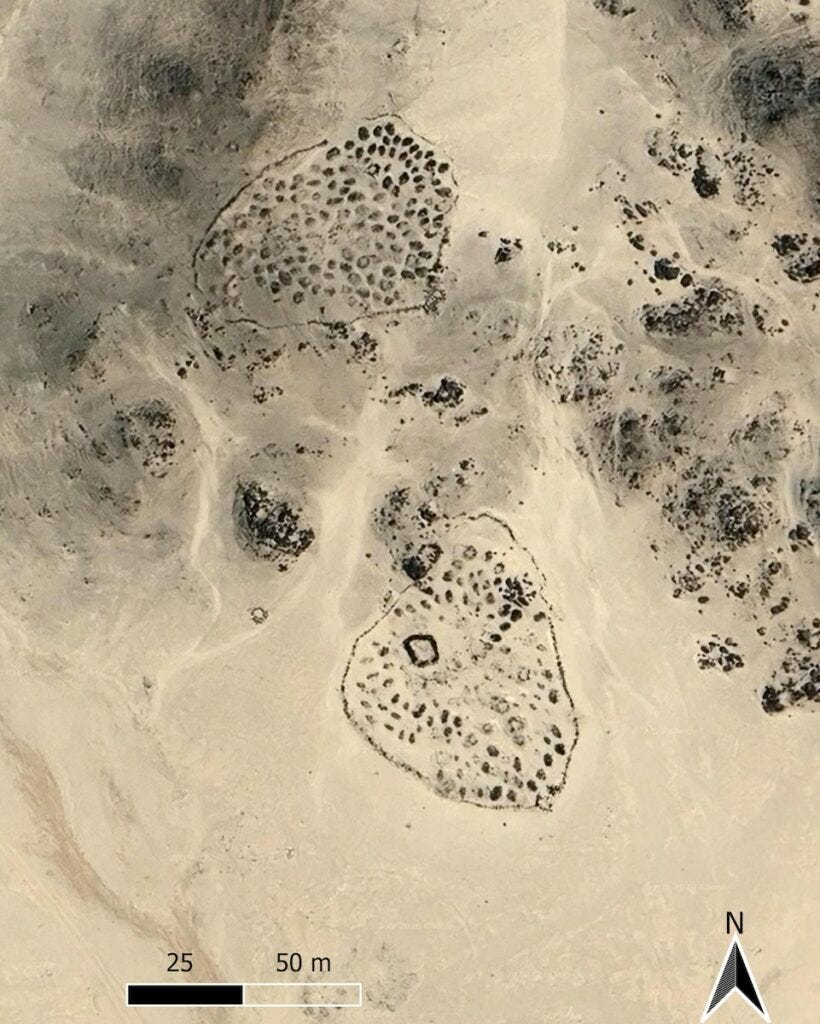
Satellite Imagery Reveals Monumental Tombs in Sudan’s Atbai Desert — Satellite surveys across Sudan’s Atbai Desert identified roughly 280 massive stone burial monuments tied to a long-lost pastoral culture that flourished between about 4500 and 2500 BCE, before the rise of dynastic Egypt. Many of the circular or elongated tomb structures measure up to 60 feet across and were built near seasonal water sources between the Nile River and the Red Sea. Archaeologists believe the monuments belonged to cattle-herding communities that survived during the final stages of the Green Sahara before increasing aridity transformed the region into desert. Human and cattle remains appear closely linked in the funerary landscape, highlighting the central importance of livestock in both economy and ritual life. Most of the monuments were previously unknown and were discovered through large-scale satellite mapping of nearly 175,000 square miles of remote terrain. The tombs provide rare evidence for complex social organization in northeastern Africa outside the Nile Valley.
A ‘Jar’ Jammed With Human Bones May Solve Laos’ ‘Plain of Jars’ Mystery — The Plain of Jars has fascinated me for a long time. Archaeologists working on the Xieng Khouang Plateau in northern Laos uncovered the remains of at least 37 people inside a massive stone jar more than 6.5 feet wide, offering some of the clearest evidence yet that the region’s famous “Plain of Jars” served a funerary purpose. The remains date from roughly the 9th to 13th centuries CE, and the jar appears to have functioned as a multigenerational burial chamber connected to ancestor worship. The discovery was made at “Jar Site 75,” about 43 miles northeast of Phonsavan, where thousands of giant carved stone jars are scattered across the landscape. Many of the bones inside the newly excavated vessel were disarticulated, suggesting bodies were first left elsewhere to decompose before the cleaned bones were gathered into the larger jar in a secondary burial ritual. Several smaller stone jars found nearby may have been used during this earlier stage of decomposition. The Plain of Jars has puzzled archaeologists for decades. Most jars stand a little over 3 feet tall, though some reach nearly 10 feet and weigh several tons. A few have stone lids, while others lie toppled on their sides. Earlier theories proposed they stored food, water, or rice wine, but growing evidence points to their role in burial ceremonies. Excavations around the jars have also uncovered burial pits, cremated remains, ashes, and burned bone fragments, indicating the sites continued to be reused after Buddhism spread into the region.
Stunning Fossil Discovery in Ethiopia Rewrites Human Origins — Fossil teeth discovered at the Ledi Geraru site in Ethiopia suggest that multiple human ancestor species lived side by side between roughly 2.8 and 2.6 million years ago, challenging the old idea of a simple, linear progression from ape-like ancestors to humans. The finds include teeth from early members of the genus Homo as well as a previously unidentified species of Australopithecus, indicating eastern Africa was home to several overlapping hominin lineages during this critical evolutionary period. The key discoveries came from 13 fossil teeth preserved in sediments dated using volcanic ash layers. The teeth confirmed the presence of some of the earliest known Homo fossils while also revealing that the unidentified Australopithecus species was distinct from Australopithecus afarensis, the species associated with “Lucy.” This supports the idea that Lucy’s lineage disappeared before about 2.95 million years ago. The fossils were found in Ethiopia’s Afar region, now a harsh landscape of faulted badlands but once a greener environment crossed by rivers and shallow lakes. Geological evidence suggests several hominin species may have occupied different ecological niches in the same region. Alongside early Homo and the newly identified Australopithecus, other lineages such as Paranthropus and Australopithecus garhi may also have lived in eastern Africa between 3 million and 2.5 million years ago. Researchers are now studying tooth enamel to investigate diet and determine how these species may have coexisted — whether they competed for the same foods, occupied separate niches, or interacted regularly on the ancient Ethiopian landscape.
Neanderthals Gathered Shellfish Using the Same Strategies as Modern Humans, Study Finds — Shell remains from Los Aviones Cave in southeastern Spain suggest Neanderthals harvested shellfish throughout the year, but favored colder seasons in a pattern remarkably similar to later modern human coastal communities. The cave deposits date to roughly 150,000 to 120,000 years ago and contained limpets, mussels, and other marine foods gathered from nearby shores. Researchers found evidence for repeated, organized collection rather than opportunistic scavenging, indicating detailed ecological knowledge of tides and seasonal shellfish availability. The findings strengthen the growing view that Neanderthals practiced sophisticated coastal subsistence strategies once considered unique to Homo sapiens. Marine foods rich in omega-3 fatty acids and zinc may also have contributed important nutritional benefits. The site has previously produced pigments, modified shells, and symbolic objects linked to Neanderthal behavior, further challenging older stereotypes of Neanderthals as cognitively primitive.
Signs Of ‘Feeding’ Ritual At Dingo Burial Site Shed New Light On Bond Between First Nations People And Canines — A roughly 950-year-old dingo burial discovered near the Baaka (Darling River) in western New South Wales is providing rare evidence of a long-term ritual relationship between people and animals. The male dingo, buried between roughly 916 and 963 CE, had healed rib and leg fractures consistent with kangaroo injuries, suggesting it had been cared for and nursed back to health. The burial was placed within a shell midden, and radiocarbon dating showed that river mussel shells continued to be added to the site for nearly 500 years afterward. Archaeologists interpret this as a ritual “feeding” practice honoring the animal across generations — something not previously documented archaeologically. The site also expands evidence for ceremonial dingo burials farther north and west along the Baaka river system than previously known. Artifacts and remains associated with the burial included dense mussel shell deposits and midden material surrounding the grave.
That’s it for the free Top 5! If you’re a free subscriber, sign up for the paid plan for another 25 discoveries and 5 recommended pieces of content.
Until next time, thanks for joining me!
-James
Twitter: @jamesofthedrum
P.S. Here’s my Buy Me A Coffee link if you’d like to support my efforts with a donation.
P.P.S. If you want access to the paid version but it’s a little too steep for you right now, just email me — I want this to be accessible.
P.P.P.S. Paid members, read on!
