

The birds are are singing and it’s a glorious day, my friends. Perfect day for a cup of something lovely and a large helping of interesting “stuff” (if you’ll excuse the technical jargon).
This is issue #195 of Ancient Beat. Here’s the latest ancient news. 👇
🗞 Ancient News: Top 5
Neanderthal Tooth Reveals 59,000-Year-Old Stone-Age Dental Procedure — A lower molar discovered in Chagryskaya Cave in Siberia’s Altai Mountains is providing evidence that Neanderthals may have performed a deliberate dental procedure roughly 59,000 years ago. The tooth, known as Chagyrskaya 64, contained a large cavity that extended into the pulp chamber, along with scratches and rotational marks consistent with drilling by a pointed stone tool. Researchers compared the marks to experiments on modern human teeth using recreated jasper tools from the cave and found that manual drilling could remove decayed tissue in under an hour. The cave was occupied between roughly 70,000 and 49,000 years ago. The damaged tooth appears to have remained functional after the procedure, suggesting the individual survived and continued chewing afterward. The study argues this may represent the earliest known evidence of intentional dental intervention in human evolution. Fine-pointed jasper perforators found at the site closely matched the traces left on the tooth. Researchers believe the treatment would have been extremely painful, especially without anesthesia, but may have relieved pressure and infection by exposing the pulp chamber. The find adds to growing evidence that Neanderthals practiced complex social care and possessed sophisticated manual skills, planning abilities, and medical awareness.
Ice Age Humans in China Crafted Surprisingly Advanced Stone Tools 146,000 Years Ago — Excavations at the Lingjing archaeological site in central China are reshaping ideas about early human innovation during the Ice Age. Researchers determined that sophisticated stone tools found at the site were made around 146,000 years ago during a harsh glacial period, not a warmer climate phase as previously believed. The tools are associated with Homo juluensis, an extinct human population with a blend of traits linked to archaic East Asian humans and Neanderthals, including notably large brains. The discovery challenges the long-standing assumption that advanced technology mainly emerged in favorable environmental conditions. The stone artifacts include carefully shaped disc-like cores designed to produce sharp cutting flakes through organized, multi-step manufacturing techniques. Some cores were symmetrically worked on both sides, while others used a more complex asymmetrical design with a prepared striking platform and a separate flake-production surface. Researchers say this demonstrates a sophisticated understanding of fracture mechanics and three-dimensional planning rather than random stone-chipping. The site also yielded butchered animal remains, including deer bones. Tiny calcite crystals inside one rib bone were analyzed using uranium-thorium dating, allowing researchers to push the site’s age back by roughly 20,000 years from earlier estimates of 126,000 years. The revised dating places the technology squarely within an Ice Age environment, suggesting ancient humans in East Asia were adapting creatively under severe climatic pressure rather than during periods of abundance.
Horse Genetics, Archaeology, And The Beginning Of Riding — A large interdisciplinary study combining archaeology, ancient DNA, and skeletal analysis challenges the idea that horse domestication began only with the spread of the DOM2 horse lineage around 2200 BCE. Researchers found evidence that humans were riding and managing horses centuries earlier across parts of the Eurasian steppe. Ancient horse remains showed signs associated with riding, including skeletal stress markers and bit wear, while genetic data revealed multiple domestication lineages rather than a single origin event. The study suggests early horse use developed gradually through different regional traditions before one lineage eventually became dominant across Eurasia. The findings complicate earlier models of domestication and indicate that horseback riding, herd management, and long-distance mobility emerged through a long experimental process involving multiple human cultures and horse populations over thousands of years.
A History Of Containers, An Ancient Technology Hundreds Of Thousands Of Years In The Making — A new study tracing the history of containers argues that carrying technology played a major role in human survival and expansion long before pottery appeared. Researchers compiled a database of more than 700 examples of ancient containers, including baskets, leather bags, nets, slings, wooden vessels, and bark containers dating back hundreds of thousands of years. Many early containers were made from perishable materials that rarely survive archaeologically, meaning their importance has likely been underestimated. The study suggests portable storage allowed humans to transport food, water, tools, infants, and raw materials across longer distances, helping mobile hunter-gatherer groups adapt to changing environments and expand into new regions. Containers may also have supported food sharing, trade, and more complex social organization by increasing how much people could carry and store at one time.
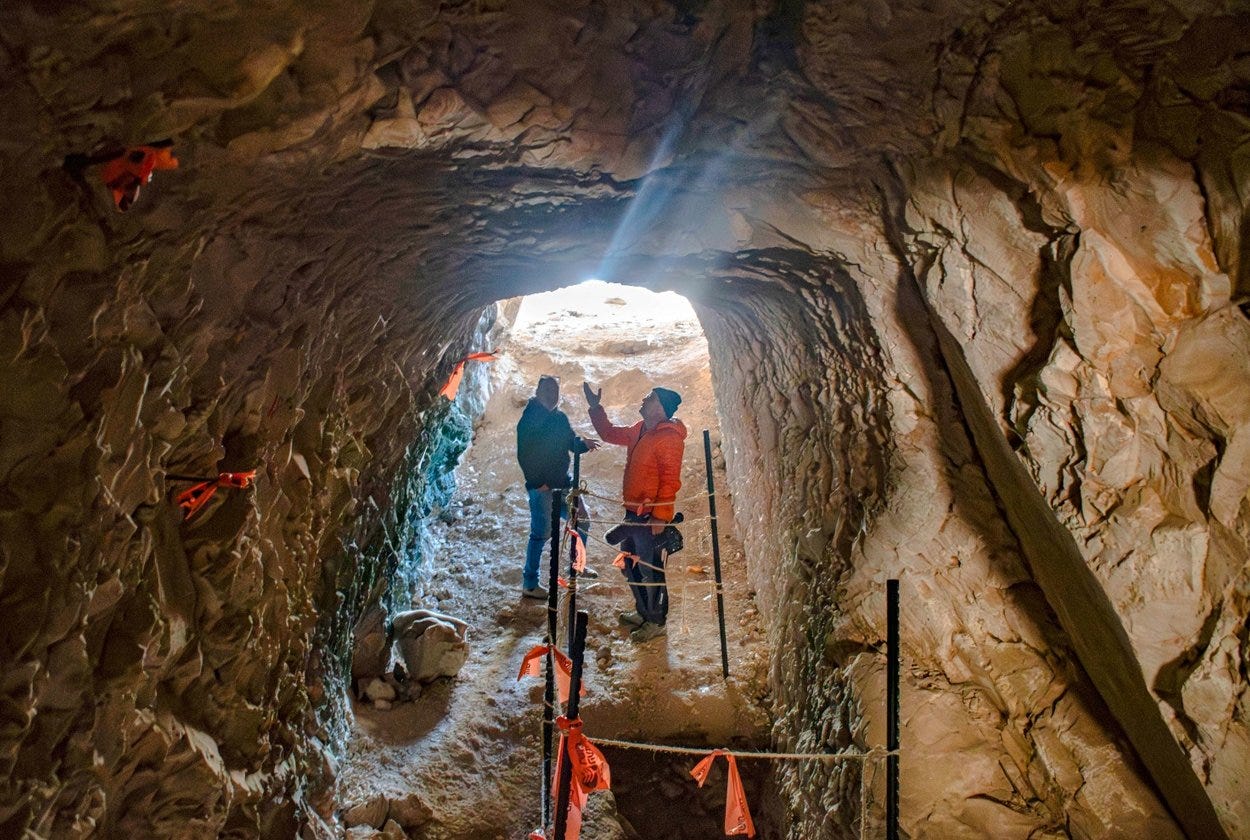
Jerusalem Excavation Reveals Vast Ancient Tunnel With Mysterious Purpose — Archaeologists excavating beneath Jerusalem uncovered a massive rock-cut tunnel dating to the Iron Age, likely around the eighth century BCE. The passage stretches roughly 394 feet long and reaches heights of nearly 30 feet in some sections, making it one of the city’s largest known underground engineering projects from the period. Carved directly into bedrock, the tunnel contains stairways, side chambers, quarrying marks, and evidence of extensive labor, but its exact purpose remains uncertain. Researchers believe it may have served as part of a water-management system, a quarrying operation, or a monumental passage connected to royal construction projects during the Kingdom of Judah. The scale of excavation suggests centralized planning and a large organized workforce. Sediment layers and pottery fragments found within the structure indicate the tunnel eventually fell out of use and was gradually filled over centuries.
That’s it for the free Top 5! If you’re a free subscriber, sign up for the paid plan for another 19 discoveries and 3 recommended pieces of content.
Until next time, thanks for joining me!
-James
Twitter: @jamesofthedrum
P.S. Here’s my Buy Me A Coffee link if you’d like to support my efforts with a donation.
P.P.S. If you want access to the paid version but it’s a little too steep for you right now, just email me — I want this to be accessible.
P.P.P.S. Paid members, read on!
