

Dearest gentle reader,
It has come to this author’s attention that… it is Saturday.
And that means it’s time for issue #192 of Ancient Beat.
Here’s the latest ancient news. 👇
🗞 Ancient News: Top 5
Behavioral Modernity, Neanderthals And Homo Sapiens: A Case For Concept Retirement — Evidence from sites across Africa, Europe, and Asia is reshaping how archaeologists understand the emergence of complex human behavior. Traditionally, “behavioral modernity” described a package of traits—symbolic art, personal ornaments, burial practices, advanced tools, and social complexity—thought to distinguish Homo sapiens, appearing around 40,000 years ago. However, discoveries dated as early as 165,000 BCE for microlithic tools, over 100,000 BCE for beads and pigment use, and around 70,000 BCE for engraved ochre show these behaviors developed gradually and much earlier than once believed. Crucially, similar evidence now appears in Neanderthal contexts, including deliberate burials, pigment use, personal adornments, complex adhesives, rope-making, and carefully crafted tools, indicating overlapping cognitive and cultural capacities. Finds such as engraved bones, decorated shells transported over 60 miles (100 km), and constructed cave features suggest aesthetic expression, symbolic thinking, and social organization. This growing overlap undermines the idea that such behaviors uniquely define modern humans. Instead of a sharp behavioral divide, the record points to shared capacities evolving across different hominin groups, prompting a shift away from broad labels toward more specific traits like social networks, learning systems, and technological innovation. Hear, hear!
110,000-Year-Old Discovery Rewrites Human History: Neanderthals And Homo Sapiens Worked Together — At Tinshemet Cave in central Israel, finds dating to roughly 130,000–80,000 years ago suggest Neanderthals and Homo sapiens in the Levant were not simply living near each other, but sharing tools, daily practices, and burial customs. The cave may have served as a dedicated burial area or early cemetery. Burials were accompanied by stone tools, animal bones, and pieces of ochre, hinting at symbolic behavior and possible beliefs about death or an afterlife. The evidence points to the region as a meeting zone where different human groups interacted, exchanged ideas, and developed similar technologies and rituals during the mid-Middle Paleolithic.
How Farming Changed Us: Ancient DNA Reveals Natural Selection Sped Up In Recent Human Evolution — A large-scale genetic study of nearly 16,000 individuals spanning more than 10,000 years across West Eurasia shows that human evolution accelerated after the shift to farming around 10,000 years ago. Instead of slow, rare genetic changes, hundreds of gene variants rose or declined rapidly under natural selection. These changes are linked to traits such as lactose tolerance, disease resistance, and risks for conditions like type 2 diabetes and schizophrenia. The findings suggest that the transition from hunting and gathering to agriculture reshaped diets, environments, and population structures in ways that drove faster biological adaptation, revealing a much more dynamic picture of recent human evolution than previously understood.
North African-Linked Stone Tools Reached Iberia 700,000 Years Ago, Evidence Suggests — Stone tools found at sites in Spain indicate technological links between North Africa and the Iberian Peninsula as early as about 700,000 years ago. The tools show similarities in design and production techniques, suggesting either direct movement of populations or the spread of knowledge across the Strait of Gibraltar. This challenges earlier assumptions that early human groups in Europe developed independently and instead points to repeated contact or migration between continents during the Lower Paleolithic. The discovery highlights the Mediterranean as a corridor for movement and exchange far earlier than once believed.
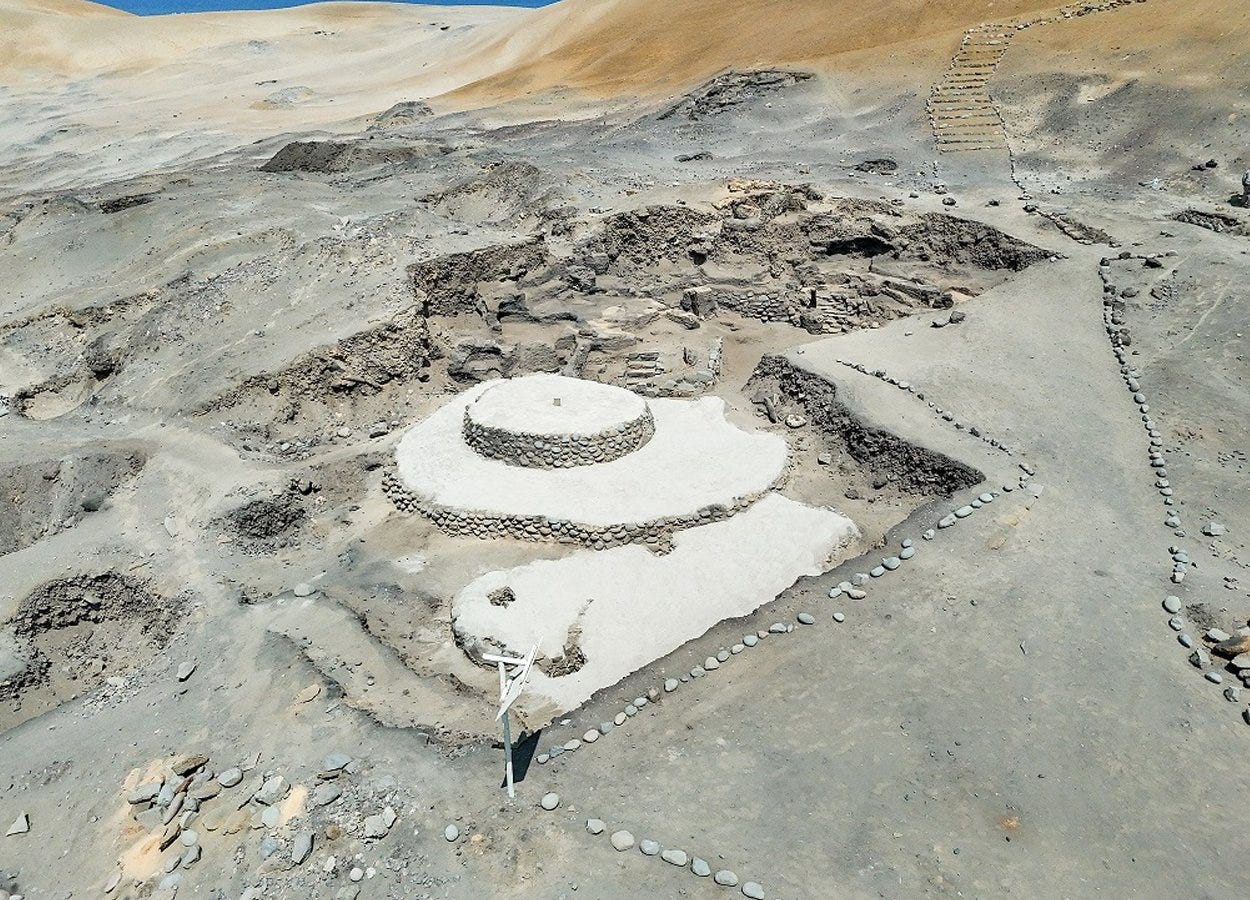
Ancient Caral Structure Linked To Astronomical Observation Discovered At Áspero — At Áspero, a coastal settlement in Peru tied to the Caral civilization (c. 3000–1800 BCE), a multi-phase structure appears to have been used to observe celestial cycles. Positioned with clear views of the horizon, the site includes a circular platform about 10 feet (3 meters) across with a central standing stone (huanca), later modified into a stepped platform with a rectangular stone and adjacent hearth. These features suggest repeated ceremonial use tied to tracking the Sun, Moon, and seasonal changes—critical for fishing-based communities reliant on tides and marine patterns. The structure was eventually buried and repurposed for domestic use, showing shifting functions over time within one of the earliest complex societies in the Americas.
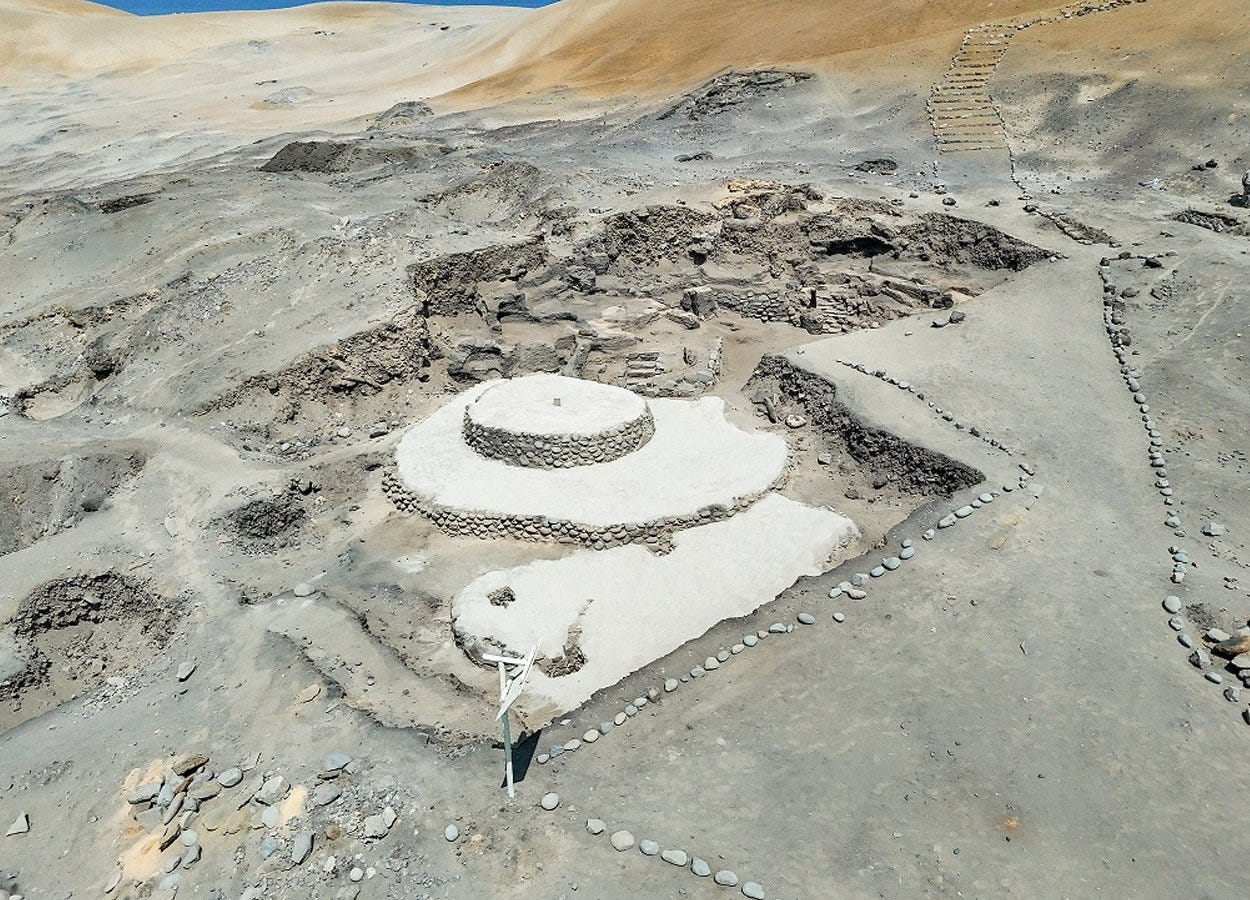
Image credit: Peruvian State
That’s it for the free Top 5! If you’re a free subscriber, sign up for the paid plan for another 20 discoveries and 2 recommended pieces of content covering kitchen knives, cauldrons, and collagen.
Until next time, thanks for joining me!
-James
Twitter: @jamesofthedrum
P.S. Here’s my Buy Me A Coffee link if you’d like to support my efforts with a donation.
P.P.S. If you want access to the paid version but it’s a little too steep for you right now, just email me — I want this to be accessible.
P.P.P.S. Paid members, read on!
