

Good morning, friends. Welcome to issue #190 of Ancient Beat. Let’s get into it.
Here’s the latest ancient news. 👇
🗞 Ancient News: Top 5
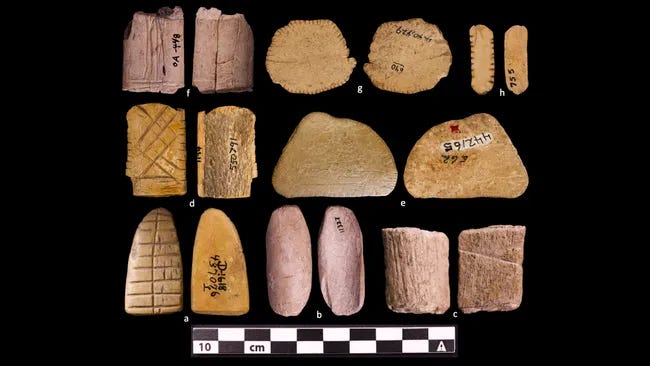
Native Americans Invented Dice And Games Of Chance More Than 12,000 Years Ago, Archaeological Study Reveals — Analysis of over 600 artifacts from 58 sites across the western United States shows that Indigenous groups were making and using dice-like objects as early as ~12,900 years ago during the Late Pleistocene. These objects—often two-sided “binary lots”—were designed to produce random outcomes and were used in structured games of chance. The earliest examples come from Folsom-period sites in Wyoming, Colorado, and New Mexico, predating Old World dice by more than 6,000 years. Rather than simple gambling tools, the games likely served as social mechanisms for exchange, relationship-building, and conflict mediation among mobile groups. The findings push back the origins of probabilistic thinking and highlight the role of games as both intellectual and social technologies in early North American societies.
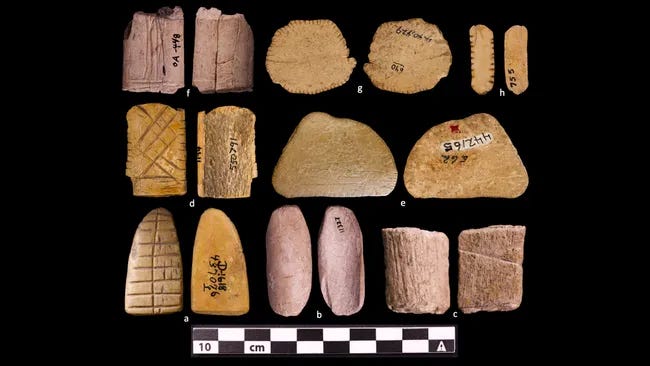
Image credit: Robert Madden How To Eat An Elephant: Fossil Find In Tanzania Shows Oldest Signs Of Butchering These Giant Mammals — At Olduvai Gorge in Tanzania, fossil remains dating to about 1.8 million years ago provide some of the earliest evidence of humans butchering megafauna. The site includes bones of a massive extinct elephant species, larger than modern elephants (which can reach about 13 ft at the shoulder and weigh over 13,000 lbs), alongside stone tools used for processing the carcass. Spatial patterns and cut marks indicate organized, intensive butchery rather than opportunistic scavenging. This pushes back the timeline for large-animal exploitation by roughly 300,000 years and suggests early humans were capable of coordinated group behavior and calorie-rich diets tied to brain development. The discovery highlights a major shift in human evolution, showing early reliance on large mammals for both food and survival strategies.
Seal Tooth Pendant Reveals Ancient Human Culture And Long-Distance Trading — A small pendant made from a gray seal tooth, originally discovered in Devon, England nearly 160 years ago, has been reidentified as a rare Upper Paleolithic ornament dating to around 40,000–28,000 BCE. The tooth was carefully shaped and perforated for suspension, indicating it was worn as jewelry. Because gray seals were coastal animals, the find—located inland—suggests long-distance movement or exchange networks among early modern humans. Such ornaments are associated with symbolic behavior and identity expression, pointing to complex social connections and possibly status signaling. The artifact adds to evidence that early humans maintained wide-ranging networks spanning dozens or even hundreds of miles across Ice Age landscapes.

Image credit: The Trustees of the Natural History Museum New Dates Push Back Occupation of Mohenjo-Daro — Radiocarbon dating from mudbrick structures near the western Stupa Mound at Mohenjo-daro, in present-day Pakistan, shows the city was already occupied around 2700–2600 BCE—about 200 years earlier than previously believed. The site, covering roughly 590 acres (about 2.3 sq km), was one of the largest urban centers of the Indus Valley Civilization, with an estimated population of 40,000. Excavations highlight advanced infrastructure including baked brick architecture, wells, reservoirs, and sophisticated drainage and sewage systems. Evidence also shows long-term development, with walls expanded and maintained until at least 2200 BCE, underscoring the city’s sustained growth and engineering complexity.
220,000-Year-Old Quarry Site In South Africa Studied — At the Jojosi site in eastern South Africa, evidence shows that early humans were deliberately quarrying stone as far back as c. 220,000 BCE, rather than casually collecting raw materials. More than 350 stone fragments were refitted like 3D puzzles, revealing the sequence of knapping and the intended shapes of tools before they were carried away. The site contains dense accumulations of flakes and production debris but lacks finished tools or domestic remains, indicating it was used specifically for extracting and shaping raw material. Luminescence dating shows repeated use over roughly 100,000 years, suggesting generations returned to the same quarry location—evidence of planning, landscape knowledge, and long-term resource management.

That’s it for the free Top 5! If you’re a free subscriber, sign up for the paid plan for another 21 discoveries and five recommended pieces of content covering shell islands, turtles, and silk.
Until next time, thanks for joining me!
-James
Twitter: @jamesofthedrum
P.S. Here’s my Buy Me A Coffee link if you’d like to support my efforts with a donation.
P.P.S. If you want access to the paid version but it’s a little too steep for you right now, just email me — I want this to be accessible.
P.P.P.S. Paid members, read on!
