

Hi folks! Welcome to a very sleepy issue #188 of Ancient Beat. 🥱
Let’s get right int…
😴
Wha, huh?!
Oh, um, let’s get right into it. Here’s the latest ancient news. 👇
🗞 Ancient News: Top 5
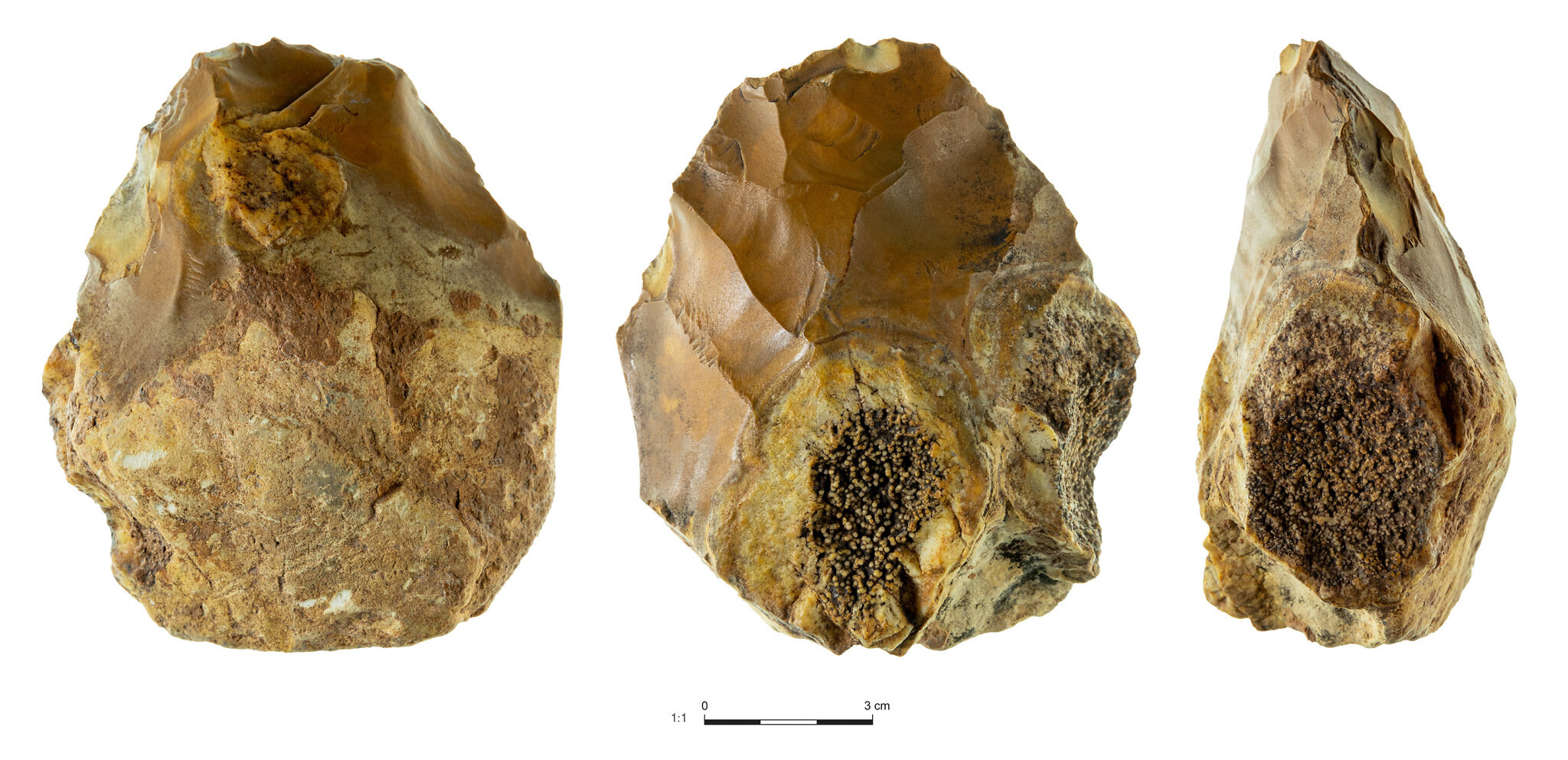
Paleolithic Chic: 500,000 Years Ago, Israel’s Ancient Toolmakers Had A Taste For Sparkle — Hundreds of Lower Paleolithic hand axes discovered in the Sakhnin Valley in northern Israel, dated to ~500,000 years ago, include a rare subset deliberately crafted to highlight visually striking materials embedded in the stone. About 15 tools feature prominent geological inclusions positioned at their center, suggesting the makers intentionally selected and shaped stone for aesthetic or symbolic reasons, not just function. The axes retain typical forms used for cutting and processing but show careful knapping to emphasize color, texture, or sparkle. This indicates that early humans were capable of visual preference and possibly symbolic thinking far earlier than traditionally assumed, adding a cultural dimension to Acheulean tool-making traditions.
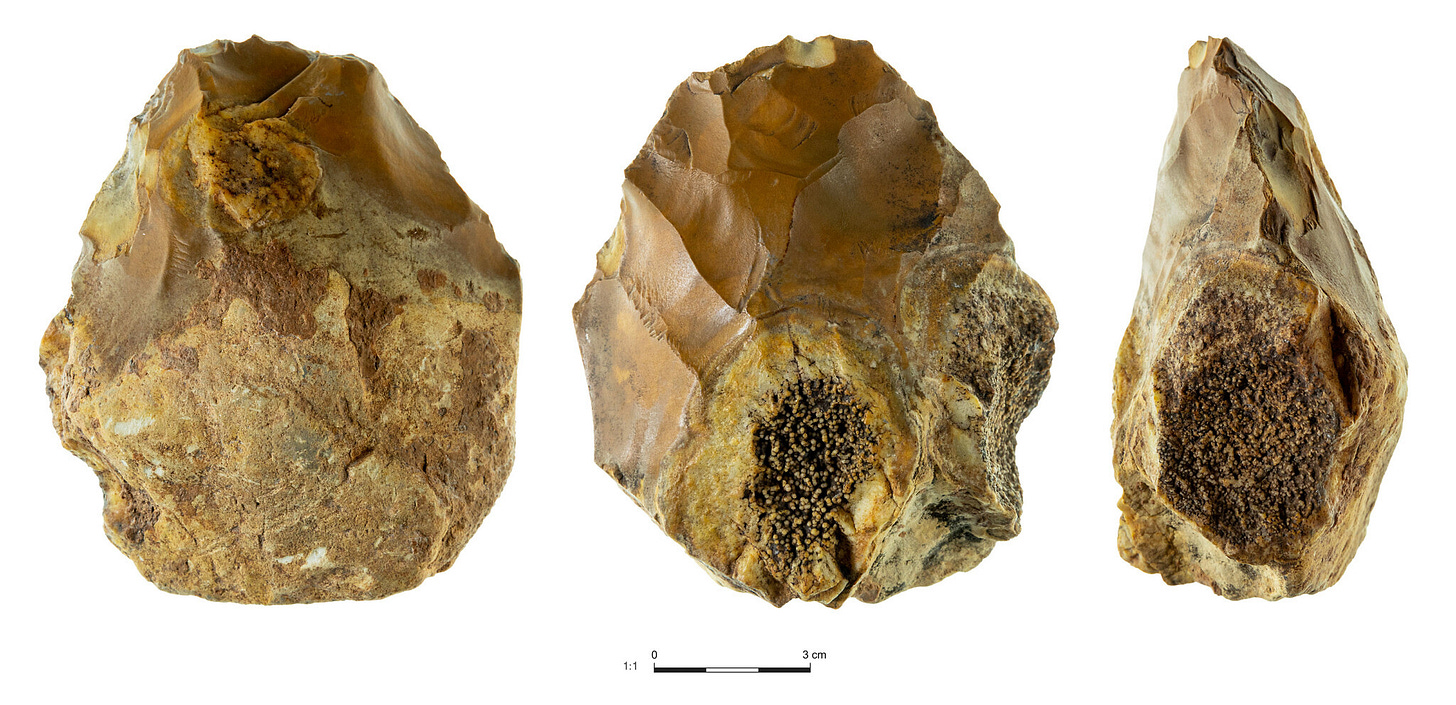
Image credit: Tel Aviv University Archaeological Site In Chile Upends Theory Of How Humans Populated The Americas Again — A reassessment of the Monte Verde site in southern Chile, near Puerto Montt, suggests it may date to roughly 6,000–8,000 years ago rather than ~12,500 BCE (14,500 years ago), overturning one of the strongest pieces of evidence for early human presence in the Americas. Earlier excavations uncovered preserved wooden structures, plant remains, hearths, and tools that had supported a “pre-Clovis” occupation model. The new analysis argues that erosion and water movement mixed younger artifacts into older sediment layers, leading to misdating. If correct, this strengthens the argument for shifting the timeline back toward a north-to-south migration after people crossed the Bering land bridge, though the findings are contested and other early sites across the Americas remain under debate. Such a strong
Ancient Human Habitation Unearthed: 125,000-Year-Old Settlement Discovered In Sharjah’s Buhais Rockshelter — Excavations at Buhais Rockshelter in Sharjah, UAE, reveal repeated human occupation spanning roughly 125,000 to 16,000 years ago, challenging the idea that southeastern Arabia was largely abandoned during arid Ice Age periods. The site preserves multiple occupation layers dated to ~125,000, 59,000, 35,000, and 16,000 years ago, indicating cycles of habitation as climates shifted. Stone tools and habitation evidence show that early humans repeatedly returned to the area, adapting to harsh desert conditions rather than abandoning the region. The site, part of the Faya Paleolandscape, provides one of the most continuous records of human presence in Arabia, reframing the peninsula as a sustained habitat rather than just a migration corridor.
China’s Earliest Bronze Age Meteoritic Iron Artifact Unearthed at Sanxingdui Sacrificial Site — A rare meteoritic iron artifact was discovered at the Sanxingdui site in Sichuan Province, southwestern China, dating to the Bronze Age (ca. 1600–1046 BCE). The object—an axe-like tool measuring about 8 in (20 cm) long—was recovered from a sacrificial pit alongside bronze masks and ritual items. Scientific analysis showed it is composed of nickel-rich iron consistent with meteorites, predating widespread iron smelting in China. The artifact is one of only about a dozen known meteoritic iron objects in the country and is the largest of its kind from the region. Its placement in a ritual context suggests symbolic or ceremonial significance, highlighting early experimentation with rare “sky metal” long before iron metallurgy became common.
Ancient Ukrainian Burial Mound Reveals Millennia Of Sacred Continuity — Excavations at Revova Kurgan 3 in the North Pontic Steppe (modern Ukraine) revealed a burial mound used continuously for nearly two millennia, from around 3711 to 1748 BCE. The earliest phase consisted of a prepared ritual platform encircled by a semi-circular ditch, with disarticulated human remains placed at its center, likely within an organic container, indicating possible ceremonial use rather than formal burial. The Yamna (Yamnaya) culture later transformed the site into a kurgan (burial mound), layering new structures and graves atop earlier sacred features. This long sequence shows deliberate reuse of ritual landscapes, where successive cultures integrated earlier sacred spaces into their own funerary traditions to reinforce identity and territorial claims.
That’s it for the free Top 5! If you’re a free subscriber, sign up for the paid plan for another 24 discoveries and 1 recommended piece of content covering temples, cemeteries, and castles.
Until next time, thanks for joining me!
-James
Twitter: @jamesofthedrum
P.S. Here’s my Buy Me A Coffee link if you’d like to support my efforts with a donation.
P.P.S. If you want access to the paid version but it’s a little too steep for you right now, just email me — I want this to be accessible.
P.P.P.S. Paid members, read on!
