

Hey team, let’s get right into issue #186 of Ancient Beat.
Here’s the latest ancient news. 👇
🗞 Ancient News: Top 5
Ancient DNA and Spatial Modeling Reveal a Pre-Inca Trans-Andean Parrot Trade — A multidisciplinary study traced the origins of colorful parrot feathers found in an elite tomb at Pachacamac on Peru’s central coast, associated with the Ychsma culture (ca. 1000–1470 CE). The intact masonry tomb contained 34 funerary bundles, including several high-status burials adorned with large feather ornaments attached to “false heads,” feather headdresses, and decorative feather bundles tied to cotton cords. Ancient DNA extracted from the feathers identified four Amazonian parrot species—the scarlet macaw (Ara macao), blue-and-yellow macaw (Ara ararauna), red-and-green macaw (Ara chloropterus), and mealy Amazon parrot (Amazona farinosa)—along with one feather from a Sabine’s gull, a seabird found along the Peruvian coast. Genetic diversity shows the parrots came from wild Amazonian populations, not captive breeding. However, stable isotope analysis revealed the birds later consumed a coastal diet rich in maize and other C4 plants, meaning they were captured in the Amazon and transported alive across the Andes, then kept on the coast before their feathers were used in elite regalia. Computer modeling of terrain, rivers, and climate reconstructed major trans-Andean trade corridors connecting Amazonian regions to the Pacific coast, demonstrating that complex long-distance exchange networks operated centuries before the Inca Empire, linking rainforest communities with coastal ceremonial centers across hundreds of miles of mountainous terrain.
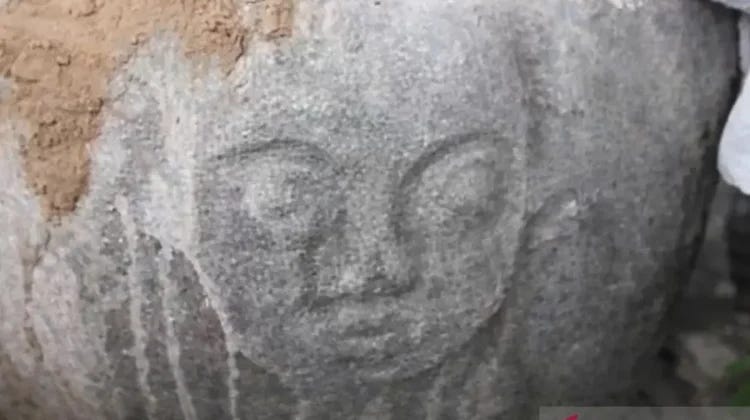
Megalithic Site Found in Dongi-Dongi Illegal Mining Area — A carved megalithic stone has been discovered in Dongi-Dongi village within Lore Lindu National Park, Central Sulawesi, Indonesia, in an area currently affected by illegal gold mining. The artifact is a large monolithic stone bearing a carved human face, resembling the distinctive anthropomorphic megaliths known from the Napu and Bada valleys, where prehistoric stone statues and ritual monuments are common. Its presence suggests that the ancient megalithic culture of Central Sulawesi likely extended farther north than previously mapped. The discovery occurred near a mining “soaking area” where soil is processed for gold, raising fears that excavators and mining activity could destroy the monument before it can be properly studied. Local residents and heritage advocates are urging authorities to secure the site and halt mining in the immediate vicinity
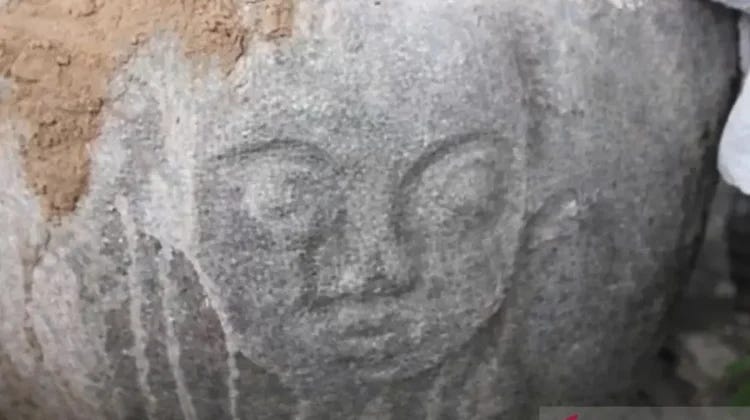
Image credit: Antara First Absolute Dating of Paleolithic Paintings in the Dordogne — Scientists have achieved the first direct radiocarbon dates for cave paintings in the Font-de-Gaume cave in Dordogne, southwestern France. Using Raman microspectrometry and hyperspectral imaging, researchers discovered traces of charcoal embedded within black pigments previously thought to contain only manganese or iron oxides. Micro-samples from the charcoal allowed carbon-14 dating of the artwork. One bison figure dates to roughly 13,461–13,162 years ago, while elements of a mask motif were painted during several phases between about 15,981 and 8,590 years ago. The results confirm that some Paleolithic artists used charcoal as pigment and demonstrate that the cave’s art was created over multiple periods during the Upper Paleolithic rather than in a single episode.
Board Game That Pre-Dates Chess Discovered in Ancient Burial Mound — Archaeologists excavating the Aglitsky I burial mound in the Aksaysky District of southern Russia discovered the remains of an ancient board game dating to the 4th millennium BCE. The game board appears to have been divided into two sections separated by a crossbar and featured a stylized anthropomorphic figure mounted on a pedestal at its center. Nearby, more than 50 small hemispherical gaming pieces were found, carved from the ends of sheep or ram femurs and shaped with flat bases to function as counters. The gaming set was recovered beside a burial placed in a curled position along with grave goods including two pointed-bottom ceramic vessels, two flint cores, and a stone tool. The design resembles early Mesopotamian board games and may represent cultural transmission from the Uruk world into the Eurasian steppe through migration and exchange networks.
Archaeologists Uncover Evidence of Iron Age Rituals at Germany’s Bruchhauser Steine — Excavations at the Bruchhauser Steine hillfort in Germany’s Sauerland region revealed signs that the dramatic rock formation served as a ritual site more than 2,000 years ago. The location consists of four towering porphyry rock pillars rising nearly 330 ft (100 m) above the surrounding forested hills. Archaeologists discovered carefully crafted Iron Age axe heads placed in association with quartz extraction areas, suggesting the mining activity had ceremonial significance rather than purely “practical” use (though to be fair, only the modern lens views ceremonies as impractical). Evidence of deliberate deposits and ritualized treatment of the materials indicates the rocks may have held symbolic or sacred meaning in Iron Age belief systems. The finds suggest the striking geological landmark functioned not only as a fortified site but also as a place tied to religious practices and ritual activity in the regional landscape.
That’s it for the free Top 5! If you’re a free subscriber, sign up for the paid plan for another 26 discoveries and 4 recommended pieces of content covering start catalogs, early ancestors, and ancient graffiti.
Until next time, thanks for joining me!
-James
Twitter: @jamesofthedrum
P.S. Here’s my Buy Me A Coffee link if you’d like to support my efforts with a donation.
P.P.S. If you want access to the paid version but it’s a little too steep for you right now, just email me — I want this to be accessible.
P.P.P.S. Paid members, read on!
