

Ancient Beat is four years old this week! 🎉🥳
Holy bananas, I’ve learned a lot from writing this. I hope you’ve learned a lot too.
Here’s 25% bday discount to the premium version of the Beat, because why not?
And here’s the latest ancient news. 👇
🗞 Ancient News: Top 5
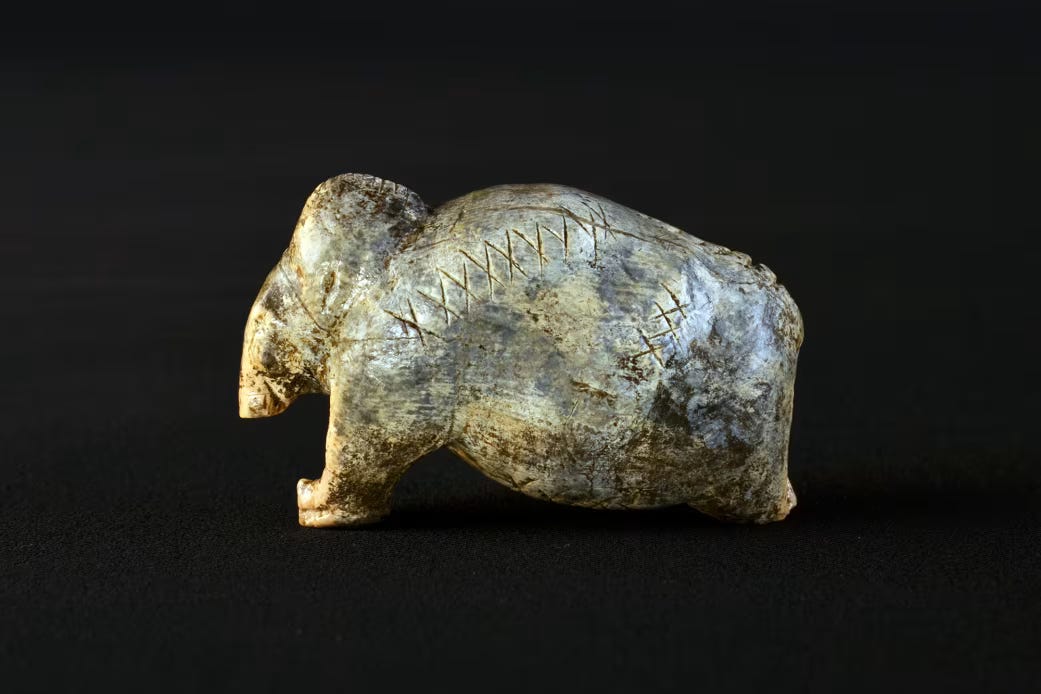
Symbols Found Carved Into 40,000-Year-Old Artifacts May Be Precursor to Writing — More than 260 artifacts from the Swabian Alps of southwestern Germany, dating between 45,000 and 34,000 years ago (~43,000–32,000 BCE), bear carved geometric signs that may represent an early notational system. Researchers analyzed roughly 3,000 individual markings — including crosses, dots, notches, parallel lines, and clustered sequences — etched into objects made of mammoth ivory, bone, and antler. Many carvings appear on figurines of animals such as mammoths, horses, bears, and lions, as well as hybrid human-lion figures and tools. Statistical modeling suggests the sign combinations show a level of structural complexity and information density comparable to early proto-cuneiform in Mesopotamia (~3300 BCE), though they do not represent full writing. Patterns suggest deliberate conventions — for example, cross symbols appear on animal figures and tools but not on human figurines, hinting at symbolic rules or taboos. While the meanings remain unknown, the repeated sequences imply that Upper Paleolithic communities were encoding information tens of thousands of years before the emergence of formal writing systems, pushing back the cognitive foundations of symbolic communication deep into the Ice Age. Here’s a Ted Talk about symbols from a decade ago that I haven’t forgotten, if you’d like this to be the beginning of a fascinating rabbit hole.
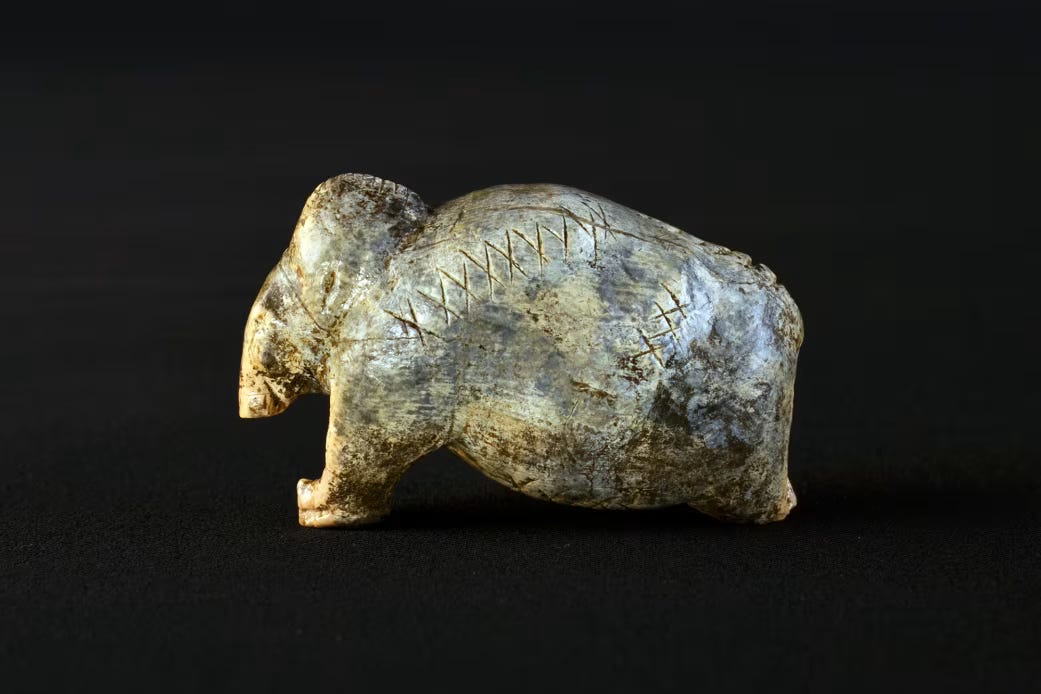
Image credit: Hildegard Jensen/University of Tübingen New Dating of Jordan Valley Site Rewrites Timeline of Human Migration From Africa — The prehistoric site of ‘Ubeidiya in the Jordan Valley (Dead Sea Rift) has been re-dated to at least 1.9 million years old, pushing it significantly earlier than the long-cited 1.2–1.6 million range. The new age estimate comes from three independent dating approaches applied to the tool-bearing layers: cosmogenic isotope burial dating (tracking predictable isotope decay after sediments are buried), paleomagnetism (reading ancient magnetic-field signatures locked into lake sediments), and uranium–lead dating on fossil freshwater snail shells to set a minimum age for the deposits. Some sediment signals initially pointed to ~3 million years, but the mismatch with other lines of evidence was interpreted as older sediments being recycled and redeposited by natural geological processes over time. Beyond the date shift, the site’s archaeology is the headline: Ubeidiya preserves both Oldowan-style simpler tools and Acheulean large, carefully shaped bifacial tools (including hand axes), found alongside a rich faunal assemblage. The overlap suggests multiple groups (or traditions) may have been moving out of Africa around the same time, rather than a neat “Oldowan → Acheulean” handoff.
Viking Sea Power May Have Emerged in the 3rd Century, During the Roman Era — New interpretations of Iron Age seafaring along Norway’s southern and western coasts suggest that organized naval forces resembling later Viking maritime power could date back to AD 180–540 — nearly five centuries before the traditional start of the Viking Age in the late 700s CE. Excavations at sites like Rennesøy have revealed large boathouse postholes and other maritime infrastructure indicating advanced shipbuilding and coordinated coastal activity during the Roman Iron Age. If correct, this pushes back the emergence of Viking-style long-distance seafaring and raiding far earlier than previously thought, hinting that northern European communities were already mobilizing fleets for warfare or long-range voyages centuries before iconic Viking raids like that on Lindisfarne in 793 CE.
Earliest Evidence of Indigo-Dyed Textiles and Single-Needle Knitting Discovered in Bronze Age Anatolia — At the Bronze Age settlement of Beycesultan Höyük in western Anatolia (modern Türkiye), archaeologists unearthed two rare textile fragments, offering the earliest known evidence in the region of indigo dye and single-needle looping (nålbinding) techniques. One fragment, dating to about 1915–1745 BCE, was looped using nålbinding — a sophisticated textile method distinct from loom weaving — and dyed blue with plant-based indigotin, likely from native woad. The second piece, from about 1700–1595 BCE, shows a plain tabby weave made on a loom. Both came from rooms rich in textile tools such as spindle whorls, needles, and loom weights, signaling organized fabric production. The finds reveal that textile craft in Bronze Age Anatolia included complex dyeing and fabric-forming methods previously undocumented in the Near East, suggesting higher technological creativity and specialized production nearly 4,000 years ago.
5,000-Year-Old Bureaucracy: Over 7,000 Prehistoric Seal Impressions Uncovered in Western Iran — At Tapeh Tyalineh on the Kouzaran plain in western Iran, archaeologists have unearthed a vast assemblage of more than 7,000 prehistoric seal impressions, along with over 200 clay figurines, clay tokens, and cylinder seal impressions dating to about 3000–2800 BCE. These seals—impressed patterns left by rolling or pressing carved objects into soft clay—reflect a highly developed system of administrative control tied to extensive economic and commercial exchange. The sheer volume and diversity of seal impressions suggest interactions with more than 150 distinct individuals or groups, implying complex record-keeping, standardization, and possibly widespread trade networks in the Late Chalcolithic to Early Bronze Age. This unparalleled collection sheds fresh light on how emerging states in southwestern Asia organized bureaucratic functions to manage resources and social affairs nearly 5,000 years ago.
That’s it for the free Top 5! If you’re a free subscriber, sign up for the paid plan for another 32 discoveries and 4 recommended pieces of content covering kings, eclipses, and castles.
Until next time, thanks for joining me!
-James
Twitter: @jamesofthedrum
P.S. Here’s my Buy Me A Coffee link if you’d like to support my efforts with a donation.
P.P.S. If you want access to the paid version but it’s a little too steep for you right now, just email me — I want this to be accessible.
P.P.P.S. Paid members, read on!
