

Happy v-day, you lovely people! 💖
This is issue #183 of Ancient Beat. Here’s the latest ancient news. 👇
🗞 Ancient News: Top 5
New Research Confirms Location Of Lost City Founded By Alexander The Great — Ancient texts describe a major port founded around 324 BCE in Mesopotamia—long debated and effectively “lost” on the ground. New survey work pins it to Jebel Khayyaber (Iraq) and maps it as a seriously big, organized city: aerial and drone imagery plus geophysical prospection reveal an urban grid of streets, walls, canals, and enormous residential blocks (insulae), along with large temple complexes and industrial districts. Between about 300 BCE and 300 CE, the settlement (later known as Charax Spasinou) appears to have boomed as a trade hub linking routes across Mesopotamia and beyond. Its decline tracks a classic river problem: by the 3rd century CE, the Tigris had shifted away, undercutting access and slowly strangling the port’s reason for existing.
5,300-Year-Old Drilling Tool Found in Egypt — A tiny copper-alloy object from Badari in Upper Egypt, long written off as a simple awl, has been re-identified as the oldest known rotary metal drill, dating to the Predynastic period (4th millennium BCE)—before Egypt’s first pharaohs. The tool is incredibly small (2.5 in / 6.3 cm long and about 0.05 oz / 1.5 g), but it carries clear use-wear from rotation: fine striations, rounded edges, and a slightly curved working tip that fits drilling rather than puncturing. The clincher is what survived on it: six coils of ultra-fragile leather thong, interpreted as a remnant of the bowstring used to drive a bow drill (string wrapped around a shaft, spun rapidly by moving a bow back and forth), giving faster, more controlled drilling than hand-twisting. Portable X-ray fluorescence also shows an unusual alloy mix—copper with arsenic and nickel, plus notable lead and silver—likely chosen to make a harder, visually distinctive metal, and possibly hinting at wider material or knowledge networks across the eastern Mediterranean that early.
Earliest Evidence of Sewn Hide Identified in Oregon Cave — In the Fort Rock Basin of Oregon, tiny fragments of animal hide connected by cordage were found in Cougar Mountain Cave, dating to between roughly 12,900 and 11,700 years ago (Late Pleistocene). These pieces represent the earliest known evidence of sewn hide anywhere, suggesting Ice Age peoples in North America were stitching materials together potentially for clothing, moccasins, shelter, or other functional items as the climate cooled dramatically. The site also yielded abundant plant-fiber cord of varying thicknesses, hinting at a range of technological applications and skill in working perishable organic materials.
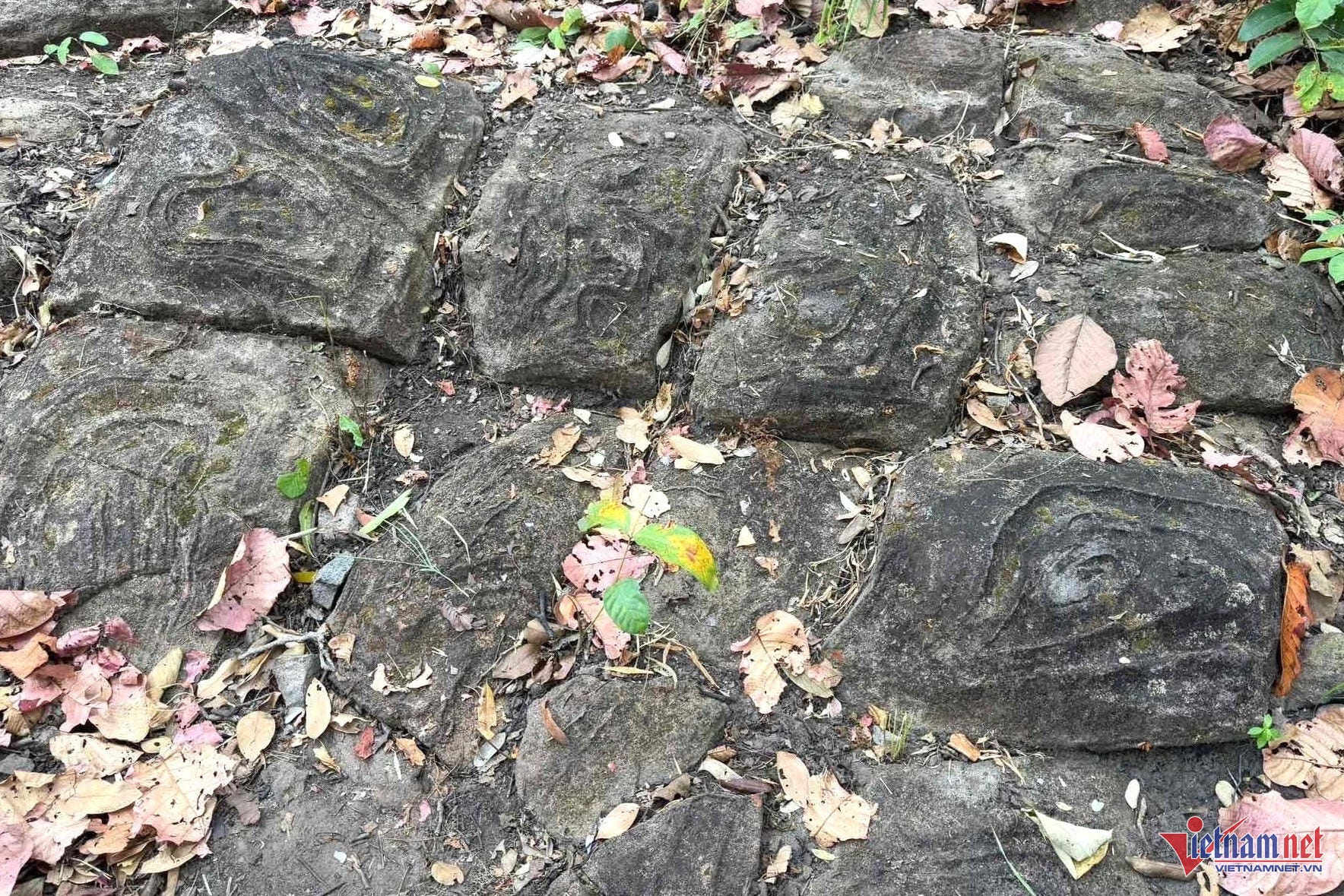
Mysterious Stone Carvings Discovered Deep in Yok Don National Park — In Yok Don National Park, Dak Lak Province, Vietnam, forest rangers and local authorities documented an enigmatic ensemble of carved stones scattered over about 200 m² atop a remote hillside. The site comprises stones etched with spirals, undulating lines, leaf-like forms, and wave motifs—patterns that field teams judge to be the result of human workmanship rather than natural weathering. First spotted in 2022 but only recently reported, the stones are now being safeguarded pending further investigation. Their age, cultural affiliation, and purpose remain unknown; the organized distribution across clusters raises the possibility of ritual, territorial, or communicative use in the distant past. Authorities have initiated protection measures as a prelude to formal archaeological study.
7,000-Year-Old Deer Antler Headdress From Eilsleben Illustrates Contact Between Hunter–Gatherers and Early Farmers — At the Neolithic settlement of Eilsleben-Vosswelle in Saxony-Anhalt, Germany—about 1.6 mi (2.5 km) southeast of Eilsleben on a slope toward the Aller River—a surprisingly “Mesolithic-feeling” ritual object turned up in a pit excavated in 1987: the antler of a 2–3-year-old roe deer with the attached skull fragment shaped into a rectangle, cut marks from skinning, and paired notches at the antler base that look made for fastening. Radiocarbon dating puts it at 5291–5034 BCE, right in the early farming horizon. The settlement itself was a multi-phase Linear Pottery culture outpost that may have been fortified with a rampart, ditch, and fence—a rare level of defensiveness for the earliest farmers, possibly reflecting life on a border zone. Worked antler “headdresses” like this are basically unknown for the Neolithic, but do show up in Mesolithic settings (often read as hunting camouflage or shamanic gear), and this roe-deer version closely echoes a famous Central German shamanic burial—hinting at contact between incoming farmers and local hunter-gatherer ritual specialists.
Bonus: Study of AI-Generated Neanderthal Scenes Reveals Major Gaps With Modern Archaeological Research — This isn’t really a discovery, but it’s interesting, so I’m adding it as a bonus. An evaluation of scenes produced by text and image-generation algorithms shows that many AI portrayals of Neanderthals are riddled with outdated ideas and inaccuracies. When thousands of AI runs were prompted for Neanderthal life, a large share of outputs misrepresented body form, posture, tools, shelters, and social dynamics in ways inconsistent with the current archaeological record—often echoing decades-old stereotypes like bent posture and heavy hair or mixing in materials (like metal or glass) that never existed in Neanderthal contexts. Illustrations from some prompts rarely featured women or children, ignoring the more diverse social makeup known from recent digs. According to the researchers, these discrepancies reflect the biases present in much internet-sourced training data and highlight the need for careful, research-grounded framing when using generative models in archaeological communication. According to me 🙃, this is less about AI and more about the humans who are putting the data on the internet in the first place — in general, we’re still holding on to an outdated idea of who the Neanderthals were and AI is reflecting that.
That’s it for the free Top 5! If you’re a free subscriber, sign up for the paid plan for another 25 discoveries and 3 recommended pieces of content covering board games, terracotta heads, and 4,000-year-old murals.
Until next time, thanks for joining me!
-James
Twitter: @jamesofthedrum
P.S. Here’s my Buy Me A Coffee link if you’d like to support my efforts with a donation.
P.P.S. If you want access to the paid version but it’s a little too steep for you right now, just email me — I want this to be accessible.
P.P.P.S. Paid members, read on!
