

Hello, friends! This is #182 of Ancient Beat — here’s the latest ancient news. 👇
🗞 Ancient News: Top 5
Scientists Examine Neanderthal Collection of Animal Skulls — At a Middle-Paleolithic deposit in Des-Cubierta Cave (central Spain), archaeologists analyzed a remarkable assemblage of 35 large skulls from horned or antlered mammals such as steppe bison and aurochs, found alongside more than 1,400 stone tools attributed to Neanderthals. Although geological processes like rockfalls have disturbed the site over millennia, spatial analysis distinguishes human activity from natural sediment movement, showing patterned placement of skulls distinct from random deposition. The absence of lower jaws and the preponderance of skulls — rather than everyday butchered remains — suggest these were not food waste but part of repeated, potentially symbolic behavior spanning thousands of years. This long-term pattern of deliberate accumulation, unrelated to subsistence, hints at complex cultural or social practices among Neanderthal groups more than 43,000 years ago.
Did Ancestors of the Clovis People Camp in Central Alaska? — Excavations at the Holzman site in central Alaska’s Tanana Valley have uncovered late Pleistocene evidence (layers dated to roughly 14,000 and 13,700 years ago) of repeated human activity well before the classic Clovis period. Archaeologists recovered fragments of mammoth ivory, traces of ancient campfires, quartz tools, and evidence of ivory rod production using a flat anvil stone. The stone tools and worked ivory in the older layers suggest that groups living in eastern Beringia — the land bridge area connecting Asia and North America — were crafting technology similar to what later appears in Clovis contexts. This supports models in which early populations dispersed southward from Alaska into the interior of North America, carrying and transmitting technological traditions that eventually contributed to the emergence of Clovis-like toolkits.
5,000-Year-Old Rock Art Discovered in Sinai — In Wadi Khamila, a dry valley in southwestern Sinai, Egypt, archaeologists recorded a panel of rock carvings dating to around 3000 BCE. The deeply incised imagery appears to show a large, triumphant figure — possibly symbolizing Egyptian power — standing over a smaller, wounded figure with an arrow in its chest, accompanied by a carved boat motif and inscriptions invoking Min, ruler of copper lands. This visual tableau is among the earliest known artistic statements of territorial dominance in the region and suggests that early Egyptian groups were projecting authority into Sinai well beyond the Nile Valley. The prominence of copper symbolism reinforces the idea that access to mineral resources, especially metal ores, was a driving factor in early Egyptian expeditions into the peninsula’s arid interior.
Unexpected Discovery: Sand Layer Beneath Ishtar Temple in Assur Reveals City’s Founding and Ritual Practices — At the ancient city of Assur in northern Iraq, researchers have identified a deliberately placed layer of sand up to ~3 ft (1 m) thick beneath the foundations of the Ishtar Temple, dating to roughly 2896–2702 BCE. This sand wasn’t natural alluvium but transported from afar, potentially from the Zagros Mountains, and was shaped by ritual intent rather than construction convenience. Radiocarbon dating of charcoal just above the layer establishes this as the earliest securely dated phase of the city’s occupation, strengething the case for Assur’s founding in the late 3rd millennium BCE. The sand layer appears to represent an early Mesopotamian foundation ritual — a purification for sacred architecture — linking cultural practices across regions. Such a deliberate choice of material hints at symbolic connections between the city’s creators and broader religious landscapes, and reflects a blend of architectural and ritual knowledge in early urban Mesopotamia.
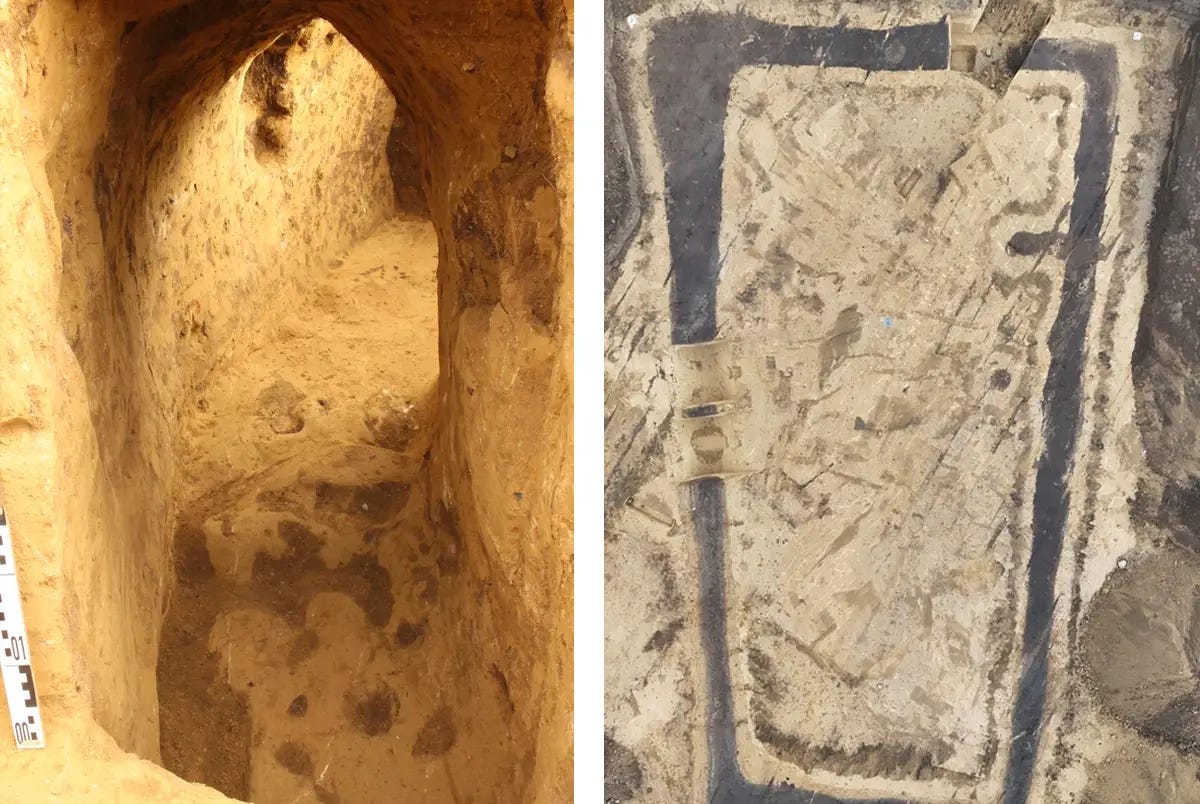
Mysterious Tunnel Found in Neolithic Ditch Enclosure — Near Reinstedt in Saxony-Anhalt, Germany, archaeologists uncovered a narrow underground passage within a late Neolithic ditch enclosure associated with the Baalberge culture (c. 4000–3150 BCE). Closer study of the oval pit’s fill revealed a deeper buried channel identified as an Erdstall — a type of medieval tunnel (likely 10th–13th century) characterized by its low, narrow passage and enigmatic purpose. Finds of late medieval pottery and stones inside the fill suggest the passage was built long after the original Neolithic works, perhaps as a hidden refuge, storage space, cultic conduit, wayfinding passage, or local secret route. The juxtaposition of this medieval tunnel beneath much older prehistoric earthworks raises fascinating questions about how later communities reused and reimagined ancient monuments and landscapes.
That’s it for the free Top 5! If you’re a free subscriber, sign up for the paid plan for another 23 discoveries and 3 recommended pieces of content covering rhino bones, Roman vials, and ancient jokes.
Until next time, thanks for joining me!
-James
Twitter: @jamesofthedrum
P.S. Here’s my Buy Me A Coffee link if you’d like to support my efforts with a donation.
P.P.S. If you want access to the paid version but it’s a little too steep for you right now, just email me — I want this to be accessible.
P.P.P.S. Paid members, read on!
