

Ya know, every time we hit a roundish issue number, I get all, “Whoa, that’s a significant number!”
Then, I’m like, “Wait, that’s just like any other number. Now, 200… that’s where it’s at. Or maybe 208. Is 208 more significant than 200?”
So, yeah. Welcome to this morning’s internal dialogue.
And welcome to issue #180 of Ancient Beat. Woohoo! 🎉🥳🎉
Oh please, hold your applause. It’s nothing, really.
Oh, go on then — hoorah!
😑
Uh, okay. Here’s the latest ancient news. 👇
🗞 Ancient News: Top 5
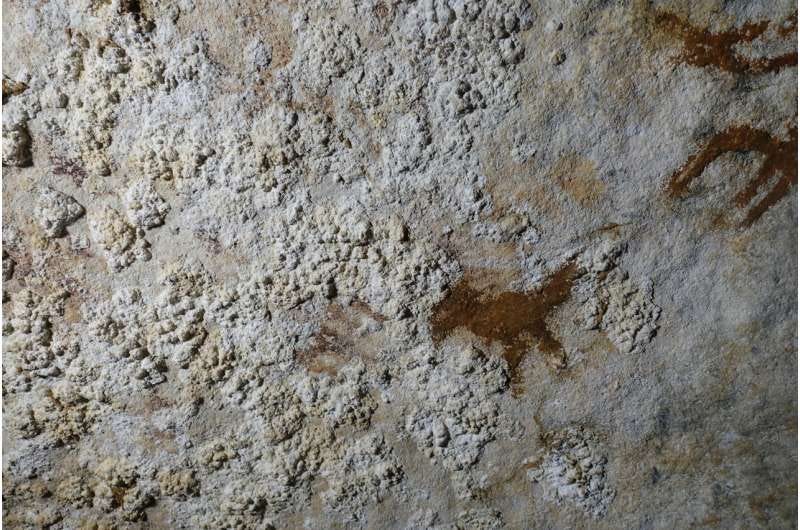
World’s Oldest Rock Art Holds Clues to Early Human Migration to Australia — In limestone caves on Muna Island, Sulawesi, Indonesia, a faded hand stencil has been dated to at least 67,800 years ago, making it the oldest reliably-dated rock art in the world. Uranium-series dating of mineral deposits over and under the pigment establishes this minimum age. The stencil, made by blowing pigment around a hand pressed to the wall, sits beneath layers of younger art, indicating long-term use of the site for symbolic expression over thousands of years. The location and age of this art shed light on early human dispersals: it supports models in which ancestral populations related to the first Australians were present in Wallacea before occupation of the Sahul landmass (ancient Australia and New Guinea) around 65,000 years ago, suggesting cultural complexity accompanied early migration. That’s cool. Pushing it back, plus a hand stencil — two things I always enjoy.
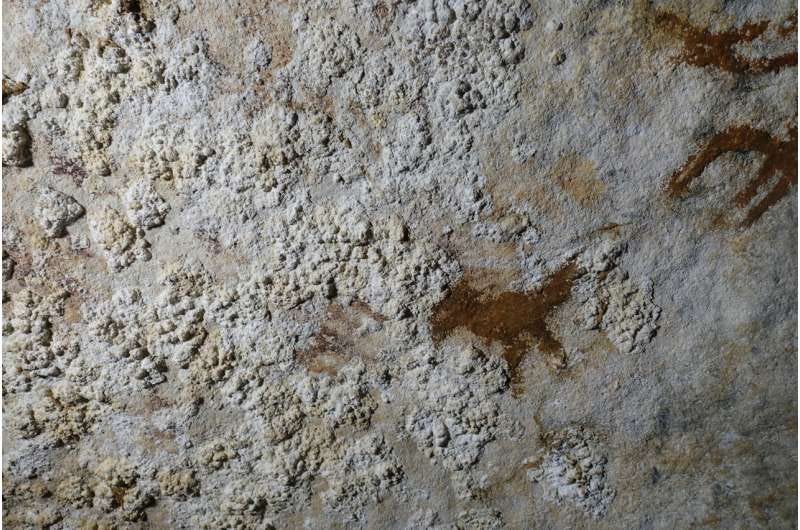
Image credit: Credit: Max Aubert New 2.6-Million-Year-Old Paranthropus Fossil Reshapes Understanding of Early Hominins — A partial lower jaw fossil attributed to an early hominin in the genus Paranthropus has been unearthed in the Mille-Logya region of Ethiopia’s Afar, dating to roughly 2.6 million years ago. This is the first known Paranthropus specimen from this part of northeast Africa and extends the genus’ known range about 1,000 km north of previously documented sites. Detailed morphological and imaging analyses indicate that Paranthropus—long viewed as a robust, chewing-adapted branch of early hominins—was more geographically widespread and ecologically versatile than once thought. Its presence alongside early Homo relatives in varied environments challenges earlier assumptions that Paranthropus was ecologically constrained or outcompeted, offering fresh perspective on early hominin diversity and adaptation during a pivotal phase of human evolution.
Prehistoric Tool From Elephant Bone Is the Oldest Discovered in Europe — A fragment of elephant bone unearthed at the Boxgrove site in southern England has been identified as Europe’s oldest known elephant-bone tool, dating to roughly the Middle Pleistocene (about half a million years ago). This bone implement was used as a retoucher — a soft hammer to sharpen and reshape stone tools by striking flint edges during the knapping process. Microscopic notches and embedded flint fragments show repeated use, and 3D scanning confirms intentional shaping for this purpose. Elephant bone was notably rarer than other animal bones in the local landscape, suggesting early hominins deliberately sought this valuable resource for its resilient properties. The find underscores advanced cognitive and technological capabilities in early human ancestors or relatives in northern Europe, illustrating sophisticated tool-making strategies long before modern humans reached the region.
Nearly Seventy Ancient Inscriptions With Declarations of Love, Insults and Slogans Left by the Public in the Corridors of the Theaters Discovered in Pompeii — New imaging has revealed 70ish previously unseen inscriptions etched into the walls of a long corridor connecting Pompeii’s theaters to the Via Stabiana, a main street of the Roman city buried in 79 CE. The wall joins some 200 known graffiti, bringing the total in this space close to 300 texts. Messages include hurried love notes, playful insults, slogans cheering on gladiators, and everyday comments, offering a vivid snapshot of urban life, entertainment culture and social interaction. The discoveries were made using advanced Reflectance Transformation Imaging (RTI), which highlights faint surface grooves invisible to the naked eye, showing that even well-examined sites like Pompeii continue to yield intimate traces of daily life from nearly 2,000 years ago. This isn’t earth shattering by any means, but I always enjoy these little windows into the everyday. Check the link for some quotes — they’re a good reminder that humans are weird and we always have been.
Could Toolmaking Abilities Be Linked to Speech? — New research highlights a noticeable shift in prehistoric stone tool craftsmanship in Britain at about 480,000–500,000 BP, where handaxes become thinner, more symmetrical, and more standardized than earlier versions. Experimental knapping recreations show that achieving these refined forms isn’t just about strength or simple learning — it demands a nuanced, repetitive sequence of strikes and careful rotation of the flint. Importantly, mastering this technique with softer hammer tools (like antler or bone) improves control and precision but is difficult even with extensive practice. Some scientists propose that the cognitive and motor skills required for these advanced toolmakers could be linked to changes in brain regions also involved in fine motor control and speech production, hinting that the evolution of more skilled toolmaking might reflect an evolving physical capacity for speech and complex communication — a key question in how early humans developed language. Fun fact: Estimates for when complex speech began range from 1.75 million years ago to (ridiculously IMO) just 50,000 years ago.
That’s it for the free Top 5! If you’re a free subscriber, sign up for the paid plan for another 24 discoveries and 5 recommended pieces of content covering cuneiform, medicinal plants, and more rock paintings.
Until next time, thanks for joining me!
-James
Twitter: @jamesofthedrum
P.S. Here’s my Buy Me A Coffee link if you’d like to support my efforts with a donation.
P.P.S. If you want access to the paid version but it’s a little too steep for you right now, just email me — I want this to be accessible.
P.P.P.S. Paid members, read on!
