

Hello, friends! Welcome to issue #179 of Ancient Beat.
Shall we?
We shall. Here’s the latest ancient news. 👇
🗞 Ancient News: Top 5
Most Complete Homo habilis Skeleton Ever Found Dates to More Than 2 Million Years Ago and Retains ‘Lucy-Like’ Features — An exceptionally complete skeleton of Homo habilis, designated KNM-ER 64061, has been described from East Turkana, northern Kenya, dating between 2.02 and 2.06 million years ago. This is the most complete postcranial (body) fossil yet known for this early human species, which lived around the dawn of the Homo genus, and includes collarbones, shoulder blades, full arm bones, parts of the pelvis, ribs, and vertebrae. The skeleton shows a unique blend of traits: its long, robust arms and thick bone walls closely resemble earlier australopithecines like Australopithecus afarensis (famously represented by “Lucy”), suggesting significant upper-body strength and possible climbing abilities, while some aspects of the pelvis and limb anatomy hint at more advanced ground locomotion. The association of these body parts with a nearly complete set of lower jaw teeth has made it possible to confidently link the bones to H. habilis, filling a major gap in understanding how early members of our genus walked, moved, and lived. This specimen underscores the transitional nature of Homo habilis between more primitive hominins and later species with fully modern limb proportions.
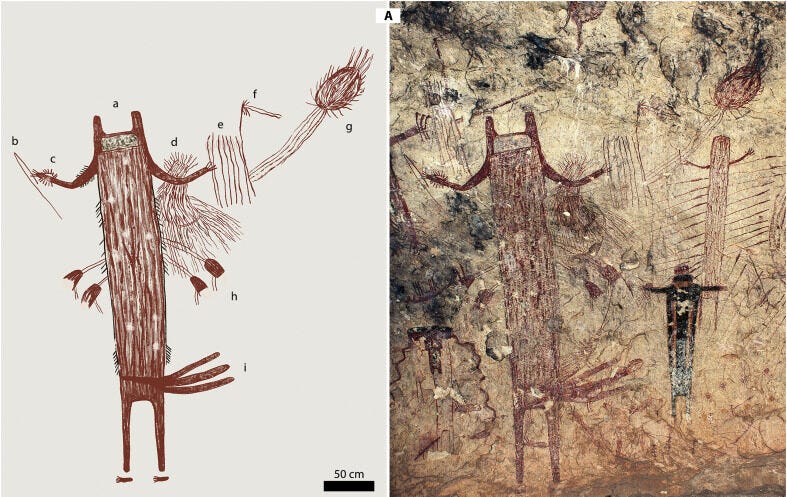
Ancient Cave Paintings in Texas Are Thousands of Years Older Than Expected, New Study Reveals — Rock-shelter murals in the Lower Pecos Canyonlands (southwest Texas and northern Mexico, near the Rio Grande) have been re-dated with direct testing of the paint itself—pushing the start of the Pecos River–style tradition back to nearly 6,000 years ago (roughly 3,800–3,400 BCE). The new timeline suggests the style stayed coherent for close to 4,000 years, continuing until about 550–950 CE—a jaw-dropping run for a rule-bound visual tradition. The imagery isn’t just “random panels over time”: many walls read like planned compositions, packed with recurring elements—towering human-like figures, animals, and dense abstract motifs—layered in consistent sequences. The dating approach extracted tiny traces of organic carbon from paint layers (likely from binders such as plant material or animal fat) and paired those results with dates from mineral accretions that formed over the art.
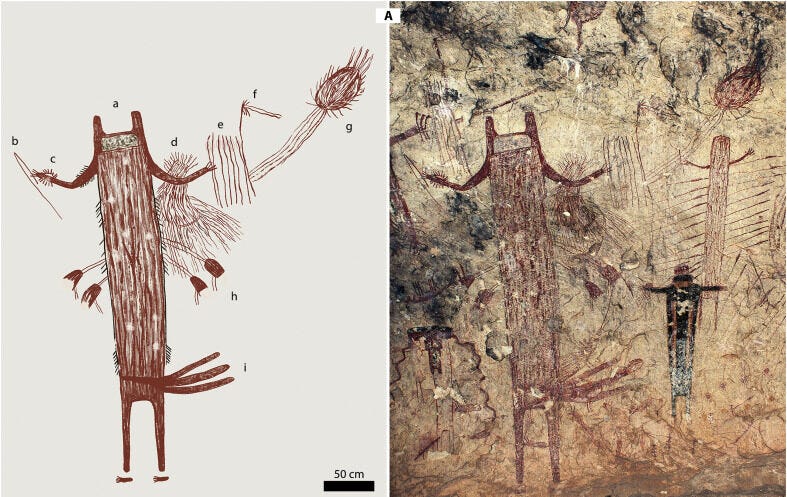
Image credit: Boyd et al., 2025, Science Advances Enigmatic Hominins May Have Overlapped With Homo sapiens on Sulawesi — Excavations at Leang Bulu Bettue, a rock shelter in the Maros-Pangkep karst landscape of South Sulawesi, Indonesia, reveal one of the longest cultural sequences known on the island, stretching back to about 208,000 years ago. Early layers show simple stone tools and evidence of animal butchery by archaic hominins. Around 40,000 years ago, a shift occurs: new tool types and signs of symbolic behavior emerge, hallmarks associated with Homo sapiens. This deep, continuous record hints that archaic human relatives and modern humans may have co-existed or overlapped chronologically on Sulawesi, potentially allowing interaction between different human lineages before archaic groups disappeared. The site thus becomes a key window into Southeast Asia’s complex human evolutionary past.
Traces of Unusual Huts Offer Clues to Origins of Medieval Port Town — On Wolin Island, off Poland’s Baltic coast, archaeologists uncovered four distinctive clay-and-sand platform structures dated to the 11th–12th centuries CE. Surrounded by ditches and containing hearths, ovens, and objects such as pottery, animal bones, Norwegian whetstones, glass beads, and metal tools, these huts differ from other regional buildings. Their isolated location near where a medieval marketplace and craft workshops once stood suggests they may belong to an early, culturally mixed community predating the known town centre. Researchers suggest Scandinavian and Slavic groups could have co-existed here, challenging previous ideas about how this important Baltic port developed.
Whale Hunting Began 5,000 Years Ago in South America, a Millennium Earlier Than Previously Thought — New evidence from coastal sambaqui (shell mound) sites in southern Brazil shows Indigenous communities were actively hunting large whales as early as around 5,000 years ago, about 1,000 years earlier than records in the Arctic and North Pacific. Analysis of whale bones from species including southern right, humpback, blue, and sperm whales reveals cut marks and associations with large, purpose-made bone harpoons, indicating deliberate hunting rather than scavenging. These findings suggest sophisticated maritime technology and coordinated social strategies were part of these Atlantic coastal cultures. The presence of inshore species alongside large whale remains also suggests wider ecological distributions during that period.
That’s it for the free Top 5! If you’re a free subscriber, sign up for the paid plan for another 19 discoveries and 3 recommended pieces of content covering roads, trade, monasteries, and dolmens.
Until next time, thanks for joining me!
-James
Twitter: @jamesofthedrum
P.S. Here’s my Buy Me A Coffee link if you’d like to support my efforts with a donation.
P.P.S. If you want access to the paid version but it’s a little too steep for you right now, just email me — I want this to be accessible.
P.P.P.S. Paid members, read on!
