

And we’re back!
It’s 2026.
You’re reading issue #178 of Ancient Beat.
Enough said. Here’s the latest ancient news. 👇
🗞 Ancient News: Top 5
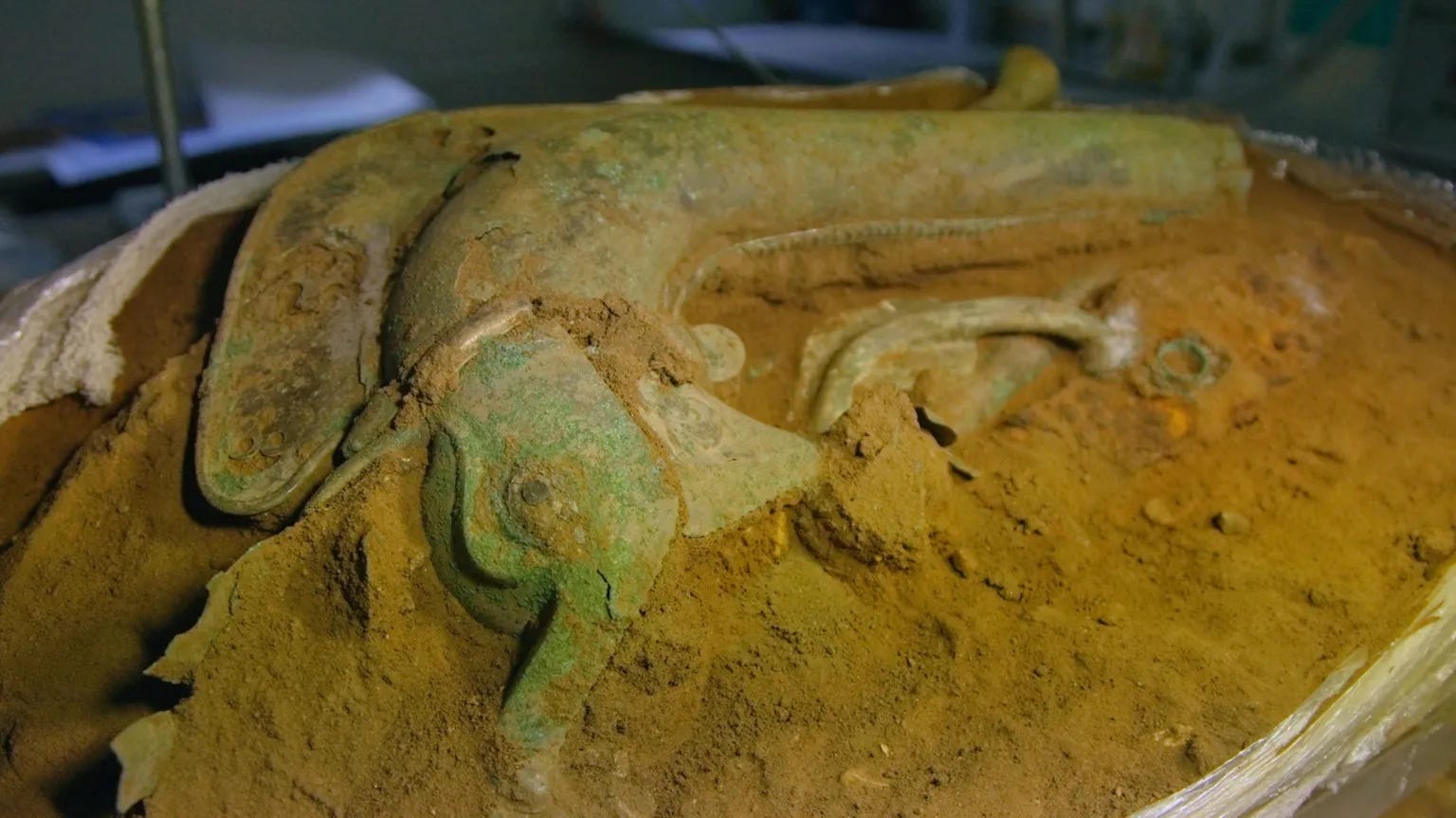
Rare Iron Age War Trumpet and Boar Standard Found — A remarkable Iron Age hoard discovered near Thetford has yielded two of the rarest known Celtic military objects buried together: the most complete carnyx (war trumpet) ever found in Europe and the first boar’s head flag standard ever discovered in Britain. The hoard dates to between 50 BCE and 50 CE, and was uncovered during construction work. The carnyx, made from extremely thin sheets of bronze, survives with its pipe, mouthpiece, and animal-headed bell intact, features a long neck, gaping mouth, and decorative crest. Carnyces were used across Iron Age Europe to signal troops and terrify enemies. The accompanying boar’s head standard, also fashioned from sheet bronze, would have been mounted on a pole and carried like a flag, likely symbolizing strength and ferocity during combat. Additional items in the hoard include five shield bosses and an iron object of unknown function. The objects were lifted as a single soil block and scanned before conservation due to their extreme fragility after nearly 2,000 years underground. The find offers rare insight into Iron Age warfare, sound, symbolism, and ritual deposition, and may represent a deliberate ceremonial burial rather than accidental loss. Here’s a photo but you can see what it originally looked like in the article.
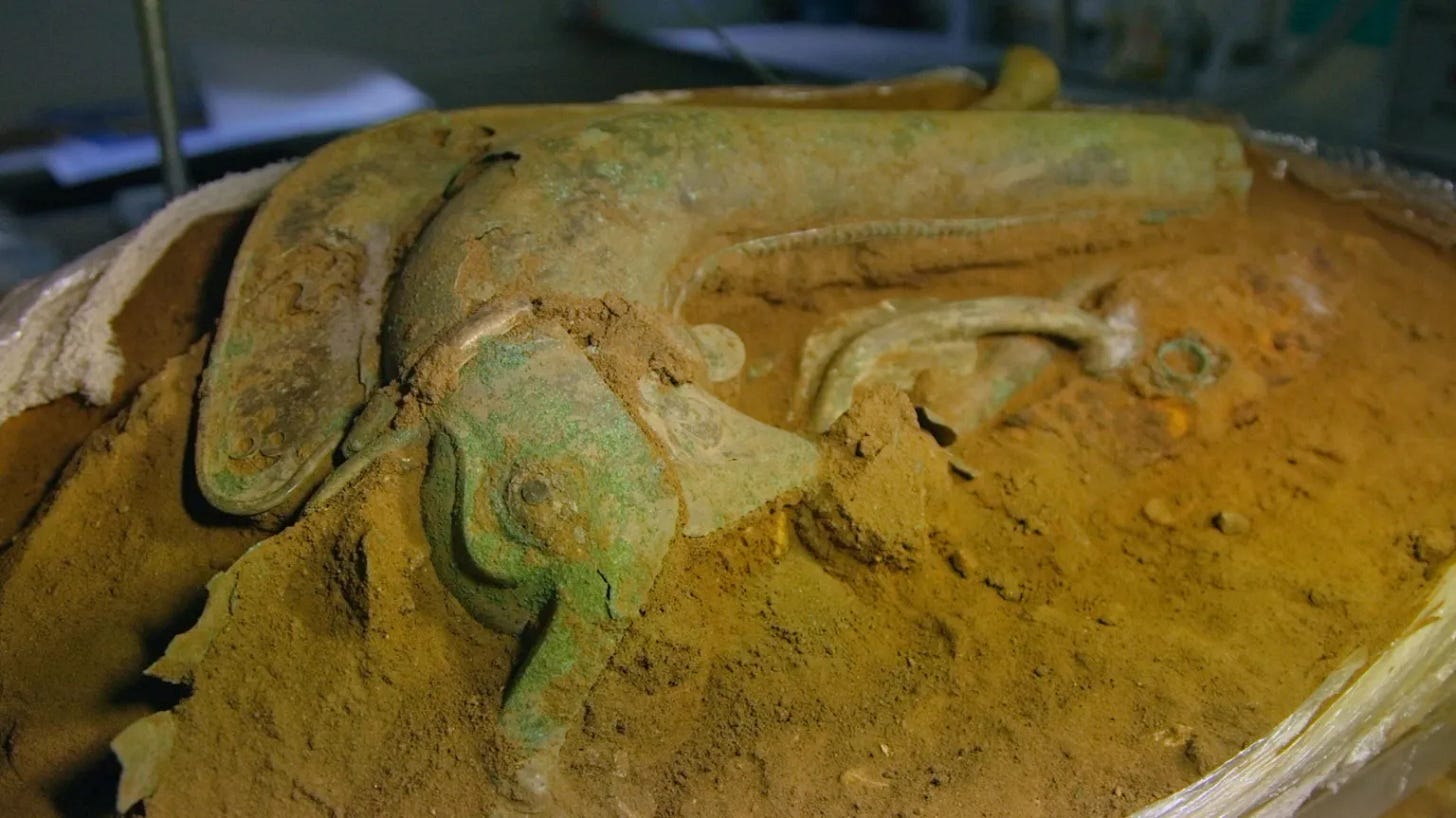
Image credit: BBC/Rare TV LiDAR Reveals Lost Ancient Landscape in Andean Chocó — In Ecuador’s Andean Chocó rainforest, northwest of Quito (around San Francisco de Pachijal / Pacto), LiDAR mapping punched through the forest canopy and turned what looked like a small site into a much bigger engineered landscape. What started as ~40 mounds and 10 terraces expanded to 200+ mounds and 100+ terraces, plus ancient roads linking circular and rectangular built features across about 600 hectares (~1,483 acres). Because that survey area is only ~2% of the broader Andean Chocó (~280,000 hectares / ~692,000 acres), the implication is that far more built terrain could be hiding under vegetation. On the ground, a sunken rectangular structure near the San Francisco River resembles architectural elements seen at the Tulipe complex regionally, hinting at deliberate water/land management. Based on associated material culture, the remains are attributed to the Yumbo cultural tradition (pre-Hispanic).
Earliest Cremation in Africa 9,550 Years Ago Discovered in Malawi — A 9,500-year-old cremation pyre at the base of Mount Hora in northern Malawi pushes back Africa’s earliest known evidence of intentional cremation by thousands of years. The remains of a short adult woman were found within an ancient ash layer, with about 170 bone fragments and stone tools from the pyre suggesting a deliberately constructed ritual event. The body appears to have been defleshed or disarticulated before burning, and the absence of skull bones hints that the head might have been removed prior to cremation. An estimated 66 pounds of wood and grass were used to sustain temperatures over 930 °F, indicating coordinated effort and complex funerary practice in this Stone Age hunter-gatherer community. The find reshapes assumptions about early ceremonial treatment of the dead among prehistoric peoples.
60,000-Year-Old Arrow Poison Reveals Early Advanced Hunting Techniques — Quartz arrowheads from the Umhlatuzana Rock Shelter in KwaZulu-Natal, South Africa, dating to around 60,000 years ago, preserve chemical residues of plant-derived poison made from the bulb of Boophone disticha (gifbol)—marking the earliest direct evidence of poisoned hunting weapons. Analyses detected alkaloids (buphandrine and epibuphanisine) on arrow tips, showing that early hunter-gatherers deliberately harnessed toxic plant chemistry to weaken prey over time, implying advanced planning and causal understanding in hunting strategies. Similar substances have been found on arrowheads from the 18th century, suggesting super duper long (to use a technical term) continuity of this technique. The delayed, chemical effect of poison would have required sophisticated hunting approaches, pushing back assumptions about when humans integrated chemistry with weaponry.
Researchers Sequence Genome of 200,000-Year-Old Denisovan — A high-quality genome has been reconstructed from a Denisovan molar found in Denisova Cave in the Altai Mountains of southern Siberia, dating to roughly 200,000 years ago, more than twice as old as the only previously sequenced Denisovan genome. The tooth, recovered from a deep cave layer belonged to an adult male and is notably larger than Neanderthal molars, matching other Denisovan dental remains. Genetic comparisons reveal that Denisovans were not a single, stable population: at least two distinct Denisovan groups occupied the Altai at different times, with one replacing the other, and both repeatedly interbred with Neanderthals. The older Denisovan carried a higher proportion of Neanderthal DNA, showing that mixing was a recurring pattern rather than a rare event. The genome also preserves traces of interbreeding with an even older, “super-archaic” hominin lineage that split from the human family tree before Denisovans, Neanderthals, and modern humans diverged. Analysis of Denisovan DNA segments in living populations indicates at least three separate Denisovan sources, contributing ancestry differently to Oceania, South Asia, and East Asia, implying multiple migration routes into Asia. Some Denisovan genetic variants appear to have been advantageous and persist today, influencing traits such as body size, blood chemistry, and immune response, while other mutations hint at distinctive Denisovan facial and cranial features.
That’s it for the free Top 5! If you’re a free subscriber, sign up for the paid plan for another 19 discoveries and 7 recommended pieces of content covering Ireland’s biggest settlement, European bows and arrows, and a new old urban metropolis.
Until next time, thanks for joining me!
-James
Twitter: @jamesofthedrum
P.S. Here’s my Buy Me A Coffee link if you’d like to support my efforts with a donation.
P.P.S. If you want access to the paid version but it’s a little too steep for you right now, just email me — I want this to be accessible.
P.P.P.S. Paid members, read on!
