

Hello friends, welcome to Ancient Beat. I’m grateful that you’re here — thank you for being a part of this little community! And a very happy Thanksgiving to all those who are celebrating it!
If you’re interested in getting ALL the latest discoveries in your inbox, memberships are currently 20% off!
And if you’re doing your holiday shopping this weekend, please consider giving an Ancient Beat subscription. My biased opinion is that it’s a particularly thoughtful gift for anyone who loves learning about the ancient world. Here’s the gift link. 🎁
Here’s the latest ancient news. 👇
🗞 Ancient News: Top 5
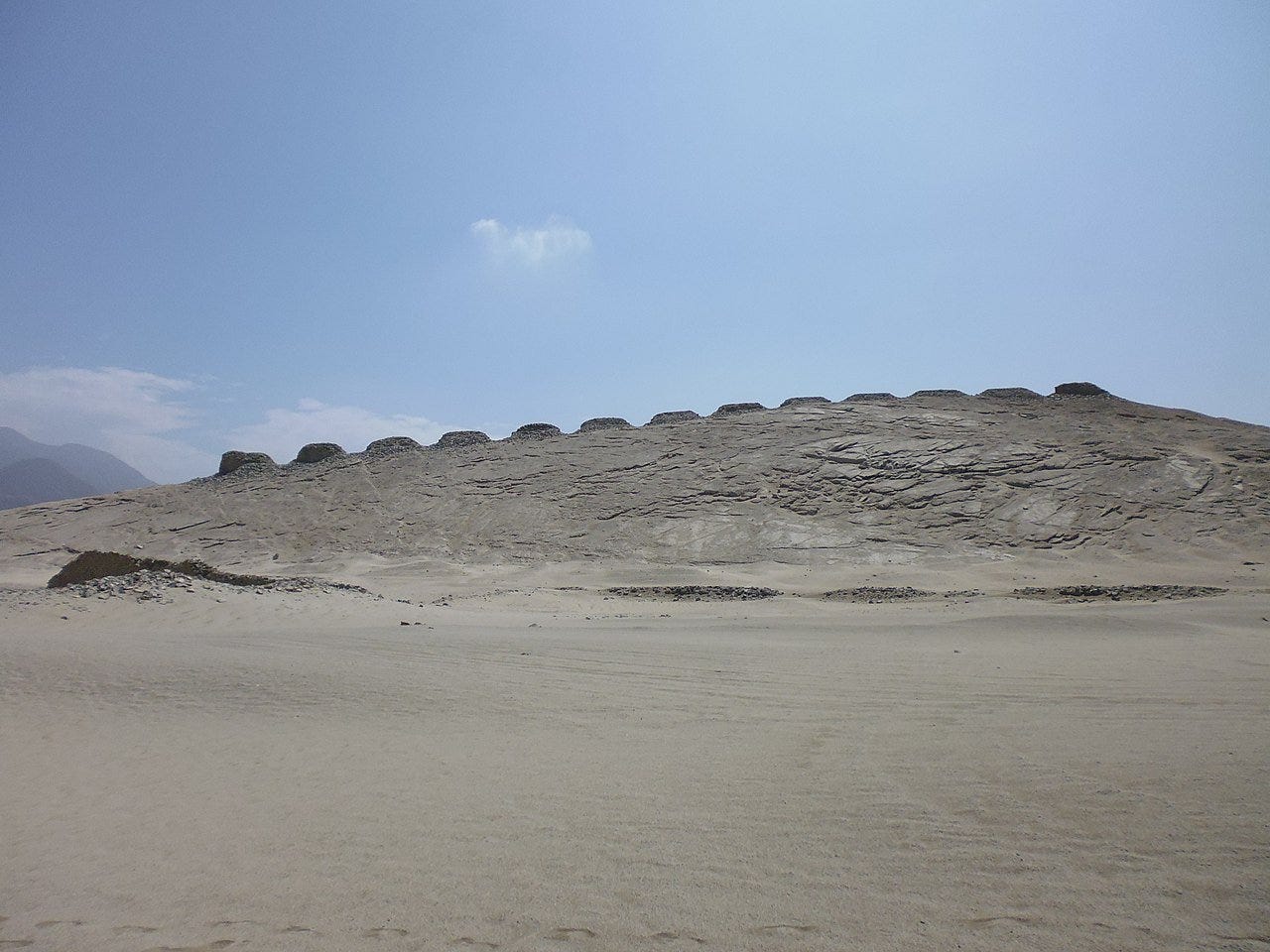
Archaeologists Uncover the Americas’ Earliest Known Observatory in Peru — A newly identified solar-aligned structure in Peru’s Casma River valley appears to predate the well-known Chankillo Solar Observatory (built around 250 BCE), pushing back the origins of Andean sky-watching by centuries. The building, located within the broader Chankillo complex, shows precise alignments with the sun’s annual path and includes a corridor oriented to lunar extremes—an unusually early example of dual solar-lunar planning. Excavators note that the construction materials, stratigraphy, and architectural style indicate great antiquity, though radiocarbon dates are still pending. The find suggests that ceremonial groups in the Casma-Sechín region developed organized astronomical observation far earlier than previously recorded. Nearby, a 3.3-ft-tall Patazca-style vessel decorated with clay warrior figures was uncovered in a restricted area, hinting that ritual authority, martial symbolism, and celestial expertise may have been intertwined. The discovery further strengthens the region’s reputation as one of the world’s earliest centers of astronomical architecture.

Image credit: Juancupi / CC BY-SA 4.0 Threads Across Time: The Ancient Craft Hidden in a Queensland Rock Shelter — Excavations at Windmill Way, a rock shelter in Queensland’s Cape York Peninsula, revealed an exceptionally rare archive of Aboriginal fibrecraft spanning roughly 1,700 years. More than 500 preserved fragments—including string, nets, bags, twined bundles, and red-dyed plant-fibre textiles—survived in a location where organic materials normally decay within years. The shelter’s dry, protected sandstone overhang created a natural time capsule, recording technologies that rarely endure archaeologically. The fibre pieces display continuity in craft traditions long before European arrival, offering insights into daily life, toolmaking, and local ecological knowledge. The discovery underscores how preservation bias shapes the archaeological record: a fragile craft tradition survived in detail only because this shelter, against all odds, created the perfect conditions for millennia-long protection.
When Minds Meet Cultures: A New Way of Understanding How Language Emerged — A new study presents a biocultural framework for the origin of human language, proposing that language emerged not from a single biological adaptation, but from an intersection of human-capacities (vocal learning, pattern recognition, social intention) with long-term cultural transmission. The argument is that teaching and being taught became central, and that the persistent cultural systems of symbol-use amplified latent biological predispositions. The authors argue this model better explains why human language appears only in our species and how it evolved gradually rather than as a sudden “language organ” event.
The Real Reason States First Emerged Thousands of Years Ago — A fresh review of early states argues it wasn’t just the invention of agriculture that paved the way for state-level societies, but specifically cereal grain cultivation that made surplus, social stratification, and extractive power viable. Although widespread farming began ~9,000 years ago, major state emergence was delayed by some 4,000 years, suggesting more complex social/economic dynamics.
Archaeologists Discover ‘Ancient Monument’ on Farm — Excavations on farmland in Aspull, Greater Manchester uncovered what appears to be a Bronze Age monument dating to roughly 2500–2000 BCE. The feature includes a large oval ring ditch with a single entrance—an unusual plan for the period—and may represent a repurposed Neolithic henge, given its size and shape. Henges from 3000–2000 BCE typically combine a circular or oval enclosure with a surrounding ditch, and fewer than 100 survive across the British Isles. The site may have first served as a ceremonial or communal space before being reused in the Bronze Age, potentially as a burial locale. Excavators also noted that the landscape may once have held marshes or natural resources that made it significant for later communities. Aerial imagery shows a clear circular mark in the field, confirming the scale of the enclosure.
That’s it for the free Top 5! If you’re a free subscriber, sign up for the paid plan for another 23 discoveries and 4 recommended pieces of content covering boardgames, hanging coffins, mortar, and feet.
Until next time, thanks for joining me!
-James
Twitter: @jamesofthedrum
P.S. Here’s my Buy Me A Coffee link if you’d like to support my efforts with a donation.
P.P.S. If you want access to the paid version but it’s a little too steep for you right now, just email me — I want this to be accessible.
P.P.P.S. Paid members, read on!

